Honoring student achievement and leadership at Magen David Yeshivah High School
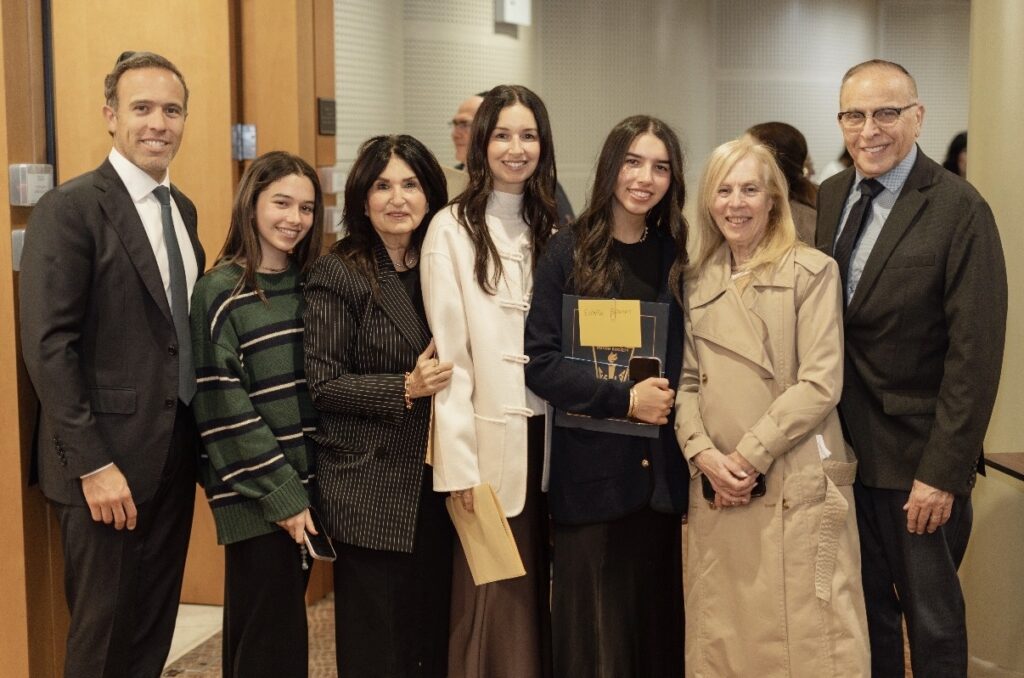
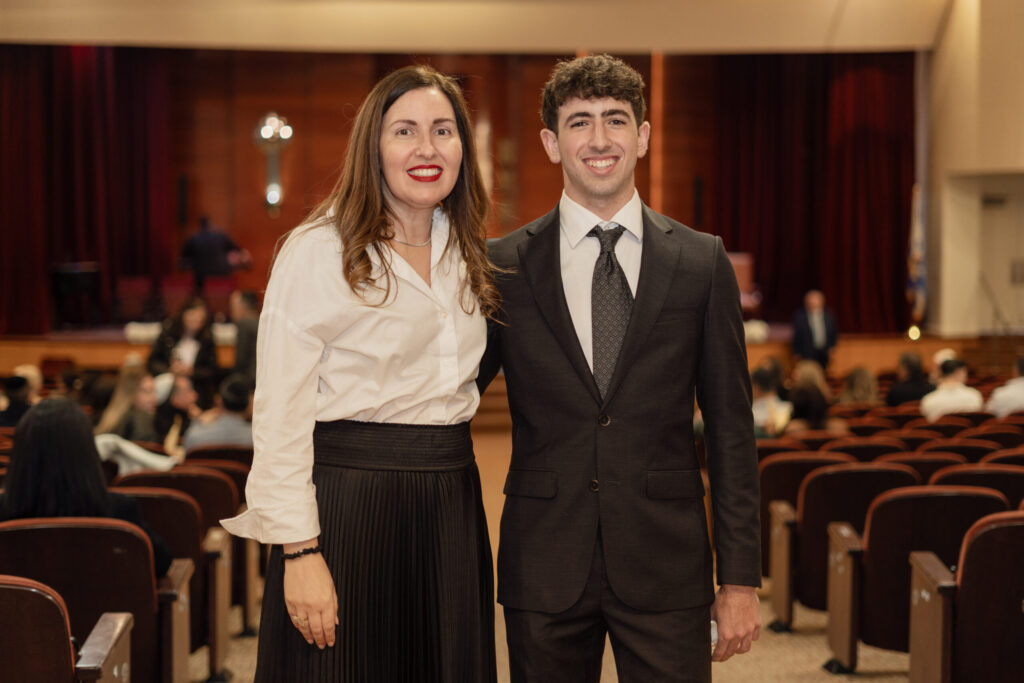
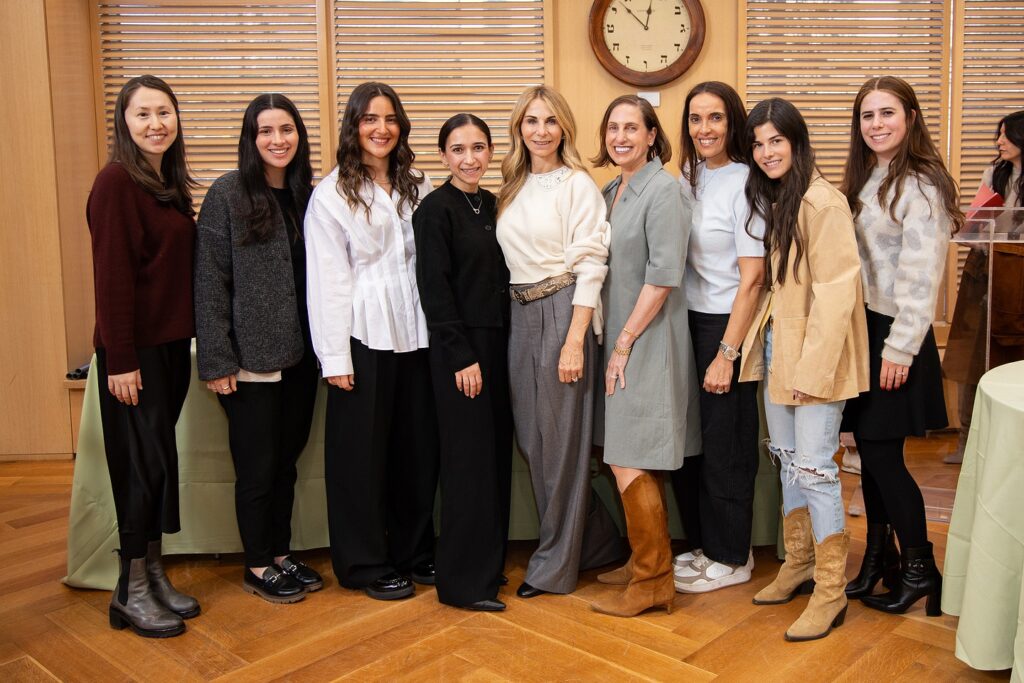
Magen David Yeshivah High School celebrated its annual Celebration of Excellence, an evening dedicated to honoring the achievements, character, and leadership of our students. The program featured inspiring words from junior class student leaders, beginning with Max Yedid, who was recognized as Student of the Year, followed by Joyce Ashkenazi, who delivered a powerful Presidential Address centered on the pursuit of excellence.
In a speech that resonated deeply with all in attendance, Max reflected not on the title he received, but on the environment that shaped him. “Standing here tonight feels surreal… not because of the title ‘Student of the Year,’ but because I’ve had the privilege of growing up in a place that shaped who I am,” he shared. Describing MDYHS as more than just a school, he added, “MDY didn’t just educate me. It raised me.” Max spoke about the opportunities that pushed him beyond his comfort zone, highlighting a transformative experience representing MDYHS at the World Zionist Jewish Youth Congress in Budapest. There, he witnessed firsthand how one individual can impact others, recalling how encouraging peers to put on tefillin led to a ripple effect across the world.“ The confidence to step forward, the pride in misvot, the comfort in my identity, that was planted in me here, in these walls,” he said. His message to his peers was clear: growth requires effort and intention. Challenging students to reach beyond what feels comfortable, he reminded them that “most people don’t fail… they just don’t go all the way,” urging everyone not to settle for “almost,” but instead to “go all in.” Building on that message, Joyce Ashkenazi challenged the audience to reflect on what truly drives success. “Excellence is not only about achieving perfection, but about pushing ourselves to do more, to dream bigger, and to strive beyond what’s expected of us,” she said. Emphasizing that real growth happens outside of one’s comfort zone, she explained that while perfection may be unattainable, “the pursuit pushes us forward,” developing the inner drive that fuels continuous improvement. Joyce highlighted that excellence is not something we are simply born with, but something we build through effort, grit, and perseverance. Using the metaphor that each person has “a pile of firewood within them,” she challenged students to decide whether they are willing to “strike the match and ignite the fire.” Reflecting on her own journey, she shared that this spark was ignited at MDYHS, where the support and belief of teachers and peers empowered her to grow beyond what she once thought possible. A signature moment of the evening was the candle-lighting ceremony, led by Vice President David Abadi, with students representing the core tenets of the National Honor Society: Torah (Aaron Farhi), Scholarship (David Tawil), Character (Jack Franco), Service (Estelle Schemo), and Leadership (Sarah Hasbani), each bringing these values to life in a meaningful way.
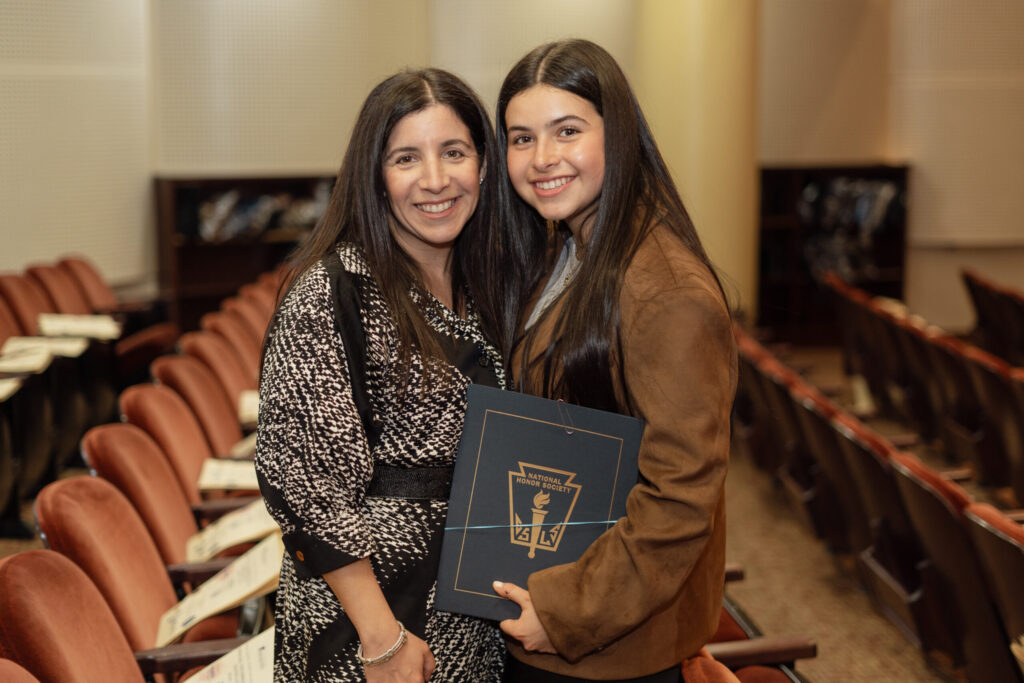
The evening culminated in the induction of our newest members into the National Honor Society, Kavod Chapter, presented by Dr. Daniel Vitow, and led by Rabbi David Elnadav and Mrs. Stephanie Shamah, followed by the administration of the pledge by Mrs. Audrey Abade. Throughout the evening, student artwork from the MDYHS art program, under the guidance of Mrs. Jennifer Cabasso, was proudly displayed, showcasing the creativity and talent of our students. The program was a powerful reflection of what defines an MDYHS education, not only academic achievement, but the cultivation of drive, identity, and purpose. As both Max and Joyce so clearly expressed, excellence is not a destination, but a pursuit, one that challenges our students to stretch higher, push further, and become the very best versions of themselves.
Most families don’t lose wealth because they failed to work hard, save diligently, or invest wisely. They lose it quietly, through outdated documents, overlooked details, and decisions that seemed harmless at the time.
Estate planning is often treated like a one-time task: sign the paperwork, put it in a drawer, and move on. But life changes. Families evolve. Tax laws shift. And strategies that once made perfect sense can slowly become expensive mistakes. The truth is, some of the biggest financial problems families face happen long before anyone realizes there’s an issue. The challenge is that estate planning rarely fails all at once. It usually unravels piece by piece, one beneficiary form here, one deed change there, one forgotten account left untouched for years. By the time families discover the problem, the opportunity to fix it may already be gone.
The “Simple” Deed Change That Can Trigger a Large Tax Bill One of the most common estate planning mistakes starts with good intentions. Parents want to make things easier for their children, so they add them to the deed of a home or property. On paper, it sounds logical. The thinking is often: “This will help avoid probate later.” But what many families do not realize is that avoiding probate is only one piece of the equation. When someone inherits property after death, they generally receive what is called a stepped-up basis. In simple terms, the property’s tax basis resets to the market value at the time of death. That reset can save heirs tens or even hundreds of thousands of dollars in capital gains taxes. For example, imagine parents purchased a home decades ago for $40,000, and today the property is worth $450,000. If the children inherit the home properly through the estate, the basis may reset close to the current value. If the property is sold shortly afterward, there may be little to no taxable gain. But if the child was added to the deed years earlier, the IRS may treat that transfer as a gift instead. That means the child could inherit the original $40,000 basis instead of the updated value. Suddenly, a future sale may create taxes on more than $400,000 of appreciation. And the tax issue is only part of the risk. Adding a child to a deed can also expose the property to that child’s creditors, lawsuits, or divorce proceedings. It may even reduce the parents’ control over the property itself. What looked like a shortcut can quietly become a financial liability.
The Beneficiary Form That Overrides Everything Else Another costly mistake often hides in plain sight. Many people assume their will controls where all their assets go after death. Unfortunately, that is not always true. Retirement accounts, IRAs, annuities, and life insurance policies typically pass according to the beneficiary forms on file, not according to the will. That creates a dangerous problem when beneficiary forms are never updated. An ex-spouse may still be listed years after a divorce. A deceased relative might remain on the paperwork. In some cases, no beneficiary is listed at all, causing the account to default to the estate. Families are often shocked to learn that a single outdated form can completely override the intentions written elsewhere in the estate plan. The reason this happens is simple: life moves faster than paperwork. People get married. Families grow. Relationships change. Accounts move between firms. Yet beneficiary forms often sit untouched for decades. What makes this especially painful is that these mistakes are usually discovered during moments of grief, when families are already overwhelmed emotionally. A fifteen minute review every few years can prevent years of legal complications later.
The Trust That Exists Only on Paper Perhaps the most misunderstood part of estate planning is the trust itself. Families spend time creating revocable trusts. Attorneys prepare documents. The binder gets organized. Everyone feels relieved knowing the plan is “done.” Except sometimes the trust never actually receives ownership of the assets. The house remains titled individually. Brokerage accounts stay outside the trust. Bank accounts never get updated. So when the trust is finally needed, it technically owns nothing. This process is known as trust funding, and it is one of the most overlooked steps in estate planning. The documents alone are not the strategy. The implementation is the strategy. A beautifully drafted trust that was never funded may still leave assets exposed to probate, delays, unnecessary legal costs, and confusion among heirs.
Estate Planning Is Not a Document. It’s a System. The biggest misconception in estate planning is believing each decision exists independently. It doesn’t. The deed affects the tax strategy. The beneficiary forms affect asset distribution. The trust affects probate. The account titling affects all of it. That is why estate planning should not be viewed as a one-time event. It should be reviewed periodically as part of an overall financial system. The families who tend to avoid major estate planning mistakes are usually not the families with the most complex legal documents. They are the families who periodically pause and ask a simple question: “Does all of this still work together?” Because protecting wealth is not only about growing assets. It is about making sure the people you love are not left dealing with preventable problems later.
This article is for informational and educational purposes only and should not be considered legal, tax, or investment advice. Estate planning strategies should be reviewed with qualified legal, tax, and financial professionals based on your individual circumstances.
At a moment when much of organized Jewish life seems preoccupied with finding ever newer ways to make Judaism more relevant, an unexpected voice reminded Jews of a far older truth. In a White House proclamation marking Jewish American Heritage Month and America’s 250th anniversary, President Donald Trump called on Americans to celebrate faith and freedom, “especially on Shabbat.” In a single sentence, the president did what many Jewish institutions have hesitated to do. He placed the most enduring institution in Jewish life back at the center of the conversation.
That formulation was striking not merely because it came from the White House, but because it touched a central question confronting Jewish communities throughout the Diaspora. How does a people that has survived exile, persecution, and assimilation preserve its distinct identity in an age of unprecedented comfort and freedom? The answer has never been complicated. Long before there were federations, advocacy groups, and continuity conferences, there was Shabbat. Ahad Ha’am famously observed that “more than the Jews have kept Shabbat, Shabbat has kept the Jews.” The aphorism has endured because it captures a historical reality. For thousands of years, Shabbat has served as the Jewish people’s weekly declaration that their lives are ordered by something greater than commerce, politics, and the relentless pressures of the surrounding culture. It sanctifies time, strengthens family, and creates a recurring encounter with faith and community. In every generation, it has functioned as Judaism’s most effective and democratic institution. Yet in recent years, even this cornerstone has at times been treated as negotiable. In some circles, traditional observance is portrayed as burdensome or antiquated, while institutional energy is directed toward making Jewish identity less demanding and more easily assimilated into prevailing cultural norms. The assumption underlying many of these efforts is that continuity depends on reducing the distinct obligations that have historically sustained Jewish life. The White House proclamation suggested the opposite. By singling out Shabbat in the context of America’s 250th anniversary, the president linked Jewish tradition to the broader American ideals of faith, family, and liberty. Whether intentional or not, the message was unmistakable. The practices that preserved Jewish identity for millennia are not obstacles to modern life. They are among its greatest civilizational assets. That insight prompted me to launch a simple grassroots initiative called 250Shabbat, encouraging Jews to honor America’s semiquincentennial by strengthening their observance of Shabbat. What began as a modest effort quickly spread far beyond anything I anticipated. Communities across the United States, South Africa, Panama, and elsewhere joined organically. Rabbis, educators, and community leaders began translating materials, creating their own graphics, and sharing the initiative through WhatsApp groups and social media. Discussions are now underway to involve senior figures, including the Prime Minister of Israel. The rapid response revealed something important. Beneath the noise of modern Jewish life lies a deep and often unspoken hunger for authentic connection. Many Jews are not searching for a diluted identity tailored to contemporary sensibilities. They are searching for rootedness. They want a practice that imposes meaning, creates sacred boundaries, and links them to generations past and future. That is why the growth of this initiative matters. Its significance lies not in the mechanics of a WhatsApp group or an Instagram account, but in what ordinary Jews recognized almost instinctively. The surest answer to Jewish continuity is not another branding campaign or institutional reinvention. It is the weekly return to a covenant that has already proven its power across centuries. The lesson extends beyond the Jewish community. In an era marked by fragmentation, loneliness, and cultural exhaustion, Shabbat offers a countercultural model grounded in rest, family, faith, and gratitude. It reminds both Jews and non-Jews that freedom is not merely the absence of restraint, but the ability to sanctify time and order life around enduring values. The most striking aspect of this story is that it did not begin in a synagogue or a boardroom. It began with one sentence in a presidential proclamation. That sentence resonated because it articulated a truth many had forgotten but were ready to hear. The institutions that preserve civilizations are often ancient, demanding, and profoundly simple.
For the Jewish people, no institution has done more to ensure survival than Shabbat. At a time when so many are searching for new formulas to secure the future, the overwhelming response to 250Shabbat offers a more sobering and hopeful conclusion. The strongest path forward may not require inventing something new. It may require returning, with renewed seriousness and gratitude, to the gift that sustained us all along.
Most of us have been in conversations that start as an expression of pain and then turn into something more troubling. A person is frustrated, wounded, and trying to make sense of what happened. But sometimes the language becomes sharper as reputations are dissected and old grievances are revisited.
At a certain point, it no longer sounds like an attempt at finding a resolution. It sounds like a claim of authority to define another person’s life, choices, and failures. What is most unsettling to me in conversations such as these is the sense that the speaker feels entitled to stand above another person and pronounce judgment. We often think lashon hara begins with what someone else did wrong. But often it begins somewhere else: in the desire to stand above another person and look down on them in judgment. King David captures this posture when he gives voice to the lashon hara speaker’s inner thoughts: “With our tongues we will prevail. Our lips are with us. Who is master over us?” (Tehillim 12:5). In the phrase lilshonenu nagbir, the tongue becomes a kind of gibor, a weapon used to overpower. And in sefatenu itanu, “our lips are with us,” speech becomes something we imagine belongs entirely to us: to define, diminish, and control others. Beneath it all lies the deeper assumption: mi adon lanu, who can tell us what we may or may not say? That is why the Gemara states that one who speaks lashon hara is as if he denies the fundamental principle of faith, ke’ilu kafar ba’ikar (Arakhin 15b). Not because he stands up and says, “I do not believe in G-D.” But because he acts as if no one, not even G-D, has a claim over how he utilizes his gift of speech. This is also one of the oldest temptations, one we find in the Garden of Eden. The serpent lures Adam and Eve with a single phrase: vihyitem k’Elokim yod’ei tov vara, “you will be like Elokim, knowing good and evil.” As Maimonides explains, Elokim here means judges or rulers: those who decide. The temptation was not simply to know more, but to become the one who determines good and bad, proper and improper (Moreh Nevukhim 1:2). Lashon hara is that same temptation: a person reaching for the authority to declare this action good, that one shameful, as though that judgment were theirs to render. This helps explain one of the strangest appearances of tzara’at in Tanakh. We are used to associating tzara’at with lashon hara, as the Torah in Devarim connects tzara’at with the story of Miriam (Devarim 24:8-9). Yet one of the most striking cases in Tanakh involves King Uzziah, where no lashon hara appears at all. King Uzziah brazenly entered the Beit HaMikdash to perform a service that was prescribed exclusively for the kohanim. And so, the Kohen Azariah approached him with eighty brave kohanim, and stood before the king and said: lo lekha Uzziah, “this is not for you, Uzziah” (Divrei HaYamim 2 26:18). King Uzziah immediately becomes visibly enraged, and from that rage, vehaTzara’at zarha bemitzho, the tzara’at arose on his forehead. His self-perception and entitlement, the assumption that no boundary applied to him, burst forth for all to see (Divrei HaYamim 2 26:19). One can almost hear Uzziah’s inner voice saying: the mi adon lanu of Tehillim, who is master over me? Who are these kohanim to stop me? I defeated enemies, fortified our city, and built an army of hundreds of thousands. Who are they to tell me no? The Uzziah case is not a sole outlier. In discussing the cause of Tzara’at, the Gemara in Arakhin lists several reasons for this affliction, including arrogance (as we saw with Uzziah), murder, and theft (Arakhin 16a). At their root, these share a common posture: a person sees himself as the decider over another person’s life, property, or dignity. With murder, a person sees it as their prerogative to decide when to end another’s life, and with theft, a person decides that what belongs to another belongs to them. Similarly, lashon hara is when a person assumes the right to define someone else, to shape how they are seen, and to decide what their actions mean.
The affliction of Tzara’at and its healing process address this directly. The person stricken by tzara’at must stand before the kohen and be seen. The one who decided how everyone else should be viewed must now wait for the kohen to determine how he will be viewed. He cannot declare himself pure or impure; his status must be determined by someone else. And then, he must announce to others who pass by, out loud: “I am impure, I am impure.” And when he calls out “I am impure,” he is not merely warning others to keep their distance. Whether his tzara’at came from arrogance, from lashon hara, from theft, or from any of the other causes the Gemara lists, the declaration is the same. There is a Master above me. My status is His to determine, not mine. Before Him, I stand. Lashon hara is often, at its core, not about the person being spoken about. It is about the speaker and where they imagined themself standing: above another person, above their choices, above their story. Speech becomes a mirror of that inner posture. It reveals not only what I think of someone else, but where I think I stand in relation to them. That is why the healing is done with cedar and hyssop. As Rashi explains: “let him abandon his pride, and regard himself lowly… as a hyssop” (Rashi to Vayikra 14:4). Tzara’at came from arrogance, and thus the remedy is to lower oneself from the cedar, the tall tree standing above everyone else, and to recognize where they actually stand, like the hyssop plant, low to the ground, not above others, and not entitled to pass judgment over them. It is not only a question about harm done to another person. It is also a question of self-understanding: “Who do I think I am when I say it?” The posture of mi adon lanu is the posture of a person who has forgotten that both he and his speech have a Master. Before we speak, we need to hear the words Uzziah could not bear: lo lekha, this is not for you. It is not your story to author or judge. The antidote to mi adon lanu is remembering who the real Adon is. We are not Elokim yode’ei tov vera, judges appointed to stand above another person’s life and pronounce what it means. Only G-D is, and before Him, we all stand.
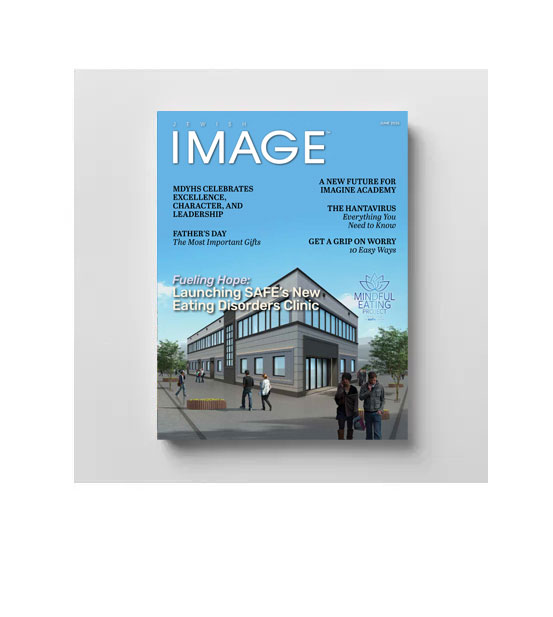
The Mindful Eating Project Opens Brooklyn’s First Dedicated Eating Disorder Clinic
Across Brooklyn’s Jewish communities, struggles with food, body image, and self-worth are reaching into more homes than most people realize, and reaching them earlier. Eating disorders do not discriminate by age. They show up in children, teenagers, young adults, and parents alike. And when one person is suffering, the entire family feels it: the worry at the dinner table, the strain on siblings, the spouse who doesn’t know what to say. This is a family issue, and it demands a family-centered response.
The Mindful Eating Project (MEP), a division of The Safe Foundation, began as a pilot in 2022 to meet a community need that was outpacing available care. Since then, MEP has sponsored thousands of individual therapy and nutrition sessions, fielded hundreds of hotline calls, and built a network of clinicians serving families across Brooklyn. That pre-launch work proved the model. This fall, MEP takes the next step: opening a fully licensed New York State outpatient clinic dedicated entirely to eating disorder treatment. The fall 2026 opening will bring therapy, nutrition, family support, and medical oversight together under one roof, built for this community, located in this community.
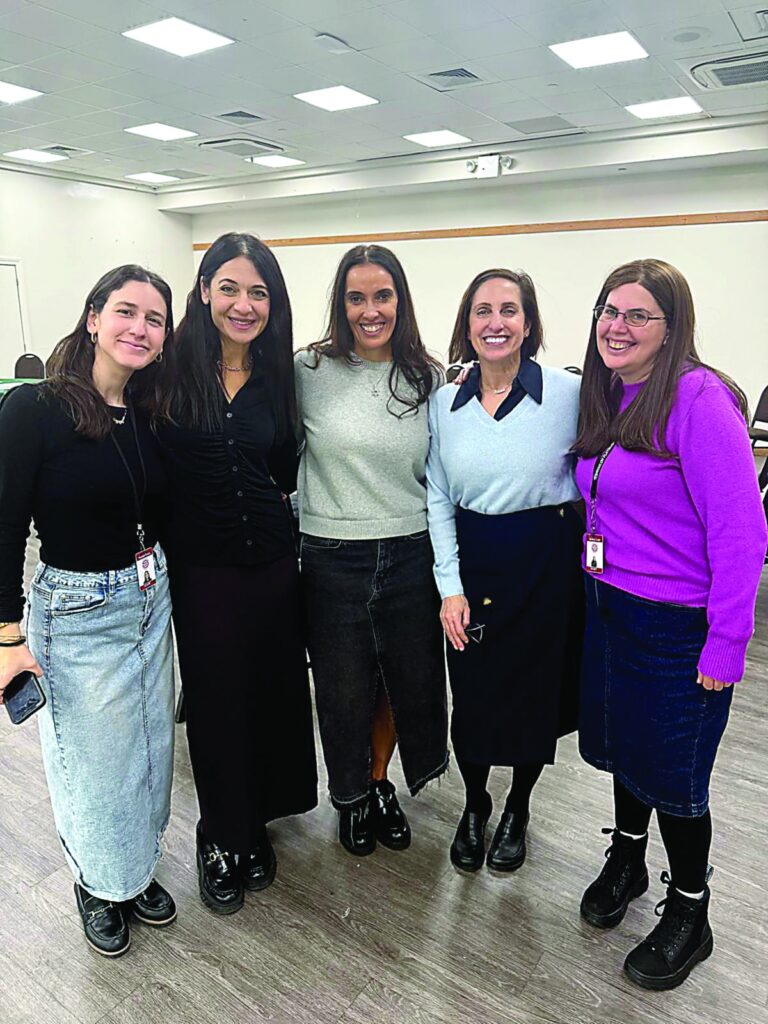
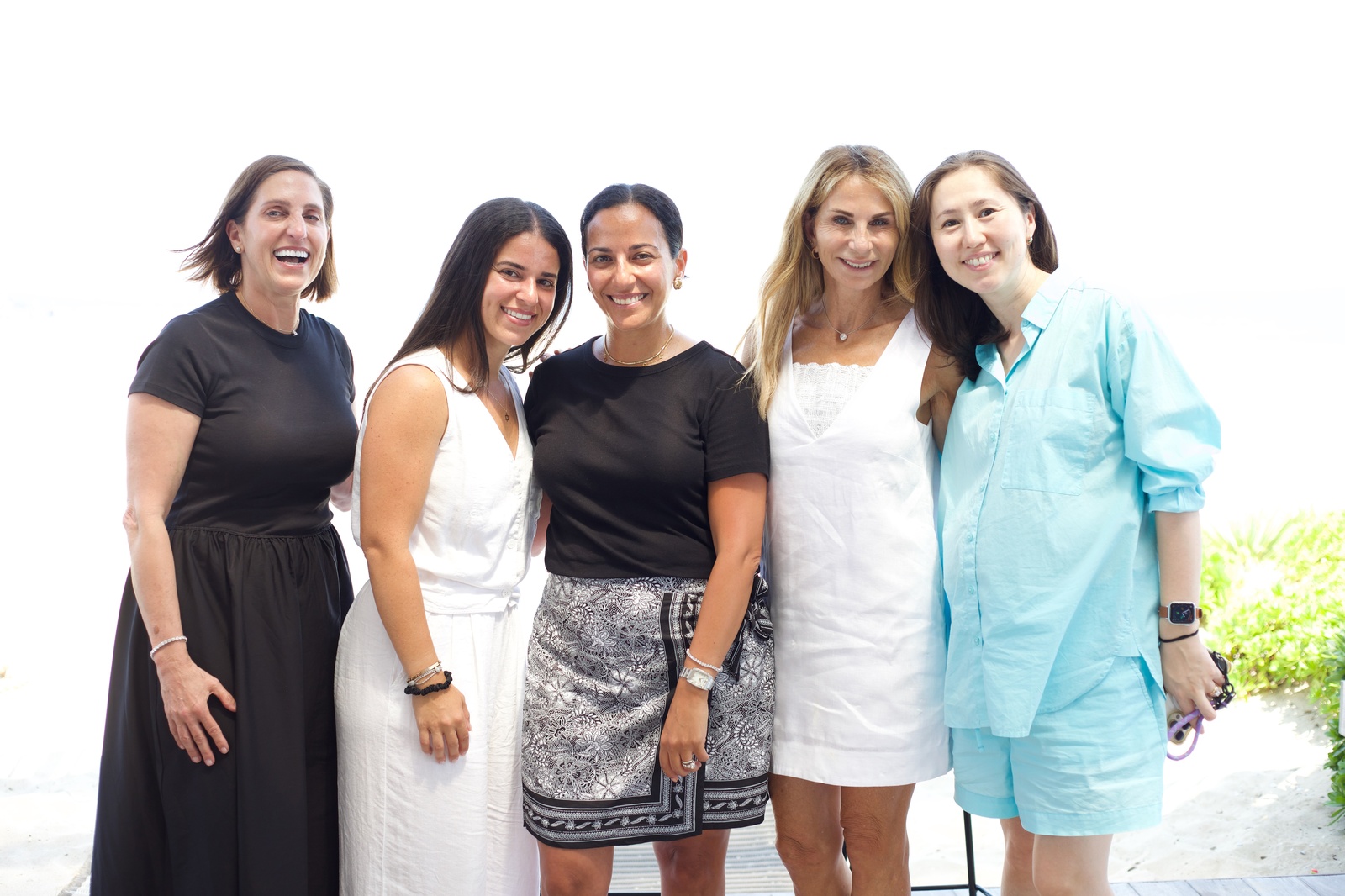
Sally Franco, CPC ELI-MP, Project SAFE Curriculum Planner, second from left, with Yeshivah of Flatbush students at a Project SAFE self-confidence event.Sari Dana, Body Positive Coach, with Michelle Haddad, MEP co-founder.L to R: Ulzhan Yeshengazina, Director of the Mindful Eating Project (MEP), Odette Franco, MEP committee member, Roberta Saban, LCSW, MEP committee member, Milana Hazan, COO, The Safe Foundation, Michelle Haddad, MEP co-founder, Sari Dana, Body Positive Coach and MEP committee member, Liat Dahan, Director of Community Education, Project SAFE, Lauren Jemal Setton, MEP committee member, Rachelle Heinemann, LMHC, LPC, CEDS, event panelist.Pictured center are Sally Franco, CPC ELI-MP, Project SAFE Curriculum Planner, Liat Dahan, Director of Community Education, Project SAFE, and Sari Dana, Body Positive Coach, with Magen David Yeshivah teachers at left and right, at a Project SAFE event.Yeshivah of Flatbush students exploring tools for building self-worth, sharing their definitions of confidence, and creating vision boards that bring those ideas to life.
What MEP Does MEP offers an integrated continuum of care designed to meet patients and families wherever they are in the process, and to give them tools that last a lifetime.
Confidential Hotline One phone call is all it takes to start. MEP’s hotline is staffed by people who understand what you’re going through and can guide you to the right next step. Case Management Every patient is paired with a case manager who coordinates care, removes obstacles, and stays with the family through the entire journey.
Therapy Individual and family therapy with clinicians who specialize in eating disorders. Treatment addresses the underlying drivers, not just the surface behaviors, and is tailored to the patient’s age and stage.
Nutrition Counseling Registered dietitians work alongside the therapy team to rebuild a healthy, sustainable relationship with food, at a pace that respects what the patient is ready for.
Higher Level of Care Coordination When outpatient treatment isn’t enough, we help families access and navigate higher levels of care, and MEP stays involved throughout, so no one falls through the cracks during transitions. The goal is bigger than any single appointment: to equip the patient and the people who love them with the tools, language, and support they need to navigate this for the rest of their lives. Recovery is not a single moment. It’s a long road, and MEP’s mission is to make sure no family walks it alone.
Confidentiality and Safety Everything is 100% confidential. You can call MEP at any time, and your information will be handled with the highest degree of discretion. Many of the people who reach out to MEP have not yet told a parent or a spouse. MEP takes great care to provide its clients with an environment that is a safe space where someone can begin to navigate treatment with full autonomy, privacy, and respect.
L to R: Event panelist Sari Dana, Body Positive Coach, moderator Bonnie Tawil, MEP committee member, event panelist Norma Saff, RD, Michelle Haddad, MEP co-founder, and Ulzhan Yeshengazina, Director of the Mindful Eating Project (MEP).Sari Dana, Body Positive Coach, with Lorayne Shehebar and Michelle Haddad, MEP co-founders as well as Ulzhan Yeshengazina, Director of the Mindful Eating Project (MEP), Larisa Manouilovitch, Director of Marketing, The Safe Foundation, and Bonnie Tawil, MEP committee member and event moderator.Registered dietitian Norma Saff addressing the attendees at a Hillel Yeshiva event focused on body image and parenting.
Prevention, Education, and Community Treatment is only part of the picture. MEP also invests heavily in prevention and education, bringing the conversation into schools, homes, and community spaces where it used to be off-limits. Recent programming has included an Instagram Live with endocrinologist Maurice Mosseri and therapist Roberta Saban, LCSW, on body image and the cultural impact of weight loss medications, and an in-person panel with Laura Shammah, MS, RDN, and Rachelle Heinemann, LMHC, LPC, CEDS, on what these medications mean for growing bodies. In schools, MEP’s partnership with Project SAFE continues to expand. In April 2026, MEP launched the Sari Dana Body Positive Online Program, giving students participating in Project SAFE schools free access to resources on body image, self-confidence, and self-acceptance. Other partnerships include Magen David Yeshivah on “Strong Together: Building Healthy Body Image,” a mother-daughter event, and Hillel Yeshiva on a community program focused on body image and parenting. Looking ahead, a summer 2026 community awareness event, expanded school programming, parent education, and digital campaigns will all tie into the new clinic. The cultural shift this work represents is real. Where there was once stigma, there is openness. Where there was once isolation, there is connection. And where there was once silence, there is now a number to call. If you’re concerned that you or a loved one may be struggling with an eating disorder, call The Mindful Eating Project at (718) 336-6363. Every call is confidential.
One question, asked in faith, has the power to change a life. I know because it changed mine. It happens when you ask: what is G-D calling on me to do in these circumstances at this time? To believe in Divine Providence is to trust that G-D is interwoven in our lives. This does not make suffering less painful. But it opens a door that leads us to the light. It helps us live a life that is an answer to G-D’s call.
I learned this from the biblical story of Joseph. Envied and hated by his brothers, he was sold into slavery by them, lucky not to be killed. Eventually he became viceroy of Egypt, second only to Pharaoh. The brothers, arriving in Egypt to buy food during a famine, do not realize that the man in royal robes is their brother. After putting them through a series of trials to show that they had repented of what they did, Joseph revealed his identity and forgave them, the first act of forgiveness in literature. The book of Genesis, a set of variations on the theme of sibling rivalry, ends on this sublime note of reconciliation. How was Joseph able to forgive? The Bible tells us. He says to his brothers: “Do not be distressed and do not be angry with yourselves for selling me here, because it was to save lives that G-D sent me ahead of you … So then, it was not you who sent me here, but G-D.” This is one of the most transformative passages in the Bible. It explains how Joseph was able to free himself from the hurt and humiliation he surely felt at being betrayed by his own family. Nowadays this is called cognitive behavioral therapy. Joseph changed the way he felt by changing the way he thought. Evidently he had asked himself, “Why has G-D put me through this suffering?” But there are two ways of asking it, and it makes all the difference which way we do. One is oriented to the past: “What did I do to deserve this? For what sin am I being punished?” The other is directed to the future: “What is it that G-D wants me to do, that I can only do here, now and in these circumstances?” Joseph must have asked this second question often during the long years he spent, first as a slave, then as a prisoner. The answer eventually came. The moment he was taken from prison to interpret Pharaoh’s dreams, seven years of plenty followed by seven years of famine, he realized that all the seemingly random events of his life were a preparation for this moment when he was able to devise a plan that would save a whole region from starvation. As soon as he had these thoughts, he was able to forgive his brothers. His fate, he now knew, was not about them at all. “It was not you who sent me here but G-D.” That one thought has the power to cure resentment and banish pain. Whenever we come close to despair, the strongest lifeline is to think like Joseph. That is how psychotherapist Viktor Frankl saved the lives of several of his fellow prisoners in Auschwitz, by helping them realize that they had a task to perform or a mission to fulfil that they could only do by surviving. This gave them the will to live. People who have suffered tragedy have often found meaning by alleviating the suffering of others. The grief may not disappear but it is redeemed. The adagio, with its intense sadness, is not the last movement of the symphony. Seen through the eyes of faith, life is not what Joseph Heller called it: “a trashbag of random coincidences blown open in a wind.” Each of us is here for a reason, to do something only we can do, and all the pain and heartbreak are bearable if we can discern G-D’s purpose or hear, however muffled, His call. As Nietzsche used to say, “He who has a strong enough Why, can bear almost any How.” In crisis, the wrong question to ask is, “What have I done to deserve this?” The right one is, “What am I now being summoned to do?” Each of us has a task. Every life has a purpose. We can bear the pain of the past when we discover the future we are called on to make.
In a time of heightened global uncertainty and urgent humanitarian need, Hatzalah YS will host its highly anticipated Gala on May 11, 2026, at the prestigious Museum of Jewish Heritage in New York City.
This distinguished evening will bring together philanthropists, diplomats, business leaders, and prominent figures from across the United States and the international community in support of one of the world’s most vital emergency response organizations.
Founded in 2000, Hatzalah YS—Rescuers Without Borders—is recognized for its elite network of over 1,600 volunteer medics who deliver rapid, life-saving medical intervention, often within seconds, in some of the most dangerous and underserved regions. Operating on the front lines, Hatzalah YS provides critical care to civilians under fire, supports vulnerable populations, and delivers aid where traditional infrastructure cannot reach.
The Gala will honor three exceptional individuals whose impact transcends their respective fields:
• Elie Tahari will receive the Humanitarian Award in recognition of his outstanding contributions to the world of fashion, his entrepreneurial vision, and his longstanding commitment to philanthropy and humanitarian causes.
• Tovah Feldshuh, acclaimed actress of stage and screen, will be honored with the Humanitarian Award for her remarkable artistic achievements and her dedication to supporting meaningful causes and strengthening communities.
• Ofir Akunis, Consul General of Israel in New York, will be recognized with a distinguished award for his unwavering leadership, diplomatic service, and steadfast advocacy for Israel and the Jewish people on the global stage.
The evening will begin with a cocktail reception at 6:00 PM, followed by a seated dinner, awards ceremony, and live fundraising initiatives in support of Hatzalah YS’s life-saving mission.
As geopolitical tensions continue to impact civilian populations across the Middle East and beyond, the need for immediate, professional, and fearless emergency response has never been more critical. Hatzalah YS remains at the forefront of this effort—proving that when every second counts, help truly has no borders.
Event Details: Museum of Jewish Heritage, New York City May 11, 2026 6:00 PM — Cocktail Reception Dinner, Awards Ceremony
The pace has changed. Homes are not flying off the market in a weekend the way they did a few years ago. Buyers are taking more time. Sellers are adjusting to a different set of expectations. The shift is not sudden, but it is real, and it affects almost every decision tied to real estate today.
What matters now is not guessing where the market is going. It is understanding how to operate in the market that exists today. Higher mortgage rates are the biggest force behind the reset. When rates rise, monthly payments go up even if prices stay the same. That alone cuts into what buyers can afford. A buyer who could qualify for a certain price range two years ago may now need to look lower or bring more cash to the table. This has slowed demand, and fewer buyers are jumping in. At the same time, prices in many areas have softened. This does not mean a crash across the board. In some neighborhoods, prices are flat. In others, they have come down from their peak. The result is a market where expectations need to be more grounded. Sellers who base their price on last year’s peak numbers often sit longer than they expect. Time on market tells the story. Listings are staying active longer than they did during the surge years, and that changes the dynamic right away. Buyers feel less pressure to rush and have time to compare options. They can walk away from a deal that does not feel right, which was harder to do when inventory was tight and competition was intense. For buyers, this creates a more stable environment, but it does not mean easy. Higher rates still make affordability a challenge. You may find a home at a better price, but your monthly cost could still be higher than you expect. That is why the numbers matter more than ever. Focus on your monthly payment, not just the purchase price. Factor in taxes, insurance, and maintenance. If the numbers do not work comfortably, it is better to step back than stretch too far. You also have more room to negotiate. In many cases, buyers are asking for closing cost credits, repairs, or help buying down their interest rate. Sellers are more open to these conversations now because they want to move the deal forward. For sellers, the biggest shift is pricing discipline. Overpricing is one of the most common mistakes in this market. A home that sits too long can lose momentum. Buyers start to wonder what is wrong, and price reductions often follow. The final sale price can end up lower than if the home had been priced correctly from the start. Presentation also matters more now. When buyers have options, they compare closely. Clean, well maintained homes with simple updates tend to stand out. You do not need a full renovation. Basic steps like fresh paint, good lighting, and removing clutter can make a difference. Small repairs that were once overlooked are now part of the buyer’s decision. There is also a gap between perception and reality that both sides need to manage. Some sellers still expect the fast sales and multiple offers of the recent past. Some buyers expect steep discounts. In most cases, the outcome falls somewhere in between. Deals happen when both sides adjust to current conditions, not past ones. Local factors still matter. Real estate is not one national market. Some areas with limited inventory or strong demand are holding up better. Others are seeing more noticeable slowdowns. School districts, community amenities, and access to transportation continue to influence value. If you are planning to buy, take the time to prepare. Get preapproved so you understand your budget clearly. Watch listings in your target area to see how long homes are sitting and how prices change. When you find the right property, move with purpose, but stay within your limits. If you are planning to sell, look at recent comparable sales, not peak prices from a different market. Work with a professional who knows your area and can give you realistic guidance. Focus on presenting your home well and pricing it correctly from day one. The market has not stopped. It has reset to a pace that requires more thought and more balance. Buyers and sellers who understand that are in a better position to make decisions that hold up over time.
How to stop dreaming and start making it real grounded in ancient wisdom
Dr. Leslie M. Gutman
Is there something you really want or wish would happen? More than 200 years ago, Rebbe Nachman of Breslov, an influential 18th-century Hasidic master, taught that when we focus every ounce of our attention on a goal and visualize it in detail, we awaken the inner strength to make it real. When our desire is strong and our concentration steady, we open the door for change.
Manifestation has become a modern trend, echoing his teachings that our inner world shapes our outer actions. Here are seven steps to manifesting your wildest dreams.
See the Path Before You Walk It When you imagine a goal vividly, what it looks like, how it feels, what steps you might take, you create a mental blueprint. Your mind becomes familiar with the path and your heart becomes more willing to take the first step. Jewish tradition calls this machshavah toba, a good and focused thought that sets spiritual and emotional movement into motion. How to. Close your eyes for a moment and picture the outcome you want. Let the image become clear and steady. One vibrant image is more powerful than a dozen vague ones.
Name What You Truly Want Most of us rush through life reacting to what’s in front of us. We rarely pause to ask: What do I actually want? What am I hoping for? What am I afraid to admit I wish for? Manifestation begins with honest reflection. It’s also the first step toward making it real. How to. Create a vision board of your dreams and hang it somewhere you will see it every day.
Visualize Yourself Overcoming Obstacles Part of manifestation is acknowledging the barriers you might face, then picturing yourself moving through them. Obstacles might include your own fears and insecurities or practical issues like time or money. How to. Visualize one challenge you might face and imagine how you might overcome it. See yourself handling it with calm, courage, and resilience.
Imagine Yourself Succeeding Once you’ve pictured the goal and the obstacles, imagine yourself taking the steps that move you forward, making the phone calls, showing up, speaking with clarity, practicing the necessary skills, and staying steady when you feel nervous. This is not wishful thinking. It’s mental rehearsal, a way of preparing your mind to act with confidence when the moment comes. How to. Choose one small action you could take this week and imagine yourself doing it well. Keep the action manageable. Small steps build momentum.
Align Thought and Action Thought alone is never the whole story. Visualization is the preparation but behavior is the vehicle. Your goal becomes reality when your actions help you to achieve the goal. Manifestation, in a Jewish sense, is the partnership between your intention, your effort, and G-D’s help. We do our part, and we trust that G-D meets us halfway. How to. Take one concrete step forward that aligns with your vision. It doesn’t need to be dramatic.
Have a Positive Mindset To maintain your motivation, rely on techniques like positive self-talk and practicing gratitude. A positive mindset doesn’t mean ignoring the difficulties. It means seeing the good in what you have now and recognizing new doors can open that you haven’t even anticipated yet. How to. Focus on what’s happening now that you are grateful for and consider tools like meditation or journaling to make this more concrete.
Stay Open to Something Better Than Your Plan Manifesting isn’t about controlling every outcome or getting exactly what we want in the moment. Jewish wisdom teaches that we can hold a clear vision and still stay open to the possibility that G-D has something even better in mind. Sometimes we focus so intensely on one specific result that we miss a different opportunity that’s even better for us. Manifestation involves a measure of faith: we clarify our hopes, we take steady steps, and we trust that the path may unfold in ways we didn’t plan but ultimately serve our highest good. Top tip. Hold your vision lightly. Stay committed to the direction, not attached to one specific doorway. Rebbe Nachman believed in the power of a focused mind and a hopeful heart. When we picture the life that we want with honesty and courage, we begin to move toward it, one small step at a time.
Spring has a way of making us want to start fresh. We clean our homes, organize our closets, and throw out what we no longer need. It feels productive, even relieving, like we are creating space for something new. And naturally, that same instinct shows up around food. “I need to clean up my diet.” “I should cut out sugar.” “I am starting over Monday.” It sounds healthy. Disciplined. But more often than not, it is just a different version of the same cycle. Because while we are busy clearing out our kitchens, we are not addressing the one place that actually drives how we eat. Our minds.
The Clutter You Cannot See Most women I work with are not struggling because they do not know what to eat. They are struggling because their minds are full. Full of rules. Full of noise. Full of constant decisions about food. “Should I eat this?” “Did I already eat too much?” “I will be good now and make up for it later.” That mental clutter is exhausting. And just like a messy home, it makes everything harder.
Why More Rules Do Not Create More Control When things feel out of control, the natural instinct is to tighten things up. More structure. More discipline. More rules. No carbs. No sugar. No eating after a certain time. For a few days, it can feel like it is working. But then real life happens. You get hungry. You get tired. You are out with people. You are stressed. And suddenly, the rules become impossible to follow, not because you lack willpower, but because the system itself is not sustainable. So the cycle continues, control, to restriction, to overwhelm, to starting over. That is not clarity. That is clutter.
What a Real Reset Actually Looks Like A true reset is not about doing more. It is about removing what is not helping. Instead of asking, “What should I cut out?” try asking, “What is making eating feel so complicated?” For many women, the answer is not the food itself. It is skipping meals and then feeling out of control later, trying to be perfect all day, overthinking every bite, and feeling guilty no matter what they choose. When you clear that out, everything shifts.
Simplicity Creates Stability Your body does not need perfection. It needs consistency. Regular meals. Enough food. A rhythm it can rely on. When eating becomes more predictable, your body responds. Hunger cues stabilize. Energy improves. Cravings feel less intense. Digestion often gets better. And most importantly, the mental noise quiets down.
A Different Kind of Spring Cleaning This spring, instead of focusing only on your pantry, consider what you can clear out mentally. The idea that you have to start over. The pressure to eat perfectly. The belief that certain foods make you good or bad. The constant negotiation around food. You do not need more rules. You need less noise.
The Shift That Changes Everything The goal is not to control your eating more tightly. It is to create a way of eating that does not require constant control. Because when food becomes simpler, your life does too. You have more space for your family, friends, your work, your energy, and your peace of mind. This spring, do not just clean your kitchen. Clean the way you think about food. Because the real reset does not come from restriction. It comes from letting go of the noise that made eating feel so hard in the first place. It comes from clarity. q
Rabbi Akiva famously taught that “love your neighbor as yourself” is the overarching principle of the Torah. Why did 24,000 of his students die for failing to do exactly that?
Why did 24,000 students of Rabbi Akiva, the greatest Torah sage of his generation, die in a plague? The Talmud (Yevamot 62b) gives a single, devastating explanation: “Because they did not treat one another with proper respect.”* Rabbi Akiva was the very sage who declared that the overarching principle of the entire Torah is the verse “Love your neighbor as yourself.” If any students should have understood the centrality of love in human affairs, it was his. How, then, did they fail so profoundly at the fundamental teaching of their own teacher? The answer lies in a debate recorded in the same Midrashic passage about what is the Torah’s overarching principle. Rabbi Akiva’s colleague, Ben Azzai, offered an unexpected alternative candidate: “This is the book of the generations of man” (Genesis 5:1). What could a genealogical verse possibly teach that would rival the commandment to love your fellow neighbor?
Respect Versus Love Rabbi Asher Weiss, a contemporary leading scholar, explains that Ben Azzai was pointing not to genealogy but to something more fundamental: the nature of what a human being is. The verse continues: “In the image of G-D He created him.” Ben Azzai’s principle is not about what we feel toward others, but about what others are. Every human being carries the image of G-D. Their value does not depend on whether we find them lovable. Their inherent G-dliness is independent from our feelings. Here lies the crux of the disagreement. Rabbi Akiva built relationships on love. Ben Azzai insisted they must be built on respect. These are not the same thing. Love, at its core, is about your experience of the other person: what is attractive, admirable, or kindred in them, the pleasure their presence brings. Respect is not a feeling but a recognition. It says, you exist independently of me. Your worth is not contingent on my affection. You have standing in the world that I did not grant and cannot revoke. Respect requires us to make space for another person’s reality, even when that reality is inconvenient or challenging to our own. This, perhaps, is the mistake Rabbi Akiva’s students made. Love without the foundation of respect is unstable. You can love someone and still dismiss them, still fail to honor their dignity. Their love was unanchored. And so the plague came and the world was diminished.
One of a Kind The Mishnah teaches: “Beloved is man, for he was created in the image of G-D” (Ethics of the Fathers, 3:14). The Maharal of Prague and the Vilna Gaon elaborate with a striking metaphor. Every human being shares the same basic form: two eyes, two ears, a mouth, a nose. And yet no two faces are identical. Human beings are not mass-produced prints from a single plate. Each one is a Rembrandt: singular, unrepeatable, irreplaceable. Rarity confers value. A one-of-a-kind painting is worth more than a thousand copies. How much more so a human being, of whom there has never been and will never be a duplicate in all of history. That is the metaphysical foundation of kavod, dignity. Their value is written into the fabric of creation itself. Two thousand years after Ben Azzai, John Gottman, the world renowned couples therapist, spent decades studying thousands of marriages. He identified what he calls, “Four Horsemen” of relational destruction: criticism, contempt, defensiveness, and stonewalling. Of these, he found that the single greatest predictor of divorce is contempt: any act of diminishment, however subtle, that communicates to another person that they are beneath consideration. In other words, the absence of kavod, respect. Gottman arrived at this through empirical observation. Ben Azzai arrived at it through the Torah. They are saying the same thing: love brings pleasure to a relationship, but respect is the ground on which it stands.
Failure of Respect, Failure of Love Because Rabbi Akiva’s students perished during the counting of the Omer, between Passover and Shavuot, the Sages ordained a period of mourning for them. Now consider the second period of mourning in the Jewish calendar: the Three Weeks between the seventeenth of Tammuz and Tisha B’Av (the Ninth of Av). The Talmud tells us that the Second Temple was destroyed because of sinat chinam, baseless hatred. The commonly proposed remedy is ahavat chinam, unconditional love: love offered without precondition, without calculation, without requiring the other person to earn it first. Place these two seasons of mourning side by side and a remarkable formula emerges. The Omer period addresses a failure of respect. The Three Weeks address a failure of love. Together, they map the full architecture of what human relationships require. Respect is the foundation: the recognition that every person, by virtue of bearing G-D’s image, is worthy of dignity. Love is what we build upon that foundation: the warmth, the connection, the willingness to see the particular beauty in another person. Love without respect drifts toward self-interest. Respect without love lacks warmth. The rabbis gave us a dedicated time each year to work on each. The Torah requires love grounded in respect and respect animated by love. This is the foundation of marriage, friendship, community, and ultimately of the covenant between G-D and Israel. Staying mindful of the profound, intrinsic value of everyone around you during this period of mourning helps to transform the tragic death of Rabbi Akiva’s students into meaningful growth for ourselves and for the Jewish people. Rabbi Akiva’s students were both exceedingly righteous and the leaders of the Jewish people, and were therefore judged in a very exacting way.
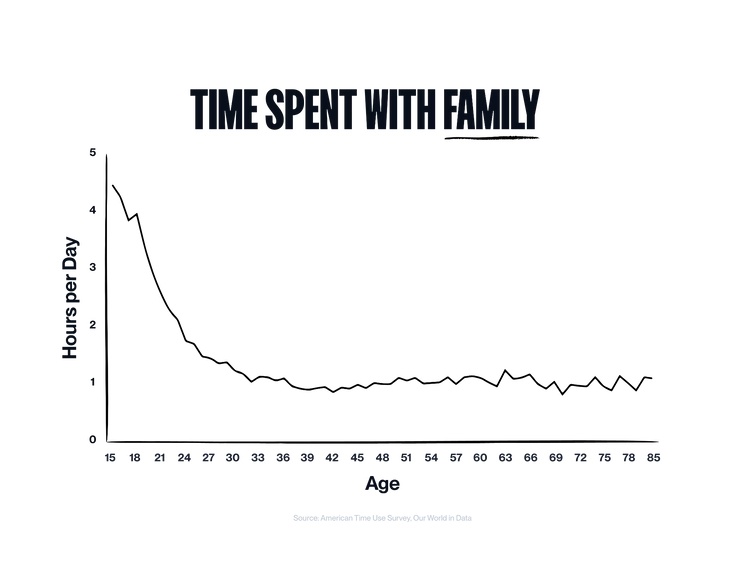
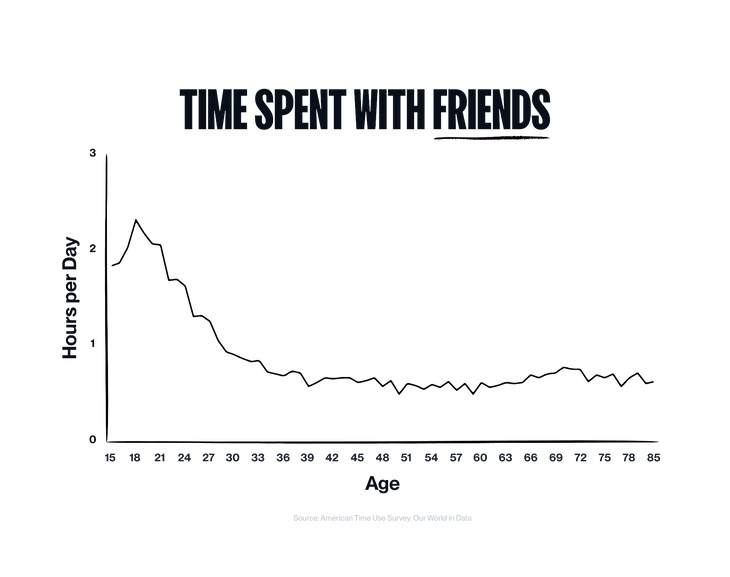
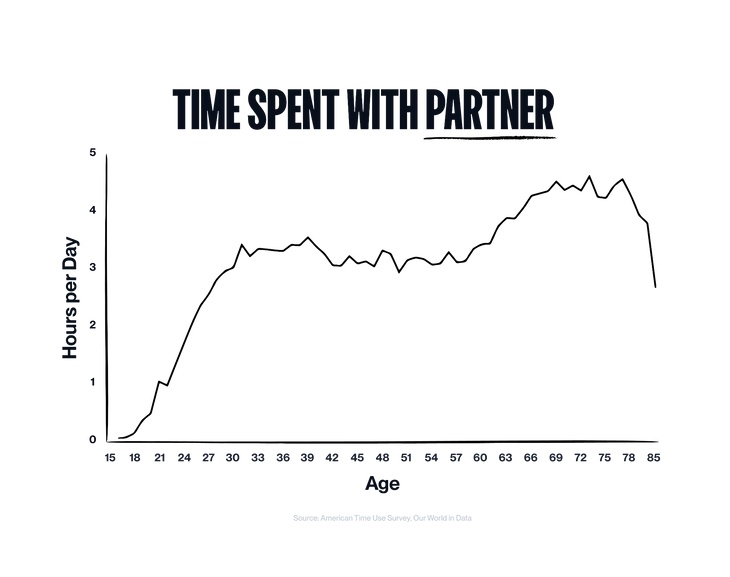
A researcher charted how we actually spend our time. The patterns are stunning, a little brutal, and might change how you live. Look at six graphs and you’ll never think about your time the same way again.
Writer Sahil Bloom pulled data from the American Time Use Survey and charted how we actually spend our hours across the key relationships in our lives. The patterns are striking, sometimes uncomfortable, and impossible to ignore. Here’s what they show, and what you can do about it.
1. Your Family: A Clock That’s Already Ticking The data shows something heartbreaking: your time with parents and siblings peaks when you’re young, then falls off a cliff after age twenty. Here’s the reality check, if you’re in your thirties and your parents are in their sixties, and you see them maybe five times a year, you’ve got perhaps one hundred to one hundred fifty visits left. Total. Ever. That’s not a lot. What you can do: Pick up the phone this week. Not because it’s someone’s birthday or a holiday. Just call.
2. Your Friends: The Window Closes Fast Friendship time hits its peak at eighteen and drops dramatically from there. You go from spending hours every day with dozens of people to squeezing in occasional dinners with a handful. The shift is massive. This is when you learn who your real friends are, the ones Bloom calls “Darkest Hour Friends.” The people who would actually show up if everything fell apart. What you can do: Identify your two to three closest friends. The ones you’d call at 3 a.m. Send them a message this week telling them what they mean to you.
3. Your Partner: The One Relationship That Grows Here’s the exception to every other curve on this list: time with your partner actually increases throughout your life. Which means this choice, who you marry, might be the most important decision you’ll ever make. And here’s what matters, you need to genuinely enjoy this person during the boring parts of life. Because most of life isn’t vacations and celebrations. It’s Tuesday nights on the couch. What you can do: Say one specific thing you appreciate about your partner today. Make it a habit.
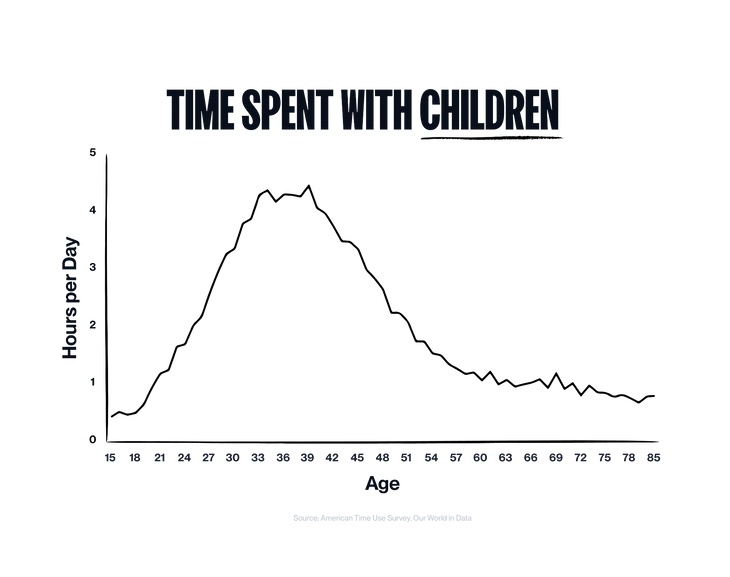
4. Your Kids: The Years That Disappear Your time with children spikes in your thirties and forties, then drops sharply when they leave home. Think about that. You’re working constantly to give them everything, but are you actually there for the moments that matter? There’s this tiny window when you’re their entire universe. Then it’s gone. What you can do: Commit to fifteen minutes of fully present time with your kids each day this week. No checking your phone. Just you and them.
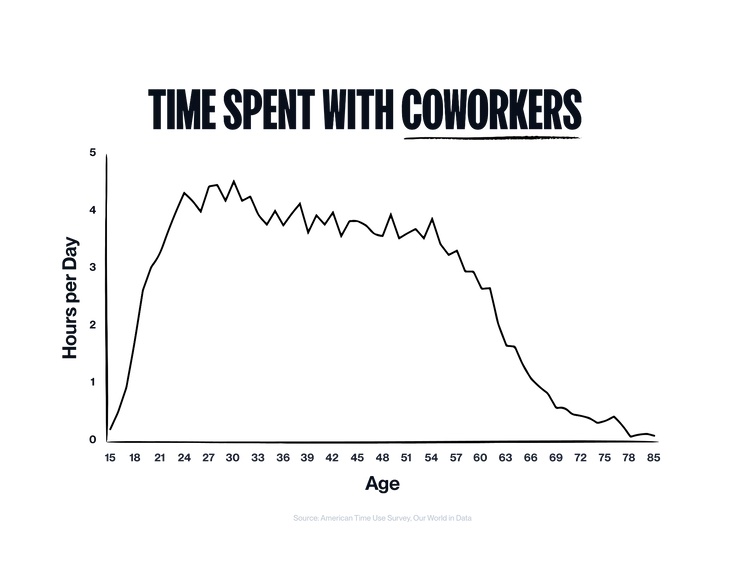
5. Your Coworkers: The Hidden Time Sink From age twenty to sixty, your time with coworkers stays consistently high. That is four decades. That’s more waking hours than you’ll spend with almost anyone else in your life. So the question becomes urgent, do these people energize you or drain you? Are you proud of what you’re building together? What you can do: Get honest with yourself. Do you gain energy from your coworkers? If not, maybe it’s time to consider a change.
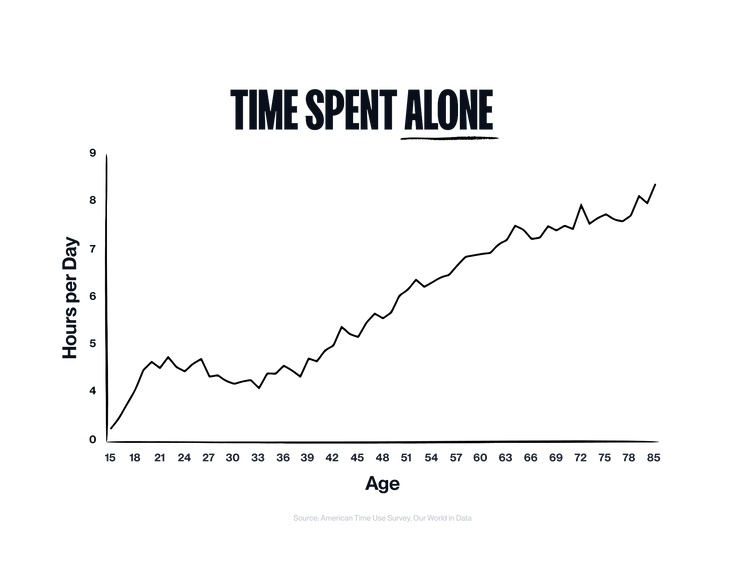
6. Being Alone: The Curve That Keeps Rising Time spent alone increases steadily throughout your entire life. When you’re young, this feels like a problem to solve. As you get older, it becomes your reality. The question isn’t whether you’ll spend more time alone. You will. The question is, are you comfortable with yourself? Can you be alone without needing constant distraction? What you can do: Practice being bored. Put your phone away for fifteen minutes each day. Just sit. Just walk. Get used to your own company.
What This Means for You These patterns aren’t inevitable. They’re just what happens when you live on autopilot. These graphs are offering a chance to see the default path clearly, so you can choose something different. You can call your parents more often while you still can. You can protect time for your real friendships. You can choose work that gives you energy instead of draining you. You can put down your phone during the precious years your kids actually want you around. The curves will shift no matter what. That’s not in your control. But you can influence their shape through the choices you make today. What will you do differently now that you see the pattern?
Some of the most popular fashion brands today were founded by proud, committed Jews
Dr. Yvette Alt Miller
Everyone knows fashion designers Ralph Lauren, Calvin Klein, and Donna Karan are Jewish. But some of today’s most sought-after brands were also founded by Jews you might not know about. Here are the innovators behind a few of the most popular high-end labels.
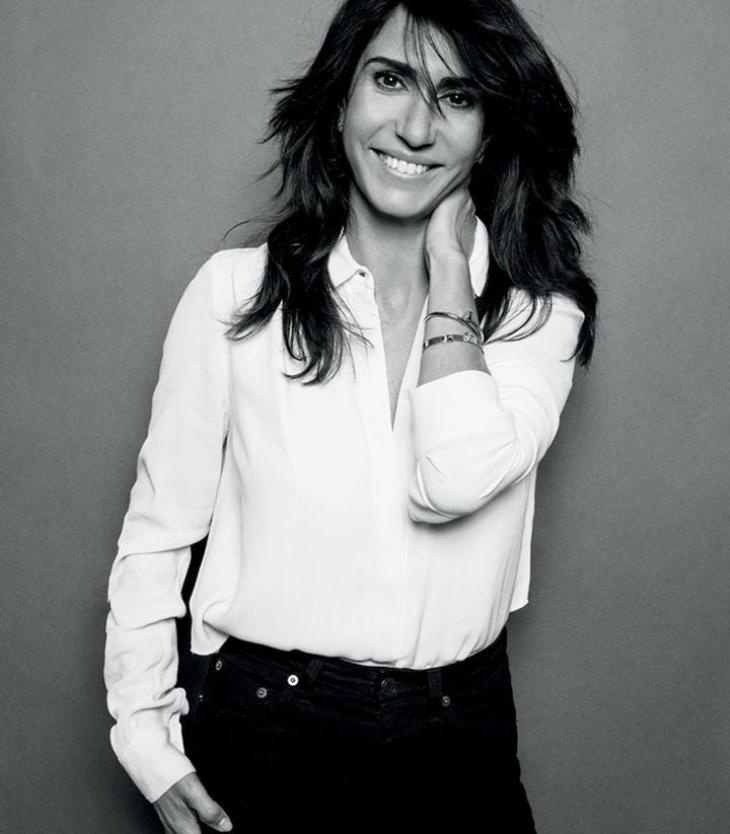
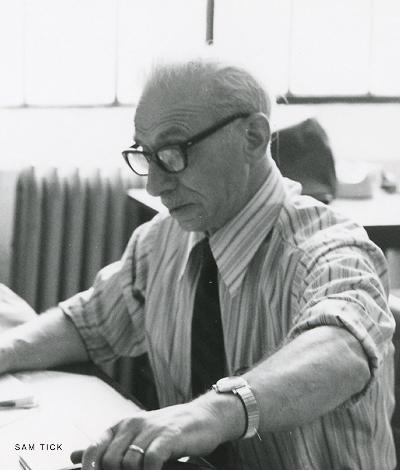
Evelyne ChetriteGabrielle Hanoka AghionDavid ReissAlexandre, Laurent, and Rafael ElichaJoyce AzriaJudith MilgomSam Tick
Chloé This iconic French brand was founded by Gabrielle Hanoka Aghion, an Egyptian Jew who moved to Paris in 1940 and democratized fashion by inventing “ready to wear” (pret a porter) clothes, designing and selling to middle-class women who didn’t have the time or money for custom couture. Born in 1921 in Alexandria, Gabrielle grew up loving fashion. Her father managed a cigarette factory; her mother was fascinated by clothes and encouraged Gabrielle to design and sew her own. “There are these really beautiful images of her playing at the beach in these really lovely light dresses,” explained Kristina Parsons, a curator at the Jewish Museum in New York, which ran an exhibit on Gabrielle. “I think that outdoorsy, very casual, easy approach to living was something that she carried into her designs.” Gabrielle met her husband, the Jewish Egyptian artist Raymond Aghion, when they were children in school; they married at 19. Together they engaged in Resistance activity during World War II, then moved to Paris in 1945, socializing with artists including Picasso and other intellectuals. Raymond opened an art gallery. Gabrielle began sewing dresses and in 1952 founded Chloé, borrowing the name from a friend because she thought it sounded more French and appealing to customers. “All I’ve ever wanted was for Chloé to have a happy spirit, to make people happy,” she said. In the 1960s, Chloé gave a young unknown designer his break, hiring Karl Lagerfeld as house chief designer after Gabrielle stepped away. She sold the brand in 1985 and passed away in 2014 at 93.
Maje and Sandro Sandro and Maje are both French brands, both fashion-forward, and both founded by sisters: Evelyne Chetrite launched Sandro in 1984, and Judith Milgom launched Maje 14 years later. The sisters grew up in the tight-knit Jewish community of Rabat, Morocco. Their family moved to Paris when Evelyne was 15 and Judith was 10. Evelyne learned the fashion business from her husband Didier, a fellow Jew who worked in Paris’ tailoring Sentier district, and launched Sandro to fill a gap in the market: high-fashion, classic French style at accessible prices. Judith worked for her sister and brother-in-law during teenage summers, then launched Maje in 1998 with a younger, more girlish aesthetic. The name is an acronym for their family: Moyal (Judith’s maiden name), Alain (her brother), Judith, and Evelyne. In 2009, the sisters jointly acquired the brand Claudie Pierlot. Both Judith and Evelyne, along with their large families, make a point of sharing Shabbat dinner every week. They start planning Friday night’s meal on Tuesday. In a 2012 interview, Judith described her commitment to not working on Shabbat: “About 20 years ago, I started to observe the Jewish Sabbath really seriously. From dusk on Friday until dusk on Saturday, I don’t do any work, don’t shop or look at my email or phone. It’s unbelievably therapeutic.”
The Kooples This prestigious label was founded in 2008 by three Orthodox Jewish French brothers: Alexandre, Laurent, and Rafael Elicha. “The Kooples” is the French pronunciation of the English word “couples;” ads feature real-life couples wearing the brand. Alexandre has said that “love is really the essence, the philosophy of the brand,” and credits his wife Charlotte, whom he met in Israel, as his muse. The brothers grew up with front-row seats to the French fashion world. Their parents, Tony and Georgette Elicha, founded the brand Comptoir des Cotonniers in the 1990s. “Our parents were amazing teachers and through them, we got great experience and contacts,” the brothers have said. But their parents also gave them something more enduring: a love of Judaism and a sense of responsibility to lead the French Jewish community, even when it’s hard. Tony led the Jewish community in Toulouse for years and served as Vice President of the Consistoire de Paris, an umbrella group for French Jewish organizations. In 2013, Alexandre became administrator of the Consistoire, running France’s large Jewish community while also running The Kooples. His brothers helped shoulder the business. The three families celebrate Shabbat and Jewish holidays together and even vacation together. In 2012, Alexandre became president of the Ohr Hatorah school in Toulouse, after it became the site of one of the worst terror attacks on French soil. On March 19, 2012, an Islamist terrorist ambushed children and staff entering the Orthodox Jewish school and opened fire. He murdered Rabbi Jonathan Sandler, who was trying to shield his two young sons, then killed them: Arie, age five, and Gabriel, age three. He then shot eight-year-old Myriam Monsonego, the school principal’s daughter, in the head. He also shot and severely wounded Bryan Bijaoui, a 17-year-old student. Alexandre remains close friends with the principal, Rabbi Yaacov Monsonego, and is devoted to strengthening Jewish education in Toulouse and beyond. Shabbat, Alexandre has said, is the cornerstone of his week. “Life is so magic… Shabbat is a good way to take time and think about what you’re doing in this world.”
Reiss David Reiss grew up in a traditional Jewish family in London and attended an Orthodox school. In 1965, he took over his father Joshua’s tailoring business in the East End, once a deeply Jewish neighborhood. “I had this entrepreneurial spirit and I suppose retail was in my blood,” he has said. He opened the first Reiss store in 1971, aiming to fill the gap between expensive designer menswear and cheap, poor-quality clothes. The brand offered elegant tailoring at accessible prices, took off quickly, and expanded into womenswear and stores worldwide.
Canada Goose This beloved brand started in 1957 when Samuel Tick, a poor Polish Jewish immigrant to Toronto, was working as a fabric cutter and decided to try making high-quality winter coats. He called the company Metro Sportswear and supplied parkas to better-known retailers, who put their own labels on the garments. In time, Samuel began selling directly to consumers under the name Snow Goose. The parkas quickly earned a loyal following: Canada’s Arctic Rangers, scientists at McMurdo Station in Antarctica, Ontario police officers, and Laurie Skreslet, the first Canadian to summit Mount Everest, who wore one on his climb. They all valued the coats’ extraordinary resistance to cold. Samuel’s son-in-law David Reiss eventually took over, followed by his son Dani Reiss, who became CEO in 2001 at 27, fresh out of the University of Toronto where he’d studied literature and philosophy. He had no plans to run the family business long-term and knew he was young and inexperienced. He proved to have a sharp instinct for business anyway. He renamed the company Canada Goose and began marketing the coats not just to outdoor workers but to city dwellers. The brand became a global phenomenon worn by celebrities worldwide.
Avec Les Filles Avec Les Filles, French for “With the Girls,” is focused on dressing Millennial women. It’s the creation of Joyce Azria, an Orthodox Jewish designer and entrepreneur based in Florida. Joyce learned fashion from her father, legendary designer Max Azria, who founded BCBG. After running BCBG, she stepped back to focus on her family. She and her husband Ilan Trojanowski have seven children. She launched Avec Les Filles in 2017 with the goal of bringing French-inspired style to a wider audience. “I love Sandro, I love Maje,” she said at the time, “but they are so high-end that I thought, ‘I want a brand that brings me in at 18 bucks and is a little easier to digest. What I strive to do with Avec les Filles is allow customers to indulge in an experience that’s designer-led and authentic, but still feels playful.” Growing up, Shabbat dinner was a central family ritual for Joyce. She made sure it remained the cornerstone of her own family’s week too. Despite running an international business, she insists what truly brings her joy is family and spirituality. “On Shabbat, I leave behind the business world and focus on my family and my relationship with G-D. I am fortunate that I’m not a slave to my work.”
Teri Jon This upscale American brand has an international origin: its founder and chief designer, Rickie Freeman-Platt, was born in Israel and draws inspiration from the real lives of her customers, guided by the belief that “every woman should have the opportunity to look great no matter what size or body shape she has.” Rickie moved to New York at 17 and worked for Jewish fashion designers Evan Picone and Elie Tahari before founding Teri Jon in 1978, a high-fashion brand specializing in special occasion dresses. An intensely private person, Rickie rarely gives interviews. Her philanthropy speaks for her. A board member of Stern College for Women, she opens her home and business to Jewish charities and actively campaigns for Jewish and Zionist causes.