AS SUMMER BREAK APPROACHES, PARENTS AND EDUCATORS EXPRESS CONCERNS ABOUT “SUMMER LEARNING LOSS,” (SLL) A PHENOMENON WHERE STUDENTS EXPERIENCE A DECLINE IN ACADEMIC SKILLS. THIS DECLINE, ALSO KNOWN AS THE “SUMMER SLIDE,” CAN BE ADDRESSED THROUGH PROACTIVE MEASURES AND ENGAGING ACTIVITIES.
UNDERSTANDING SUMMER LEARNING LOSS SLL refers to the decline in academic skills and knowledge that occurs during the summer break. Studies have shown that without engaging in educational activities, students may lose several months’ worth of progress, resulting in setbacks when they return to school.
EFFECTS OF SUMMER LEARNING LOSS The effects of summer learning loss can be significant, leading to decreased academic performance, lower confidence, and reduced motivation. Over time, this can create an achievement gap between students with access to educational resources and those without. Addressing this issue requires collaboration among parents, educators, and communities. COMBATTING SUMMER LEARNING LOSS
Encourage Reading Reading is a powerful tool to combat summer learning loss. Encourage your child to read regularly, whether it’s books, magazines, or online articles. Create a cozy reading nook at home and set aside dedicated reading time (at least 20 minuets) each day.
Explore Summer Programs Look for summer programs or camps that offer educational opportunities. These programs provide engaging and interactive activities aligned with school curricula, allowing children to learn while having fun.
Visit Museums and Libraries Regularly visit local museums, libraries, and cultural centers. These institutions often offer summer reading challenges, workshops, and exhibits that enhance your child’s learning experience.
Set Learning Goals Collaborate with your child to set learning goals for the summer. Break these goals into manageable tasks and create a schedule to track progress. Celebrate achievements along the way to maintain motivation.
Embrace Technology Leverage educational apps, online resources, and interactive learning platforms to supplement your child’s learning. Many websites offer engaging educational games and activities across various subjects. Here are a few websites that we recommend:
Engage in Everyday Learning Learning opportunities exist in everyday activities. Involve your child in cooking, gardening, or DIY projects to develop their math, science, and problem-solving skills. Encourage discussions about current events to foster critical thinking and communication skills.
Support Social and Emotional Learning Summer is an excellent time to focus on your child’s social and emotional well-being. Encourage engagement in activities that build empathy, teamwork, and resilience. This can include joining community service projects, participating in team sports, or engaging in creative arts.
Foster a Love for Learning Make learning enjoyable by incorporating hands-on activities, field trips, and educational games. When children find joy in the learning process, they are more likely to retain information and develop a lifelong love for learning.
By encouraging reading, exploring educational programs, visiting cultural institutions, and fostering a love for learning, parents can help their children maintain and enhance their academic skills during the summer break. Learning doesn’t have to stop when school ends; it can be a year-round adventure that paves the way for future success. Let’s work together to ensure our children return to school ready to thrive and reach their full potential.
Ruchi (Eita) Feller is the Educational Director at Yes I Can.
Hacham Yom Tob Yedid lived an epic life of courage and devotion through his decades as Chief Rabbi of the glorious Halab (Aleppo) community. As the community’s leader during its last days, he courageously faced challenges, torture, and threats. Amidst the confusion and turmoil, Hacham Yom Tob had the enormous responsibility of keeping his community devoted to Torah and tradition. And he accomplished the impossible: Halab remained as it had for centuries, a city where everyone kept Shabbat, prayed in the Bet Knesset, and stayed connected to Torah. How did he do it? How did a young man, thrown into a role with great responsibility, respond so fearlessly, demonstrating wisdom and leadership well beyond his years? The ArtScroll biography For the Sake of Heaven takes us on an epic journey from Halab of old to tree-lined Brooklyn streets. With its fascinating twists and turns, this is a biography that reads almost like a novel, leaving us awed as we see so clearly the impact of one who devotes his life to teaching and studying Torah. In this Inside ArtScroll interview, Rabbi Meyer Yedid, son of Hacham Yom Tob, speaks about his father’s incredible story of heroism, courage and the power granted to one who is totally devoted to Torah.
Two Jewish Families Created the Iconic Jewelry Company
Dr. Yvette Alt Miller
Van Cleef & Arpels is one of the world’s top luxurious jewelry brands, with an annual revenue of over half a billion dollars and nearly 200 stores worldwide, servicing Hollywood stars and royalty for over a century. But few know the company’s Jewish history, and how its owners endured the Holocaust and rebuilt after World War II.
Alfred and Esther Van CleefRachel Van CleefAlfred
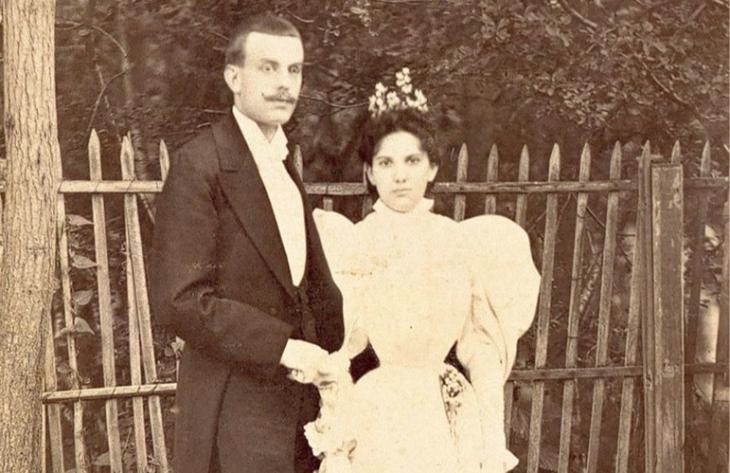
In the “Belle Epoque” of the 1890s, Paris was the world’s most fashionable city. Creative artists and artisans flocked there to ply their trades and create the most up-to-date styles. Among the jewelers who opened workshops was a young Jewish goldsmith and stone cutter from the Netherlands, Alfred Van Cleef. Born in 1873 into a family of Dutch Jewish jewelers, Alfred learned how to cut precious gems from his father Charles. Alfred completed an internship in jewelry-making, then immediately moved to Paris to open a workshop of his own there. He was welcomed to Paris by the close-knit world of Jewish gemsmiths, including a friendly middle-aged cousin of his, Leon Salomon Arpels. Alfred and Leon Salomon’s daughter, Esther, fell in love, united in part by their love of high style and interest in jewelry-making. They married in 1895 and gave birth to a daughter, Rachel, in 1896.
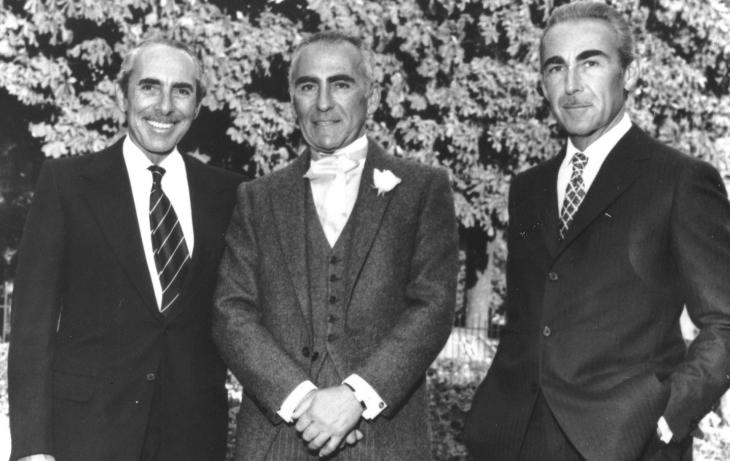
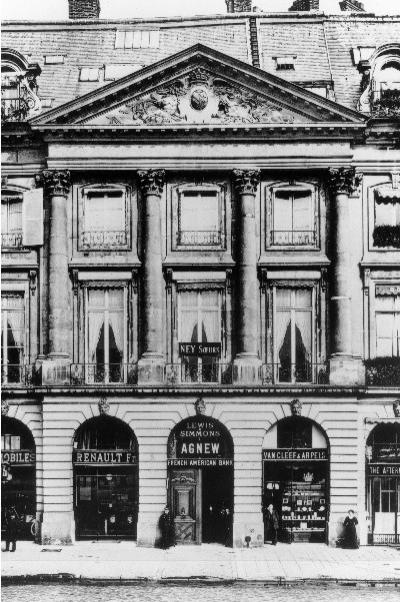
Hotels Parc et MajesticClaude, Jacques, and Pierre Arpels circa 1975Their first boutique on 22 Place Vendome, circa 1906
Alfred opened a cutting-edge jewelry atelier in Paris’ gritty 10th Arrondissement along with his new brothers-in-law, Charles, Julien, and Louis Arpels. Their beautiful pieces and exquisite settings earned them a loyal following, and soon the young jewelers began looking for a larger space in a more fashionable quarter of Paris in which to work. When the Ritz Hotel opened in the Place Vendome in 1898, Alfred and Esther, now going by the less Jewish-sounding name Estelle, decided to move to this newly fashionable square. They opened a larger store at 22 Place Vendome, which remains the center of the Van Cleef & Arpels empire to this day. They first focused on pearl jewelry, which was all the rage at the time. Soon, their impeccable gem settings began attracting notice and a loyal customer base. Decorated During World War I The Van Cleef and Arpels served with incredible bravery during World War I. Louis Arpels enlisted in a Field Artillery Regiment and fought in Verdun, among other battles, before being injured by poison gas and decommissioned. Louis Arpels fought with distinction. Estelle worked as a nurse. Alfred Van Cleef, who was in poor health, worked for the army’s auxiliary service in Paris. After the war, Alfred Van Cleef, Estelle Van Cleef, Louis Arpels, and Charles Arpels were each awarded France’s Legion d’honneur. During World War I, Van Cleef & Arpels produced jewelry out of cheap materials, eschewing finery during wartime. They introduced a wildly popular “touch wood” collection, combining decorative pieces made out of wood with a popular belief in France at the time that touching wood somehow brought good luck. When World War I ended, the company switched gears, expanding and emphasizing luxury for a population that was weary of austerity and craved expensive trinkets.
Creating France’s Iconic Style In the 1920s, Van Cleef & Arpels opened new stores in fashionable holiday destinations such as Nice and Monte Carlo. The company embraced the new Art Deco style and sold to actors and royalty. It introduced one of the first ladies’ wristwatches in 1923. In 1933 they introduced a cutting-edge way of creating invisible settings so that jewels appear to be floating on top of jewelry. In 1939 they introduced a wildly popular piece that could be used as a necklace, belt, or broach. In 1939, Van Cleef & Arpels created a priceless diamond and platinum set of jewels for Egyptian Princess Fawzia’s marriage to Mohammed Reza Pahlavi, who became the Shah of Iran. Other fans included King Edward VII of England, who bought Van Cleef & Arpels jewelry for his paramour Wallace Simpson. In 1926, Alfred and Estelle’s daughter Rachel Van Cleef took over as Artistic Director of the thriving company. By now, the Van Cleef family was intermarrying into non-Jewish French and European high society. Rachel ditched her Jewish-sounding name and went by Renee. She was briefly married to Emile Puissant, a dashing racecar driver, until his death in a crash in 1926. Renee threw herself into her family business, guiding its expansion and ensuring that Van Cleef & Arpels remained on the cutting edge of jewelry design.
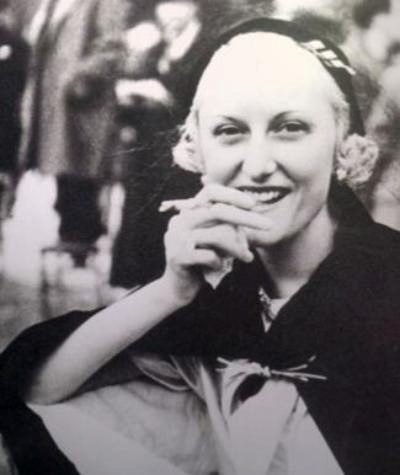
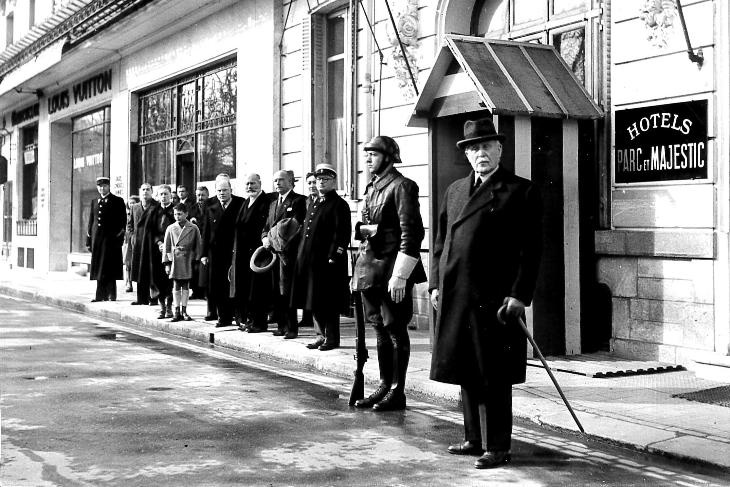
During the Holocaust With antisemitism rendering life for Jews in France ever more difficult, the Arpels brothers who ran the company opened a branch in New York in 1939. (Often sickly, Alfred Van Cleef had died the year before.) The move to New York saved their lives. Other members of the Arpels family were living in the southern French city of Vichy when World War II broke out. Estelle Van Cleef assumed a false identity and worked secretly for the Free French resistance forces, which commended her after the war. The only family member still living openly in Paris was Estelle’s daughter Renee, who worked to keep the store open amidst the chaos and death all around her. German troops arrived in Paris on June 14, 1940. Under Nazi rule, it became impossible for Jews to own businesses. In 1941 Renee transferred ownership of Van Cleef & Arpels to a French nobleman, Comte Paul de Leseleuc, in order to “aryanize” the company and enable it to stay in business. Renee secretly packed the most valuable pieces in the Paris store into a suitcase – it weighed almost too much to carry – and travelled to Vichy, which by then was the seat of France’s collaborationist government. Renee rented a suite of rooms in Vichy’s best hotel, the Hotel Parc et Majestic, which also housed Marshal Petain, the Prime Minister of Vichy France, the French republic which governed the south of France and actively colluded with the Nazis. Renee was used to socializing with people at the very pinnacle of French society, and was sure her friends would protect her from the anti-Jewish decrees that targeted her co-religionists. She was sadly disappointed. At first, Vichy officials forced Renee to move out of her fancy hotel, refusing to countenance a Jew living in the same building. Renee took daily walks and worked in her company’s Vichy store, maintaining a semblance of normality. In 1942, however, Nazi Germany took control of Vichy France directly. Renee appealed to her father’s old friend Colonel Rene Marty (who had signed her uncle’s Legion d’honneur certificate after World War I), who was living in Vichy, to help her to no avail. Renee’s old friend Arlette Scali described: “She could not cope with all the goings-on, all the laws, and had been counting on Colonel Marty, the trusted administrator of her father, Alfred Van Cleef…. She was not only frightened, she was sick with fright.” (Quoted in Les Parisiennes: How the Women of Paris Lived, Loved, and Died Under Nazi Occupation by Anne Sebba: 2016.) On December 11, 1942, all Jews in Vichy France were ordered to wear a Jewish star on their clothes. The following day, French police burst into her third-floor hotel room; whether they were seeking to question her or arrest her will never be known. Panicked, Renee threw herself from the window and died on the pavement below.
Becoming a Ubiquitous Brand The Arpels family regained control of Van Cleef & Arpels in 1944 after the Allied liberation of Paris. Julien Arpel’s sons Claude, Jacques, and Pierre became directors. They continued to innovate, introducing playful animal and floral styles into the brand’s jewelry design. In 1956, Prince Rainier of Monaco bought a set of diamond and pearl jewelry as a wedding present for his fiancé Grace Kelly, giving the brand another boost to its growing prestige. In 1967, the Empress Farah Pahlavi of Iran flew Van Cleef & Arpels artisans to Iran to create a crown and necklace for her coronation made with gems from Iran’s crown jewels. The last Arpels family members to lead the business would be Jacques Arpels’ children Philippe and Dominique in the 1990s. In 1999, the brand was sold to the Richemont Group, a Swiss corporation that owns many luxury brands. Little memory remains of Van Cleef & Arpels’ Jewish origins. The company offers no Jewish-themed Stars of David or other Jewish designs. Among the company’s scores of boutiques around the world, not one operates in Israel.
Honest Answers, With Practical Steps Husbands Can Start Using Tonight
Debbie Gutfreund
Every woman is different, but there are some things nearly all women want from their husbands. Here are six of them.
To Feel Emotionally Safe Women want a husband who listens without judging, dismissing, or jumping straight to fixing the problem. They want to know their feelings matter. What you might hear, “Can you listen to the whole story?” “I don’t want advice. I just want you to understand how I feel.” What you can do: Make eye contact, put your phone away, and validate what she’s feeling. Ask how you can support her today.
To Feel Prioritized Women want to feel truly seen every day and to know their husbands are consistently investing in the relationship. They want to feel, “You matter to me.” What you might hear, “Can you call me if you’re running late?” “Can we talk for a few minutes?” “Can you help me with this?” What you can do: Look for chances to help. Check in on how her day went. Schedule date nights or daily walks together.
Respect and Kindness Women are sensitive to harsh tones, especially during disagreements. They want to be treated with courtesy, respect, and kindness. Jewish wisdom teaches, “A man should honor his wife more than himself” (Talmud, Yevamot 62b). What you might hear, “Why are you talking to me like that?” “I wish you’d give me the benefit of the doubt.” “Would you talk to a friend that way?” What you can do: Speak gently, skip the sarcasm, and only correct each other in private. Ask for her opinion, make big decisions together, and value her ideas even when they differ from yours.
Affection Without an Agenda Sometimes women just want affection, no strings attached. They want to hold hands, hear a genuine compliment, and share touch that isn’t about sex, physical affection that expresses love, not just desire. What you might hear, “Can you just hold me for a while?” “Can you hug me just because?” “I don’t always want something to happen afterward.” What you can do: Hold hands while walking or driving. Kiss her hello and goodbye. Sit close on the couch. Put your arm around her, just because.
Healthy Communication Women want open, honest conversations with their husbands, ones that work through conflict instead of avoiding or escalating it. They want a relationship where both partners own their mistakes, forgive, apologize, and never take each other for granted. What you might hear, “Can we talk about what’s really going on?” “Please tell me what you’re thinking.” “I want us to be able to talk without it turning into a fight.” “I’d rather you tell me you’re upset than pretend everything’s fine.” What you can do: Share your thoughts even when it’s hard. Listen without getting defensive. Ask questions instead of assuming. Work toward a solution instead of trying to “win.”
Shared Growth and Purpose Women want a relationship built on more than logistics; they want to build a life together, shared values, family traditions, common dreams, and mutual encouragement to grow. What you might hear, “I don’t want us to get stuck in a routine.” “What goals can we work on together?” “Can we make time for what matters most to us?” “I want us to inspire each other.” What you can do: Learn something new together. Go to synagogue as a family. Volunteer or set goals together. Encourage each other’s growth. A strong marriage is built on the daily choice to keep showing up for each other. Jewish wisdom teaches that where there is love, G-D’s presence can be felt. Understanding what your wife truly wants doesn’t just strengthen your marriage; it brings more light into the world.
For a dentist, the statistics are frustrating, only 2 percent of the population flosses on a daily basis. For those who do floss, most are doing it wrong, and rather than helping, they are causing damage. Holding the floss the wrong way or pressing on the gums with the floss may tear the delicate ligament around the tooth that seals out the bacteria from damaging the bone.
If you are going to floss, make sure you follow three rules. 1) Use your middle fingers as the “spool” to wrap the floss around. This will give you the most control. 2) Use your thumb and pointer to work the floss between the teeth. This prevents the floss from snapping into the gums, which would cause a lot of damage. 3) Don’t press on the gums, lean on the tooth. The bacteria stick to the teeth, not the gums. When I ask, “How do you clean between your teeth?” most people will answer, “I brush.” I then explain that brushing is critical to clean at the gumline but it won’t remove the bacteria that hide between your teeth. For that you need either dental floss, Waterpik, RotoPoints, Proxabrush, Sulcabrush, or any other tool designed to get the bacteria that your brush can’t reach. Those people who tell me they do floss will readily admit, “Well not every day. I floss maybe once or twice a week.” It’s important to remember that bacteria accumulate every day. If you clean between your teeth only once or twice a week, the bacteria will build up, causing gum disease and cavities (and then you’re surprised when you need a root canal or gum surgery!). Another thing that surprises me is that many patients will say, “I’m too tired at night to do anything. I only brush in the morning.” Too bad for this group since bacteria do the most damage to teeth and gums while you sleep. The saliva is less effective while you sleep and the bacteria are much more damaging. This is why it’s so important to brush and clean between your teeth every night. Because it is so difficult to floss effectively and without causing damage, I usually recommend the Waterpik. Studies have shown that it is easier for patients to use and we see our patients greatly improve the condition of their gums and also eliminate cavities. If you decide that you want to be in the 2 percent minority that flosses every day, make sure that you do it correctly. If you think that brushing alone will do the trick. Think again. We see patient after patient with gum disease and cavities that could have been prevented with a few minutes of “homework” every night. It’s daily cleaning that will prevent damage and help you keep your teeth for a lifetime. In addition, the medical journals are loaded with repeated studies that show that people with gum disease are more prone to heart disease, stroke, Alzheimer’s, and diabetes. Isn’t your health worth a few minutes a day? Dr. Doueck’s office is located at 563 Kings Highway. For more information or to schedule an appointment, please call 718-339-7982.
The holidays are supposed to be a time of celebration, family, tradition and connection. Yet for many people, they also bring something else, food guilt.
After several large meals, desserts, challah and a schedule that looks nothing like your normal routine, it is easy to wake up thinking, “I ate way too much. I need to be good today.” So you skip breakfast. You promise yourself no carbohydrates. You decide you need an extra-long workout. You step on the scale and immediately regret it. But what if the healthiest thing you could do after eating more than usual was simply go back to eating normally? As a dietitian who specializes in eating disorders and helping people develop a healthier relationship with food, I see this pattern all the time. The problem usually isn’t the holiday meal itself. It’s what happens afterward. We overeat, feel guilty, restrict to compensate, become overly hungry, eat more than we intended again and then feel even more guilty. That is how the restrict-overeat cycle begins. One meal, one day or even several days of eating differently do not undo your health. Your body is much more adaptable than we give it credit for. You may feel bloated after the holidays. Your clothes may feel tighter. The number on the scale may even be higher. That doesn’t mean you’ve suddenly gained several pounds of body fat. Restaurant meals, salty foods, carbohydrates, desserts, changes in digestion and simply having more food in your system can all temporarily affect your weight and how your body feels. You don’t need to punish your body for celebrating. Instead of asking, “How can I undo what I ate?” ask, “What does my body need today?” Usually, the answer is surprisingly simple. Eat breakfast. Drink water. Have balanced meals. Include vegetables, protein, fat and carbohydrates. Move your body because it feels good, not because you are trying to erase last night’s dinner. Most importantly, don’t save up your calories for the next holiday meal. Going into a large meal overly hungry often makes it much harder to listen to your body’s cues. Eating regularly throughout the day allows you to arrive at the table hungry, but not ravenous. And when you are sitting at that holiday table, enjoy it. Have the foods that are meaningful to you. Have challah. Have dessert if you want it. You don’t need to make every holiday recipe “healthy” in order to be healthy. Health is not determined by one meal. This is especially important for our children to see. They are listening when we announce that we were “bad” because we ate dessert. They notice when we skip meals after a holiday. They hear us criticize our bodies. Imagine instead what they could learn from hearing, “Dinner was delicious. I really enjoyed it.” And then watching us eat breakfast the next morning. As we move through the Jewish holidays, there will be many meals and many opportunities to enjoy food. Let them be meals, not tests of your willpower. You don’t need to earn your food before the holiday, and you don’t need to compensate for it afterward. Enjoy the holiday. Enjoy the traditions. Enjoy the people sitting around your table. Then, at the next meal, simply eat again. That is what a healthy relationship with food looks like. Wishing everyone a healthy and happy New Year!
On Rosh Hashana, we dip apples in honey and pray for a sweet year ahead. A few days later, many of us walk to a body of water for tashlich, and empty our pockets of bread crumbs, a small physical ritual for something much harder. Releasing what we’ve actually been carrying. I think about tashlich often in my work, because so much of what I do with the people who sit across from me is exactly that. Helping them empty their pockets of years of food rules, body-checking, and guilt that never once kept them safe, and that they’re finally ready to put down.
The shofar is supposed to wake us up, a call to pay attention before the year moves on without us. But for a lot of the people I see, what actually wakes them up this time of year isn’t the shofar. It’s the sound of their own stomach after twenty-five hours without food. It’s the quiet in the car on the way home from a family meal, where nobody says out loud what everyone was thinking while the food was on the table. It’s a comment about someone’s plate, or someone’s body, made lightly, that lands and stays for days. I think about the men in their cars, because they’re so rarely the ones anyone asks about. Many of the men I work with have spent years quietly overeating, managing stress, exhaustion, and pressure through food, without ever having language for what they were doing or permission to talk about it. More of them lately are coming in already on a GLP-1 medication, prescribed by a doctor who is treating a number on a chart. That’s a legitimate medical decision, and not mine to question. But a medication that quiets appetite doesn’t teach anyone how to sit with a hard feeling without needing to eat it away. That’s a different kind of work, and it’s the work we do together, whether or not there’s a prescription involved. For the women I work with, the pattern often looks different but comes from the same place. Bingeing, bulimia, a private cycle of overeating followed by an attempt to undo it. Yom Kippur can act almost like a pressure valve for this. Some people overeat in the days before the fast, as though stocking up against what’s coming. Others find that breaking the fast at the end of the day turns into something they can’t quite steer, no matter how much they promised themselves it would be different this year. I say this to every person who tells me this about themselves, and I’ll say it here too. This is not a failure of willpower. It is a pattern your body and mind learned for a reason, and patterns that were learned can be unlearned. And then there’s the exercise, the surge of it, every year around this time, as people try to outrun a holiday meal or manage their fear of a changing body by pushing harder at the gym. Healthy movement and exercise addiction can look identical from the outside. The difference lives in the why. Are you moving because it feels good in your body, or because you’re afraid of what happens in your head if you skip a day? Have you trained through pain an orthopedist told you to rest? Has a workout ever come before a holiday meal with people you love? I’ve worked alongside orthopedists treating stress fractures and worn joints in people whose real injury had nothing to do with bone or cartilage at all. The orthopedist can mend the fracture. My job is to help someone understand what that fracture was protecting them from feeling. Here’s what I want to leave you with. Recovery from emotional eating isn’t a smaller, quieter version of the problem you started with, something you manage forever instead of solve. In my years of doing this work, I have helped many, many people find real, lasting peace with food. Not a truce. Peace, the kind where a holiday meal is just a meal, where a mirror stops running the show, and where a person is finally, comfortably, living in the body they actually want to live in. That peace is attainable, and it’s permanent, in the same way tashlich is permanent, not because the current never carries anything back to shore again, but because you now know exactly how to let it go the next time it does. If any of this sounds like your table this year, I’d be glad to talk with you. I see individuals, couples, and families, and I run support groups as well, with offices in Midtown Manhattan and Highland Park, New Jersey, and teletherapy for those who prefer it. Wishing you a sweet and peaceful New Year.
A late husband, an unanswered text Five ways to stop assuming the worst about the people you love
Devora Levy
Sarah’s husband promised to be home early. Dinner was ready, the kids kept asking when their father would arrive, and then six o’clock came and went. By the time he walked in, she was disappointed and hurt. In her mind, the story had already written itself: He forgot and doesn’t care. He immediately explained: a bad accident had traffic backed up for miles. The hurt disappeared instantly. The delay was real, but the pain had come from the story she’d built around it.
We all do this. A friend doesn’t say hello and we assume she’s upset with us. A text goes unanswered and we feel ignored. Psychologists call this cognitive appraisal: our emotions follow the meaning we attach to events, not the events themselves. Ethics of the Fathers teaches: “Judge every person favorably.” It’s a practical reminder that our first read on a situation is rarely the full picture. Here are five ways to put that wisdom to work in your own relationships.
Your First Explanation Is Rarely the Only One People rarely fight about the event itself. They are usually fighting about what they believe the event means. A client felt crushed by her business partner because he had stopped including her in some early-stage emails. She became convinced that he was quietly trying to push her out of the business. The reality turned out to be completely different: he knew she was caring for an ill parent and was trying to protect her time and energy. She interpreted the fewer emails as betrayal. When she paused to ask, “Is there another way to understand this?” she discovered her partner was in fact acting with kindness and sensitivity.
The Story Creates the Feeling Your emotions respond to the meaning you give what happens. A friend doesn’t text back for several hours and your immediate thought is, She’s ignoring me. You will naturally feel hurt, anxious, or defensive. If your thought is, She’s probably busy and will answer when she can, your emotional experience will be completely different. The situation hasn’t changed; only the interpretation has. Before you let a feeling determine how you respond, it’s worth examining the story underneath it. Your feeling may be real, while the explanation you attached to it may not be.
You Collect Evidence for What You Already Believe Once you settle on a fixed narrative about someone, that a spouse is inconsiderate, a teenager is irresponsible, or a colleague is difficult, your mind naturally begins to search for proof to support that belief. A forgotten errand, a delayed text, a minor mistake, suddenly everything gets folded into the same ongoing argument in your head. You stop seeing individual moments and start seeing people through a rigid lens. You stop responding to the actual person in front of you and begin reacting to the version of them you have created in your mind. Judging favorably allows us to keep people open and complicated. It reminds us that one moment does not define an entire person.
Judging Favorably Doesn’t Mean Ignoring Reality Some people worry that giving others the benefit of the doubt means ignoring red flags, denying your feelings, or excusing genuine harm. That is not what the Torah is demanding. Judging favorably means separating facts from the conclusions you quickly add to those facts. The fact: They didn’t call back. The story: I don’t matter to them. The fact: They spoke sharply. The story: They don’t respect me. Sometimes the difficult story will turn out to be true. Sometimes people really do make mistakes, act carelessly, or hurt you. But leaving room for another possibility before jumping to conclusions is recognizing that you almost never have the complete picture of what is happening inside another person’s heart.
The Story You Choose Shapes the Relationship You Build The interpretations you believe influence your tone, your body language, and how willing you are to listen. When you approach someone assuming good intentions, something changes. Your voice softens, your curiosity grows, and you become less focused on proving your point and more interested in understanding the other person. People can sense whether they are being approached with suspicion or with trust, and they often respond accordingly. Of course, relationships require honesty. Sometimes conversations need to happen, boundaries need to be set, and difficult truths need to be addressed. But there is a big difference between responding to reality and reacting to an assumption. The next time you feel a sudden surge of frustration or hurt, try asking yourself two simple questions: What are the objective facts here? And what is the story I am adding to those facts? That small pause may be the difference between reacting to a story and responding to a person. And often, that is where kindness, understanding, and stronger relationships begin.
Optimism is a skill you can build. Here are seven research-backed steps to train your brain toward hope, resilience, and a better outlook on life.
Most of us are not naturally optimistic. When life gets difficult, our minds often jump to worry, self-criticism, or the belief that one bad moment predicts a bad future. But psychology research finds something encouraging. Optimism is not a fixed trait. It is a learnable skill, shaped by the way you interpret events, the habits you practice, and the thoughts you choose to strengthen. This coincides with Jewish tradition. The idea of gam zu l’tovah (“this too is for good”) is a mindset that inspires us to look for the good in every situation, even when the circumstances feel disappointing. Optimism matters. People who think optimistically recover faster from setbacks, persevere longer, and feel more capable of shaping their lives. Optimism supports emotional resilience, improves relationships, and even benefits physical health. This is different from toxic positivity. Toxic positivity insists on being happy at all costs. It tells you to “look on the bright side” even when you are hurting. It shuts down emotional honesty. Optimism, by contrast, acknowledges your difficulties, but emphasizes interpretations that support your healing and growth, not your denial. Here are seven steps to a more optimistic mindset.
Change Your Explanatory Style for Negative Events The way you explain setbacks to yourself has a big impact on how you feel about your life. A pessimistic explanation treats problems as permanent, pervasive, and entirely personal. An optimistic view sees them as temporary, specific, and influenced by many factors. Imagine someone who makes a mistake at work and immediately thinks, “I always mess things up.” That interpretation drains their motivation. A more optimistic interpretation is, “I struggled today, but tomorrow I can try again.” Tip. When something goes wrong, ask yourself whether you are exaggerating its impact on your life, the role you played, or how long it will last.
Spend Time With Positive People Optimism spreads through social contact with others. When you spend time with people who see their lives with hope and positivity, their mindset influences yours. Think of a friend who responds to challenges with problem-solving instead of panic. Being around that person changes your own reactions. The people you surround yourself with shape your inner world. Tip. Notice who leaves you feeling more hopeful and who leaves you feeling depleted, then adjust your time with them accordingly.
Imagine a More Positive Future One of the most effective optimism exercises is imagining your “best possible self.” Picture your “future self” living a meaningful and fulfilling life. This is not just a fantasy. Research finds that visualizing your “best possible self” improves your mood and increases your expectancies for a positive future. For example, a student who imagines herself succeeding in her studies becomes more willing to take steps toward that future. Hope begins with the ability to picture something better. Tip. Spend five minutes each day imagining your future, full of hope and possibility.
Find a Role Model Optimism becomes easier when you can see someone who lives it. A role model shows you how positivity looks in action. Think of someone who has faced hardship with dignity and grit. Seeing how they interpret setbacks models how to interpret your own challenges in ways that are productive, not pessimistic. A role model gives you a mental template for your own optimism. Tip. Choose one person who is honest about their struggles yet still inspiring. Notice how they speak about their own challenges and how they frame their setbacks.
Reduce Your Exposure to the News Constant negative input trains your brain to expect the worst. You do not need to avoid the news entirely, but you can curate what you take in. Someone who scrolls through alarming headlines all day long will naturally feel more pessimistic. Someone who checks the news once a day from reliable sources will feel more balanced. What you take in influences your mindset. Tip. Set a specific time to read the news and avoid checking it outside that window.
Focus on Your Successes The human brain has a negativity bias. It remembers your failures more vividly than your successes. To counter this, intentionally notice what is going well in your life. A person who ends the day thinking only about what went wrong will feel discouraged. A person who remembers things that went right will feel more capable and motivated. Appreciating your wins strengthens your confidence and builds momentum. Tip. Write down three successes at the end of each day, no matter how minor.
Give Yourself Positive Feedback Optimism grows when you speak to yourself with encouragement rather than criticism. Imagine someone who finishes a project and immediately thinks, “It’s not good enough.” That mindset erodes confidence. A more optimistic approach is, “I worked hard on this, and I’m proud of my effort and progress.” Being kind to yourself is not self-indulgent. It is a psychological tool that strengthens resilience. Tip. When you hear yourself slipping into self-criticism, take a moment to rephrase your thoughts with more self-compassion and encouragement. Optimism is not pretending everything is perfect. It’s seeing the world through a more positive lens. When you do so, you pave the way for more resilience, more opportunity, and a more hopeful future. q
Six Practical Ways to Support Your Child’s Success, Without Turning into The Homework Police
Adina Soclof, MS. CCC-SLP
Every parent wants their child to succeed in school. The most powerful things you can do have less to do with grades and more to do with relationships, responsibility, and emotional support.
Here are six ways to help:
Check Your Own Mindset First Parents naturally care about their child’s school performance. But sometimes, without realizing it, we start seeing our child’s grades as a reflection of our own parenting. If our child succeeds, we feel successful. If they struggle, we feel like we’ve failed. That mindset creates enormous pressure for kids. Children pick up on what’s not being said out loud. Even if you never tell your child “you need top grades,” they sense your anxiety, disappointment, or fear, and school starts to feel heavy instead of manageable. A child already struggling in school shouldn’t also carry the weight of feeling like they’re disappointing their parents. So the first step is this, try not to make your child’s school performance mean too much about you. Your child’s grades are not your report card.
Make Sure Your Child Knows Your Love Isn’t Based on Grades Children need to know they’re loved for who they are, not for their test scores or report card. A child who feels pressure to perform just to keep a parent happy can become anxious, discouraged, or oppositional. Sometimes kids “act out” because they’re really asking, Do you love me for me, or only when I do well? If I don’t get an A, will I still be okay in your eyes? Protecting your relationship with your child is protecting their ability to learn. Kids who feel deeply loved and emotionally safe are less consumed by fear and more able to focus, try, recover from mistakes, and keep going when school gets hard. Before you even look at a test grade, it helps enormously for your child to hear, “I hope you know I love you no matter what your grades are.” Don’t spend all your energy managing schoolwork. Spend some of it building connection, talk, laugh, spend time together that has nothing to do with homework or performance.
Stay at a Safe Distance from Your Child’s Schoolwork Parents often think being involved means checking every assignment, monitoring every grade, and reminding kids about every piece of homework. But when we take over our child’s academic life, we accidentally teach them that we’re in charge of it. Your child needs ownership over their work. That doesn’t mean ignoring school, it means staying supportive without taking over. You might say, “When were you planning on doing your homework?” Or, “Oh, you’re not doing your homework tonight? I sure hope you don’t get in trouble with your teacher tomorrow. Let me know what happens.” Then step back and let your child deal with the natural consequences. This will look different depending on your child’s age and temperament, a first grader needs more structure than a middle schooler. But even young kids benefit when parents resist becoming the homework manager, reminder system, and emotional enforcer all at once.
Praise Effort, Not Just Intelligence It’s tempting to say “you’re so smart!” or “you’re the brightest kid I know!” But this kind of praise can backfire. Kids praised mainly for being “smart” start to feel their worth depends on always looking capable. When school gets hard, they shut down or give up rather than feel “not smart.” Instead, praise effort, persistence, and problem-solving. You might say, “You really stuck with that even when it was hard.” You could also say, “I noticed how carefully you studied for that test,” or, “You kept trying even when you got frustrated.” This teaches children that effort matters, growth is possible, and mistakes are part of learning, and it helps them feel more in control of their own progress.
Stay Calm When Your Child Gets a Bad Grade If your child comes home with a bad grade, don’t panic, even if it stirs up your own old fears or disappointments. When parents react with anger or harsh criticism, kids feel shame, not motivation. And shame rarely helps anyone learn. More often it leaves them defensive or hopeless. Instead, respond with calm and confidence. You might say, “I’m sure you’re disappointed with that grade. Let me know if I can help.” Or, “I will always love you. I believe you can turn this around.” You might also say, “Let’s think about what might help next time.” This keeps responsibility where it belongs, on your child, while you remain a steady, supportive presence.
Be a Problem Solver, Not a Blamer If your child is consistently struggling, resist the urge to blame your child, the teacher, the school, or yourself. Blame rarely helps kids improve. Instead, calmly name the problem, “My son came home with a D. That’s too bad.” Then ask yourself what your child is missing that they need help with. Do they need help with organization, reading, attention, or study habits? Is something going on socially or emotionally that’s affecting school? How can you support your child without taking over? Sometimes a child isn’t struggling because they “don’t care.” They may be overwhelmed, disorganized, anxious, or confused about the material, and need more structure, tutoring, or better communication between home and school. Stay calm and curious, and you’re far more likely to land on a plan that actually helps.
This month’s Community Photo Album celebrates our community making the most of summer. From children enjoying camp and families spending time together to tournaments, bake sales, auctions, fundraisers, concerts, singles events, family programs, community gatherings, nonprofit events, and other meaningful summer activities, these photos capture the energy and spirit of the season.
Summer brings countless opportunities for our community to connect, give back, celebrate, and spend meaningful time together. Whether enjoying camp, attending a local program, supporting an important cause, participating in a community event, or simply spending time with friends and family, we are proud to share these special moments from across our community.
Starting a business is incredibly exciting, but building something that lasts requires a solid game plan. Today, modern tools allow small startups to compete with giant corporations. However, opening your doors is only the first step. To truly succeed, every entrepreneur needs to master three crucial stages, Start, Run, and Grow.
START Create the Right Foundation Every great business begins with a strong foundation. Choosing a legal structure, such as an LLC or a corporation, is an important early step toward establishing your company. In the past, many founders thought that incorporating required expensive lawyers and endless piles of confusing paperwork. Thankfully, modern tech and online electronic filing services have changed the game. Today, business owners can complete their formation steps faster and more efficiently than ever before. A professional filing service can easily handle the heavy lifting, helping you complete and submit vital business formation documents. Getting this right from day one gives you the confidence to focus on what matters most, building your dream.
RUN Operate Like a Professional Once your business is legally official, your next big challenge is creating a professional image. Customers judge companies by their online appearance long before making first contact. To build instant trust, your business needs a cohesive digital setup, including a clean, modern website, a dedicated business email address, a professional business phone number, a verified Google Business Profile, and an internet presence in search engines. These simple tools make your business look credible, keep your communications organized, and prove to potential clients that you are the real deal.
GROW Turn Visibility into Success The final piece of the puzzle is long-term growth. Having a great product or service is a wonderful start, but it only succeeds if people actually know it exists. Growth requires smart, modern marketing strategies to reach your ideal audience. Today’s most successful entrepreneurs leverage smart digital solutions like search engine visibility, targeted social media, automated email campaigns, and automated follow-up systems to turn casual visitors into loyal customers. Marketing creates the awareness and trust that keeps your business moving forward.
Four Rosh Hashanah Recipes for A Sweet and Flavorful New Year
Rosh Hashanah is the perfect time to bring a little extra sweetness into the kitchen. Honey, apples, dates, pears, and maple syrup add seasonal flavor while still keeping these dishes balanced and savory where they need to be. These four recipes offer a mix of comforting classics and fresh ideas for the holiday table. From tender brisket and stuffed chicken to roasted sweet potatoes and a pear dessert, each one is practical enough for home cooking and special enough for Yom Tov.
Honey Mustard Brisket with Caramelized Onions Meat Yields: 1 brisket Serves: 8 to 10
Ingredients 4 to 5 pounds first cut brisket 2 tsp salt 1 tsp black pepper 2 tbsp olive oil 4 large yellow onions, thinly sliced 4 cloves garlic, minced 1 cup beef broth ¼ cup honey ¼ cup Dijon mustard 2 tbsp apple cider vinegar 1 tbsp tomato paste 1 tsp paprika
Instructions
Preheat the oven to 325 degrees.
Pat the brisket dry. Season both sides with the salt and pepper.
Heat the olive oil in a large Dutch oven or oven safe roasting pan over medium high heat. Brown the brisket for about 4 minutes per side. Transfer it to a plate.
Reduce the heat to medium. Add the onions and cook for 12 to 15 minutes, stirring occasionally, until softened and golden. Add the garlic and cook for 1 minute.
Stir in the beef broth, honey, mustard, apple cider vinegar, tomato paste, and paprika. Bring the mixture to a gentle simmer.
Return the brisket to the pan, fat side up. Spoon some of the onions and sauce over the meat.
Cover tightly and bake for about 3 to 3 and a half hours, until the brisket is fork tender.
Remove the brisket from the pan and let it rest for 20 minutes. For easier slicing, refrigerate the brisket until cold, then slice it thinly against the grain.
Return the sliced brisket to the sauce. Cover and reheat at 325 degrees until hot, about 30 minutes.
Maple Roasted Sweet Potatoes and Apples Parve Yields: About 8 cups Serves: 8
Ingredients 3 pounds sweet potatoes, peeled and cut into 1 inch pieces 3 firm apples, peeled, cored, and cut into thick wedges 3 tbsp olive oil 3 tbsp pure maple syrup 1 tsp ground cinnamon 1 tsp salt ¼ teaspoon black pepper 1 tbsp fresh lemon juice
Instructions
Preheat the oven to 400 degrees.
Place the sweet potatoes in a large bowl. Add 2 tablespoons olive oil, 2 tablespoons maple syrup, the cinnamon, salt, and pepper. Toss until evenly coated.
Spread the sweet potatoes in a single layer on a large rimmed baking sheet.
Roast for 20 minutes.
Toss the apples with the remaining 1 tablespoon olive oil, remaining 1 tablespoon maple syrup, and lemon juice.
Add the apples to the baking sheet and gently toss them with the sweet potatoes.
Return the pan to the oven and roast for another 20 to 25 minutes, stirring once, until the sweet potatoes are tender and lightly browned and the apples are softened but still hold their shape.
Serve warm.
Date and Walnut Stuffed Chicken Meat Yields: 8 stuffed chicken breasts Serves: 8
Ingredients 8 thin chicken breast cutlets 1 tsp salt ½ tsp black pepper 1 cup pitted dates, finely chopped ¾ cup walnuts, finely chopped 1 small onion, finely diced 2 tbsp olive oil, divided 2 tbsp chopped fresh parsley ½ tsp ground cinnamon ½ cup chicken broth 2 tbsp honey 1 tbsp fresh lemon juice
Instructions
Preheat the oven to 375 degrees. Lightly coat a large baking dish with 1 tablespoon olive oil.
Heat the remaining 1 tablespoon olive oil in a skillet over medium heat. Add the onion and cook for 5 to 7 minutes, until soft.
Remove the skillet from the heat. Stir in the dates, walnuts, parsley, and cinnamon. Let the filling cool for several minutes.
Lay the chicken cutlets on a work surface. Season them with the salt and pepper.
Place about 2 tablespoons of the date mixture near one end of each cutlet. Roll the chicken around the filling and place it seam side down in the prepared baking dish.
Stir together the chicken broth, honey, and lemon juice. Pour the mixture around the chicken.
Cover the baking dish tightly and bake for 20 minutes.
Uncover and bake for another 10 to 15 minutes, until the chicken is cooked through and reaches 165 degrees in the center.
Spoon some of the pan juices over the chicken before serving.
Honey Pear Upside Down Cake Pareve Yields: 1 9 inch cake Serves: 8 to 10
Ingredients 3 ripe but firm pears 3 tbsp honey 2 tbsp neutral oil 1 ½ cups all purpose flour 1 tsp baking powder ½ tsp baking soda ½ tsp ground cinnamon ¼ tsp salt 2 large eggs ½ cup sugar ¼ cup honey ½ cup neutral oil 1 tsp vanilla extract ½ cup unsweetened applesauce
Instructions
Preheat the oven to 350 degrees. Lightly grease a 9 inch round cake pan and line the bottom with parchment paper.
Peel the pears, cut them in half, and remove the cores. Cut the pears into thin slices.
Spread 3 tablespoons honey over the bottom of the prepared pan. Drizzle with 2 tablespoons oil.
Arrange the pear slices over the honey in an even, slightly overlapping layer.
In a medium bowl, whisk together the flour, baking powder, baking soda, cinnamon, and salt.
In a large bowl, whisk the eggs and sugar until well combined. Add the quarter cup honey, half cup oil, vanilla, and applesauce. Whisk until smooth.
Add the dry ingredients to the wet ingredients. Stir just until no dry streaks remain.
Pour the batter carefully over the pears and spread it evenly.
Bake for 40 to 45 minutes, until the center is set and a toothpick inserted into the cake comes out clean.
Let the cake cool in the pan for 15 minutes.
Run a thin knife around the edge of the cake. Place a serving plate over the pan and carefully invert the cake onto the plate.
Remove the parchment paper and let the cake cool before slicing.
Standing inside the Great Synagogue of Rome, I couldn’t stop staring at the architecture and everything surrounding it. The building is shaped like a cross because Jews didn’t design it. Roman and Greek columns were built into it on purpose, a reminder, etched in stone, of the two empires that once believed they had crushed the Jewish people for good. When the Nazis occupied Rome, they made plans to preserve it as a museum, a monument to an extinct race.
The synagogue sits in what was once the Roman Ghetto, deliberately placed beside the Tiber River, which flooded regularly and was expected to help finish the job the empires couldn’t. Churches once ringed the ghetto, built there in the hopes of pressuring conversion. The Greeks are gone. The Romans are gone. The Nazis are gone. And there I was, praying in that room with a minyan of living, breathing Jews. I’ve never felt anything like the wave of hope that hit me in that moment. I felt a bone-deep certainty that the eternal promise made to the Jewish people is real. No empire, no ideology, no river was ever going to be the end of the story. Hope Changes Everything Charles R. Snyder, a researcher in the field of positive psychology, spent decades studying why some people manage to change their lives, break a habit, heal a relationship, rebuild after collapse, while others, facing the very same circumstances, stay stuck. What he found surprised many. More essential than willpower was the power of hope. You need to believe a better outcome actually exists, and that you have some way of getting there. Take away either piece, and people stop trying. Why put in the work to change if you’re convinced nothing is going to be different on the other side? Hope is the prerequisite for change. Before you can build new habits, repair a relationship, or start over after failure, you have to first believe that starting over is possible for you. Everything else is built on that.
Spiritual Lesson of the Jewish Calendar This is a fascinating sequence embedded in the Jewish calendar. You walk out of Tisha B’Av flattened. You’ve spent the day mourning the destruction of the Temple, the exile, the long catalog of catastrophes that fell on this specific date across history. By the time the fast ends, you are spiritually and emotionally in pieces. And yet, a few weeks later, you’re expected to walk into Rosh Hashanah, the day you stand before the King of the universe and ask to be written into a new year of life, to dream about life, and to set new goals. How do you go from “everything I had is destroyed” to “I am worthy of a fresh start” in seven weeks? That’s an enormous emotional distance to travel. The answer is the seven Haftarahs read on the Shabbats between Tisha B’Av and Rosh Hashanah, the Shiva D’Nechemta. Each one is a message of comfort from the prophets to a broken nation. Before the Jewish people can be asked to do the difficult work of teshuva, of real change, they first have to be handed hope and taught to believe that restoration is actually possible. Transformation cannot begin from a place of despair. So the Jewish calendar doesn’t rush you from ruin straight into judgment. It gives you seven full weeks of being told, in seven different ways, that the story isn’t over and that rebuilding is indeed possible. That’s what hit me in that synagogue in Rome. Empires tried to write the Jewish people out of history, and in the end became background scenery for a people still standing, still praying.
But What If Your Past Argues Against You? But you’ve made this same resolution before. You stood at this crossroads last Rosh Hashanah, and the one before that, working on the same weakness, praying about the same relationship, still stuck in the same place. Your own track record can undermine any feeling of hope for change. How do you believe change is possible when the evidence in front of you says otherwise? Snyder’s research offers an answer, because hope is built from two separate ingredients. The first is having an actual pathway to your goal. The second is believing you’re capable of walking it. Most people’s yearly disappointment isn’t proof that change is impossible for them. It’s proof that they tried the identical pathway that already failed them, and expected a different result the second, third, or tenth time around. So the practical shift is this: stop asking, “Will I change this year?” Start asking, “What am I doing differently this time?” If your strategy is unchanged from last Elul, the result will be unchanged too. A different pathway, smaller, more specific, built around your actual patterns instead of a vague hope for willpower, is what turns “I’ve tried before” from a reason for despair into simply useful information about which pathway didn’t work. And look for the evidence you already have, even if it’s small. You don’t need a full year of transformation behind you to justify hope. You need one moment when you didn’t do what you would have done a year earlier. That single data point is enough to make the belief legitimate, not naive. So before you make a single resolution for the new year, start strengthening the key prerequisite, the inner belief that things can actually be different. Your future growth rests on that conviction.
Amid rising anti-Semitism, the People of the Book rejoice with the Torah
Jeff Jacoby
On Oct. 14, 1663, the English civil servant Samuel Pepys decided to pay a visit to the Jewish synagogue in London’s Creechurch Lane. Jews were a novelty in Restoration England. They had been expelled from the realm nearly four centuries earlier, and it was only in 1656 that they had once again been permitted to live on English soil. Pepys, knowing nothing of Judaism, wasn’t aware that his excursion happened to coincide with the most euphoric day in the Jewish calendar, the festival of Simchat Torah. What he saw bewildered him. “But, Lord!” he recorded in his famous diary, “to see the disorder, laughing, sporting, and no attention, but confusion in all their service, more like brutes than people knowing the true G-D, would make a man forswear ever seeing them more and indeed I never did see so much, or could have imagined there had been any religion in the whole world so absurdly performed as this.” What Pepys had unwittingly walked in on was a celebration of the oldest love affair in history, the infatuation of the Jewish people with the Torah. In Judaism, there are no saints to adore or icons to venerate. Rather, there is a book to study and teach: the scroll of the law, the Torah given by G-D to Moses and the Israelites at Mount Sinai, the essential text with which Jews have engaged intellectually and by which they have been sustained emotionally for more than three millennia. That book is “our most cherished possession,” writes Rabbi Jonathan Sacks, the noted British theologian and member of the House of Lords. “We stand in its presence as if it were a king. We dance with it as if it were a bride. We kiss it as if it were a friend. If, G-D forbid, one is damaged beyond repair, we mourn it as if it were a member of the family.” If a Torah scroll is accidentally dropped, everyone who witnesses it is expected to fast in penance. When a synagogue is burned, whether by accident or by arson, there is an immediate, palpable anxiety to know whether the Torah scrolls were saved or lost. Simchat Torah occurs on the last day of a three-week sequence of fall holidays. It follows Rosh Hashanah, Yom Kippur, and Sukkot. Unlike those holidays, however, Simchat Torah is not biblically ordained. It was not imposed by religious authorities from the top down, but grew organically from the bottom up. Its roots reach back 15 centuries to the ancient Jewish community of Babylonia, which formalized the practice of publicly reading the entire Torah, from the beginning of Genesis to the end of Deuteronomy, over the course of a year. The completion of the annual cycle became an occasion of joy, marked by singing and dancing around the synagogue with the Torah scrolls. Adults and children alike take part in the festivities. And as soon as the final verses of Deuteronomy are chanted from the end of one scroll, another is opened and the first chapter of Genesis is chanted: “In the beginning, G-D created the heavens and the earth.” The Jewish engagement with the Torah never ends; as soon as we finish, we start again. The “people of the book,” Jews are called. The phrase comes from the Koran, where it appears 31 times, an apt emphasis, for no nation has ever been as closely identified with a book as have Jews with the Torah. Sacks notes that by the time Simchat Torah had spread throughout the Jewish world, Jews had lost everything that would seem indispensable to national survival: land, sovereignty, political freedom, a military. Yet they still had their book to study and teach and rejoice with. Somehow, that was enough to keep Jewish peoplehood alive. Three centuries after Pepys made his diary entry, another renowned writer encountered Jews celebrating Simchat Torah. In 1965, Elie Wiesel traveled to the Soviet Union, where Jews lived in fear and religion was repressed. And yet, he discovered, on one day of the year, Simchat Torah, throngs of young Jews streamed to the remaining synagogue in Moscow, bravely defying the KGB to openly celebrate their Jewishness. Wiesel was astonished. “Where did they all come from?” he marveled. “Who told them that tens of thousands of boys and girls would gather here to sing and dance and rejoice in the joy of the Torah? They who barely know each other and know even less of Judaism, how did they know that? I spent hours among them, dazed and excited, agitated by an ancient dream.” It was a harbinger of the coming struggle to save Soviet Jewry, which would eventually crack open the Iron Curtain and change the trajectory of the Cold War. Simchat Torah returns amid a rising global tide of anti-Semitism. After the Tree of Life massacre in Pittsburgh, and after the Yom Kippur shooting in Halle, Germany, Jews increasingly require police protection when they gather in prayer. Nevertheless, synagogues the world over will be filled anew with the same euphoria that so startled Pepys and amazed Wiesel. The People of the Book will once again rejoice with the Law, dancing with the scrolls that have been, for 33 centuries, the ultimate source of their identity and strength.