THEY SAY THERE ARE A LOT MORE FISH IN THE SEA. BUT WHEN YOU TAKE A LOOK AT THE SEA, IT IS IMPOSSIBLE NOT TO BE CYNICAL, TO SEE THE FISH ALL STRUGGLING, DESPERATE TO GET OUT OF THE WATER, TO BE PLACED IN THEIR OWN LITTLE TANK WITH JUST ONE OTHER.
The jaded heart does not comfort easily and the bruises acquired through years of experience never really go away. So you jump in the sea and give each fish in it a blinding flash of attention before turning to the next, never fully focusing on one too long, afraid to get hurt yet again. Afraid to be given the fraction of attention by ones who have been hurt just like you.
All of the scar-free fish have already been snatched, mostly when they were young and serene, not a care in the world, just starting out. They gave their pure hearts to the one who loved them, never asking questions, never hesitating to share their heart with someone else, that special someone they would do anything for and their loved one’s heart is equally shared in return.
All those left in the sea are the ones with broken fins, shattered hearts, fragmented souls too afraid but yearning for one just as bruised as they are to give them a chance, to give their attention to them for a moment, to pause and look into their eyes, the windows leading to their hurting soul, to give comfort and to make the choice to swim away to their very own little fish tank, away from the vast sea, where all of the other fish still swim, circling each other and waiting for another to give it all they’ve got. The chance of that happening should be high. After all, there are a lot more fish in the sea.
Sadly, surrounded by others yet totally alone, they never find comfort in each other’s company. They are strangers, never stopping long enough to find out what makes the other special, to form a bond that might connect their two hearts as one. Instead, they keep searching for one with fewer scars, who may be more beautiful, carefree, or perfect in some way.
The search never ends, a continuous journey of disappointments and longing, the waters surrounding them infused with fear of the unknown, swirling with regret and deep despair.
I ask you not to be afraid. I ask you to find just one, and make the choice to give it all you’ve got, so that you can swim away together to a tank of your very own. I ask you to leave the sea. The sea hurts the fish that are in it. The longer they are in there, the more dulled and pained they become, never resting, never ceasing to search, to find what is already there, that one beautiful fish that has been swimming right in front of them all along.
Compromise, take turns before you even love them, and give with your whole heart, choosing to dedicate your time and attention to one special person. Love is a choice and staying with that person who brings healing and happiness to your soul is one that you make constantly.
It may not be easy, but it is far more rewarding and beautiful than swimming with no end in sight. Choose friendship, companionship, and love; they are stronger than the deepest currents of the ocean. Choose someone to hug and to hold, to laugh and to cry with, to hold hands with and stay connected to. Catch one you like and never let it go.
One day, my hope is that there are fewer fish in the sea.
MANY YEARS AGO, I FOUND MYSELF IN A LEADERSHIP POSITION, SOMEWHAT ACCIDENTALLY. THIS WAS NOT SOMETHING I WAS READY FOR NOR WAS I FULLY COMFORTABLE WITH IT. I KNEW I HAD THE POTENTIAL FOR THE BACK-END WORK, BUT BEING FRONT AND CENTER WAS NOT SOMETHING I WANTED ANY PART OF.
Even more traumatic was finding myself, some months in, writing a speech to be delivered in front of thirty women. I wrote, I drafted, I edited. I woke up that morning with laryngitis.
I took to the podium with my body shaking from nerves and my voice cracking every other syllable. Miraculously, I somehow managed to crawl through the speech. I doubt anyone understood a word I attempted to say that afternoon. But it was over and I could breathe again. Until the next month when I had to do it all over again.
I wrote, I drafted, I edited. I woke up that morning with laryngitis. I kid you not, this pattern happened five or six times that year. Public speaking was, quite literally, making me sick. I vowed never to be in that position again and made sure to stay behind the scenes for the next several years, comfortably so.
And then I hit a wall. I had reached the point where making any progress on any of the paths I was leaning towards required public speaking skills, or at the very least the ability to address a crowd and not turn four shades of red. Only so much could be done without using your voice.
You could research public speaking to death, as I did, read books, as I did, study the greats, as I did, but the only way to truly get better at public speaking is through practice, and plenty of it. There is just no way around it. And so I jumped into Toastmasters, not willing to leave my dreams unrealized.
I reached out to Allegra Mamiye, President of Brooklyn’s Best Toastmasters (BBTM), who introduced me to the process and became my Toastmasters mentor. It was just that simple. One phone call and I had the full championing of the Toastmasters team behind me. It’s this combination of a dedicated mentor and an encouraging toastmaster group that allows each member to achieve success.
BBTM is our community club, chartered with Toastmasters International, a worldwide organization with a mission to create leaders through public speaking. BBTM is an incredibly supportive space where we’re all working towards the same goal, each of us at our own level and pace, each of us maintaining our individuality.
Whether it’s to present in front of a board, solicit on behalf of a charity or add polish to social media videos, this is the place to build those skills. When you’re comfortable in front of a crowd, the world opens up. You can put your ideas to use and make change, help others, create beauty. Effective communication skills are the gateway to confidence and leadership and to personal, familial and career success.
Toastmasters addresses the many aspects of public speaking. Most speech requirements have specific goals attached to them ranging from the preliminary steps of organizing and researching content to pinpointing and refining your personal delivery style. Skills like voice intonation, pauses and body language are worked on. Persuading an audience and using visual aids are practiced as well.
After one year in this amazing club, I’m still in disbelief every time I don’t get nervous before delivering a speech. I’m excited. I look forward to organizing my thoughts and words and sharing them. At the meetings, I’m eager to hear from my peers, to learn from them and witness their growth. When we partake in Table Topics, the impromptu speaking portion of the night, we laugh and challenge each other with our sometimes silly, sometimes thought-provoking questions.
Outside of Toastmasters I notice a difference too. I make a conscious effort to speak up more in meetings. I encourage a more elevated, descriptive vocabulary from my children. I learned to mentally prep what I’m going to say before I say it. Perhaps, most importantly, I haven’t had laryngitis in years!
For me, the Toastmasters benefits really come down to one simple thing—having a space to regularly exercise my public speaking skills. The how-to steps of speechmaking and evaluating we practice are incredible but that’s not what the main event is for me. BBTM is a place to learn, to trip and fall, and get back up without professional or social consequences. And the feedback is specific, ensuring we will do better next time.
This past July we had the thrill of our first in person meeting in over a year! For some who joined while on Zoom, it was a chance to finally meet our new crew in person. Taking these relationships offline was so rewarding and the energy in the room was palpable. The live/real time interaction between speaker and listener is something Zoom just can’t replicate. Our creativity has been rekindled and this is the year we’re going to push ourselves and take BBTM to new heights!
And so I invite you all to step into the Toastmasters arena and come practice with us. Please reach out to Nellie Haddad, VP of Membership, at nellbell1818@aol.com to strengthen your skills and elevate your life, infusing it with a renewed energy and a readiness to express yourself.
Get inspired. Build yourself. Share your mind. Live your dreams. Join Toastmasters.
Rachel Ashkenazi is Vice President of Public Relations, Brooklyn’s Best Toastmasters. She is a life long student who is always learning and growing.
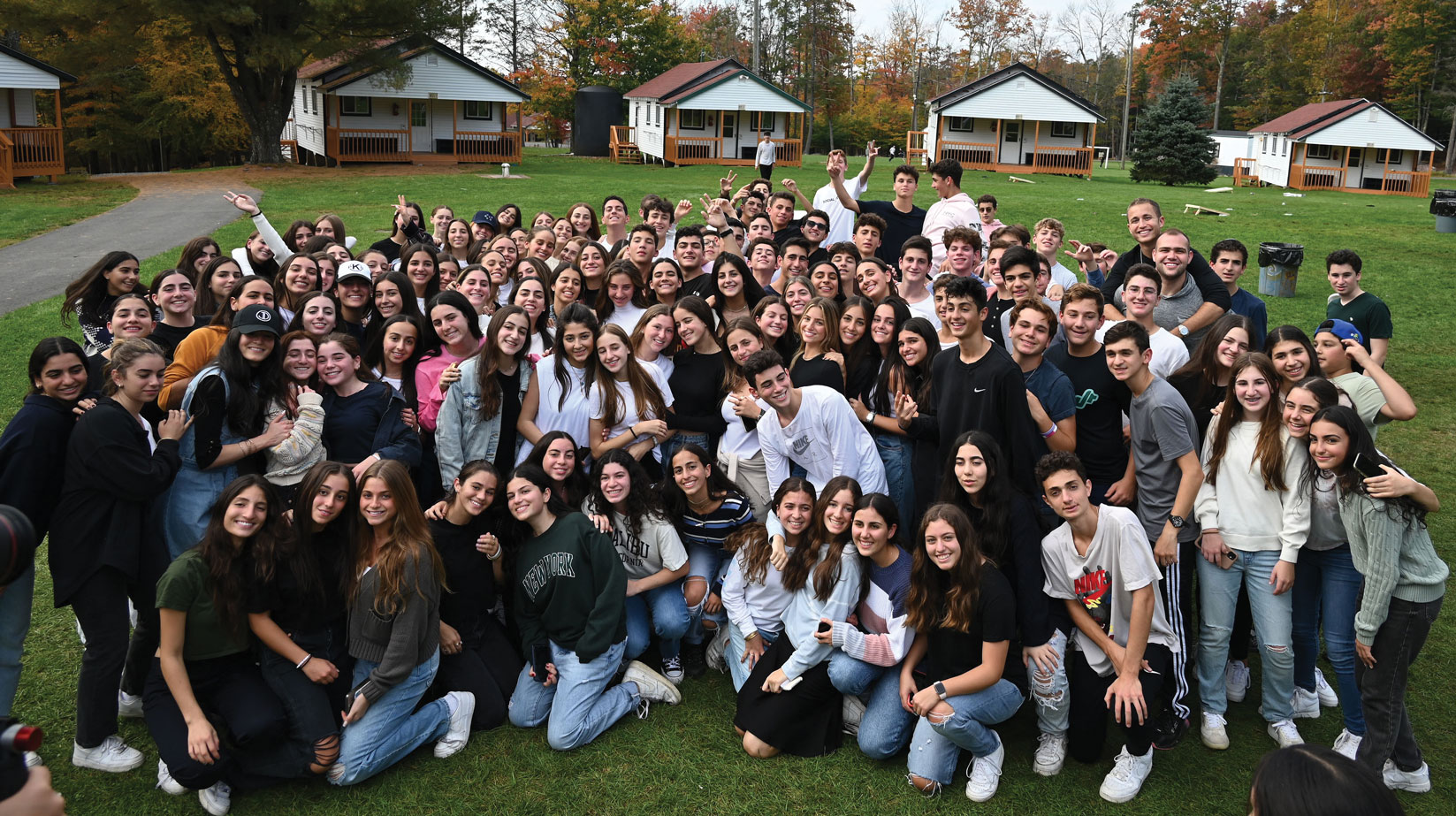
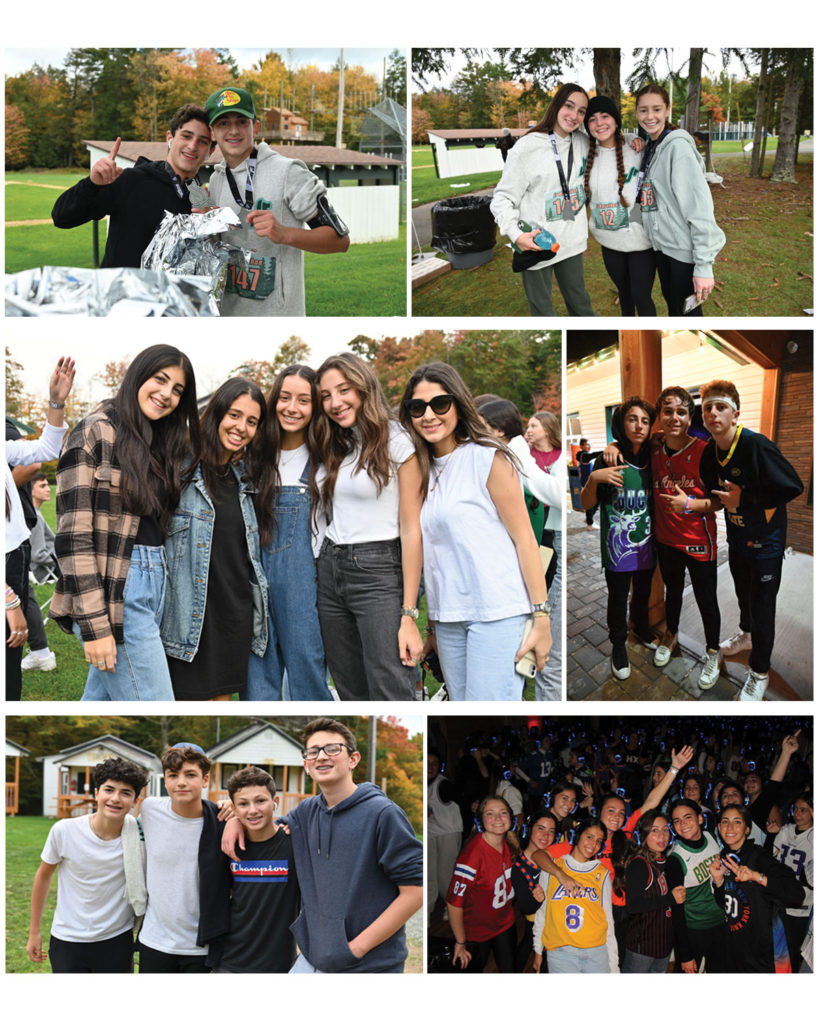
RECENTLY, SBH BUSES TOOK 400 HIGH SCHOOL STUDENTS TO UPSTATE NEW YORK FOR THE HIGHLY ANTICIPATED SBH JUNIOR MARATHON. THIS WEEKEND, AND PREPARING FOR IT, TAUGHT THE STUDENTS ABOUT HESED, SELF-ENCOURAGEMENT AND LEADERSHIP.
For many of these students, the Junior Marathon is the first time they raise money for charity, train for a 10K, and experience a full weekend away from home. It’s SBH’s goal to imbue the next generation of leaders with hesed, kindness and the dedication to give back.
Esther Naftali, one of the Junior Marathon Captains, shared her thoughts on the incredible weekend, “SBH Junior Marathon is a weekend never to be forgotten. It is filled with excitement, inspiration, motivation, and devotion. The beautiful and delicious Shabbat meals, as well as the fun and games provided, are just one small part of the weekend. From musical chairs to writing Shabbat-o-grams, to dancing in the rain, to running in the marathon, there’s always more excitement coming your way. Running in the marathon helps build one’s confidence and gives the runners that little boost that they can do anything they put their minds to. The speeches given throughout the weekend keep you on edge. The emotions and spirituality one feels during the times of the singing and speeches, won’t only change one’s perspective on hesed, but on one’s entire life as well! As you watch the tears fall and feel the love and connection to the people around you, you will want to freeze time, and live in that moment forever. Being a part of this powerful trip causes you to truly change your idea of hesed. Hesed isn’t only about giving to, caring for, and loving people without receiving anything in return; Hesed isn’t about changing the world and doing something astronomical. True hesed, in its essence, is acts of kindness to others, it’s the small acts done for the ones closest to you. It’s those tiny little acts that will bring you to the start of something new. This truly is what the idea of SBH’s Junior Marathon is all about. Taking that first step and desiring to do that hesed without it feeling like a chore, getting that feeling of accomplishment, and most importantly, giving you that push and opening your eyes to what SBH is all about. Hesed is a ripple effect. Trust me, once you start, you will never want to stop.”
The SBH Youth Division has hesed events every night of the week.
HAVE YOU EVER EXPERIENCED STRESS OR SELF-DOUBT? STRESS IS KNOWN TO BE A KILLER. IT CAN CAUSE MEDICAL, PSYCHOLOGICAL AND EMOTIONAL PROBLEMS THAT CAN LEAD TO HEART ATTACK, STROKE, AND DEATH.
What if you could live a stress-free life? What would it be worth to have no stress? How nice would that be? Perhaps there’s a way of managing stress so that it doesn’t kill us. What if we could understand stress differently, making it not all bad and evil. What if there are benefits to stress? What if there’s some value in being stressed?
One of my clients was doing really well. Millions of dollars in revenue with a decent-sized team when they hit a “speed bump,” which then created a few more bumps, and he was completely stressed out. Constant challenges, constantly putting out fires is how he described it.
“Oh, so you’re a fireman?” I asked.
He said, “No, I’m a businessman. I have a business, a team, customers, clients and vendors.”
I said, “It sounds like you’re a fireman.”
He replied, “I don’t know, fireman, businessman, fact is, I’m a very stressed out man, and I heard you can help me. Can you help me?”
“Yeah, absolutely.” I said, “I understand it, I get it. You have a tremendous amount of demands and you have constant emergencies. There are urgent situations that require your attention, and you feel like you’re not even breathing half of the time. At this point, you want to pull your hair out, escape, sell the business, or run away, but you can’t. You’re too invested here and you need to do something. I get it. Your life is mega stressful.”
He said, “Yeah, but can you solve it? Can you fix the problem?”
I answered, “Well, I don’t know if I can fix this for you, but I might be able to help you improve things. I can help you redefine your stress. If you allow me, I can coach you through a process of shifting, how you address your business, how you put out fires and help you become a fire chief instead of a fireman. I might know something about this from my years of experience in EMS (Emergency Medical Service) leadership.”
We began with understanding stress and its purpose. What I helped him recognize is that the stress and tension he was feeling was a message for him. True, it created a fight or flight type of response and this was becoming traumatic for him. Through coaching, he began to see benefits in feeling stressed because it was helping him notice potential problems and make improvements.
The ParenTEEN experience, an online program for parents to teach them the skills and tools I’ve been using to help families for over 20 years, was created from stress. Because parents keep telling me; we’re overwhelmed, we can’t handle this, we’re frustrated and need you to “fix my teen.” There are not enough hours in the day to help everyone, and I wanted to give back and make these tools accessible for people who weren’t able to pay $1,000’s for 1:1 coaching.
To be less stressed, we must begin to understand stress from a different perspective and perhaps even embrace it. Dr. Danny Friedland teaches that the essence of stress is when the perceived demands upon us are greater than our resources. When the demands upon us feel overwhelming, we react in fight or flight, triggering a downward negative spiral leading to feeling trapped. This can lead to collapse, depression, feeling extremely overwhelmed and burnout.
What are you to do, when the demands upon you are greater than the resources that you have?
You can use the tools and redefine your relationship with stress.
It’s not so funny, but when we’re feeling stressed, we’re stressed and that’s the most significant stress. Because we’re stressed about our stress and don’t know what to do, which creates more stress.
In the “Manage Your Stress 2.1” workshops, we encourage you to think about stress as information. You learn to pause, ground, breathe, notice and choose your response. Here are some possible reactions and ways for you to understand your stress.
REACT: This is usually an automatic fight or flight type reaction.
TEND & BEFRIEND: Tend to the distress and get curious about what it’s telling you.
HARNESS the ENERGY: Employ the energy and channel it to your advantage.
25 years ago as a young man starting out in the business world, I switched jobs planning to make more money and accepted less weekly income with long-term commissions. Meanwhile, I was going broke, and the fear of failure, the fear of not paying my rent, the fear of not being able to pay my bills, and the shame of not earning enough money to care for my family appropriately weighed heavily upon me because I was making less than what we needed. My income was less than my expenses and my savings were dwindling. As I looked at these negative numbers, my stress increased and the fight or flight instinct kicked in. The fear of failure was paramount, and yet this also created a particular fuel of desire. It fired me up and generated tremendous drive.
Instead of shutting me down and causing me to collapse, this fueled a tremendous drive and desire. Over the following 10 months, I doubled my income. Not once, but twice. You can do the same.
Remember, you have the most incredible resource for any demand. Hashem loves you and you can rely on Him to help you navigate your stress for your benefit. Stress can actually be a gift.
Rabbi Ezra Max, PCC, MHMP, Xchange Guide & Creator of “The Max Method” assists businesses and professionals deal with stress and achieve success. Rabbi Max has witnessed 20 years of results helping executives, parents and teens overcome struggles, improve communication and thrive. He lives in New York with his wife and five children.
THE MITZVAH MAN RECENTLY RECEIVED A CALL THAT WENT LIKE THIS: “I’M IN MANHATTAN, MY NAME IS JAMIE, I’M 77 YEARS OLD AND BLIND. I HAD AN APPOINTMENT WITH MY DOCTOR THIS AFTERNOON THAT ENDED HOURS AGO. I’VE BEEN WAITING ALL DAY FOR A RIDE TO PICK ME UP AND TAKE ME HOME TO BROOKLYN, BUT NO ONE HAS ARRIVED YET.”
Jamie continued, “They keep telling me someone will be here soon, but it’s 7 p.m., it’s getting dark now, and it’s raining hard. I just remembered that a friend added your number to my contacts in case I ever had an emergency. I’m scared. I hope you can help.”
The Mitzvah Man replied, “I’m on it.”
Jamie described what happened next. “Within 20 minutes, a car pulled up. The person inside said, ‘Hi I’m a volunteer from Mitzvah Man and I’ll take you home.’ It’s amazing that he spotted me in the dark and rain. He safely and cautiously escorted me into his car and drove me home and at the same time calmed me down. I blessed the driver and the organization. I really thought I was going to be homeless for the night. It’s a relief to know that there are such kind people and a wonderful organization, willing to help those in need. Thank you, Mitzvah Man!”
NOW THAT DSN HAS BECOME THE CENTRAL HUB OF RECREATIONAL AND SOCIAL LIFE ON THE JERSEY SHORE, FAMILIES ARE CLAMORING TO BE INVOLVED IN DSN’S ACTIVITIES TO MEET AND HAVE FUN. TO HANDLE THE EXTRAORDINARY DEMAND, DSN WELCOMED DANIELLE SHEMUELI AS ITS ASSISTANT YOUTH DIRECTOR, JOINING AN ALREADY SUPERB TEAM.
Recently, hundreds of people excitedly poured into the DSN gymnasium for the legendary return of the Pajama Jam! Siblings, parents, cousins and friends were amongst the droves of community members who showed up at 5:30 p.m. for an evening of fun and amusement. Kids were ecstatic, their eyes wide open as they saw the large-scale bounce house, a musical concert on stage by Little Rockers, a delicious dinner consisting of noodles, pizza and cucumbers, along with personalized balloons.
Danielle Shemueli, DSN’s new Assistant Youth Director, stopped counting after 200 people. She grabbed the opportunity to greet new families and ensure they were having a blast. She noted “I’ve been to many of DSN’s pajama jams in past years as a parent. Now that I’m part of the best team, I am able to witness first-hand how much thought, effort and organization goes into the fun being created! I loved seeing kids and moms dancing and enjoying it so much! We need to do this again!”
Pajama jams are meant to bring families together—for mothers to meet new friends and children to enjoy a night out. As a benefit to DSN members, there is no charge, allowing all members to attend without hesitation.
New members were blown away and in awe, while ongoing members were flooded with memories of pajama jams from the past. Jersey mother Sonia Cohen was thrilled. “My kids were so eager to get back to DSN for pajama jam night! The memories of getting into their favorite pajamas to have dinner and play with their friends stayed throughout COVID! When pajama jam returned, this time my oldest child whispered to me ‘I missed this, and Ma, look, they even have a balloon guy this year!’”
Due to popular demand, the next pajama jam is already in the works. DSN promises to deliver them on an ongoing basis! Frieda Shamah, DSN’s Youth Program Director, explained, “I loved seeing all the new faces of those who recently moved to the area, and also seeing every single child having the time of their lives while enjoying our building. This makes me so happy and is why I love what I do!”
DSN member and mother Danielle Bromberg added, “We were so happy to have pajama jam back! The kids all got to be together again and everyone had a blast with their friends—kids and parents alike! We truly can’t wait for the next one!”
Sammy Sitt, DSN’s Executive Director, summarized, “As we move towards the post-pandemic world, DSN needs to be at the forefront of providing social and healthy activities for our community. Pajama jams are one of many ways we are accomplishing that goal. We are super fortunate to have a passionate and hard-working professional staff who give it their all to bring happiness to children and parents. With Hashem’s help, DSN will continue to provide exceptional programming for the growing community.”
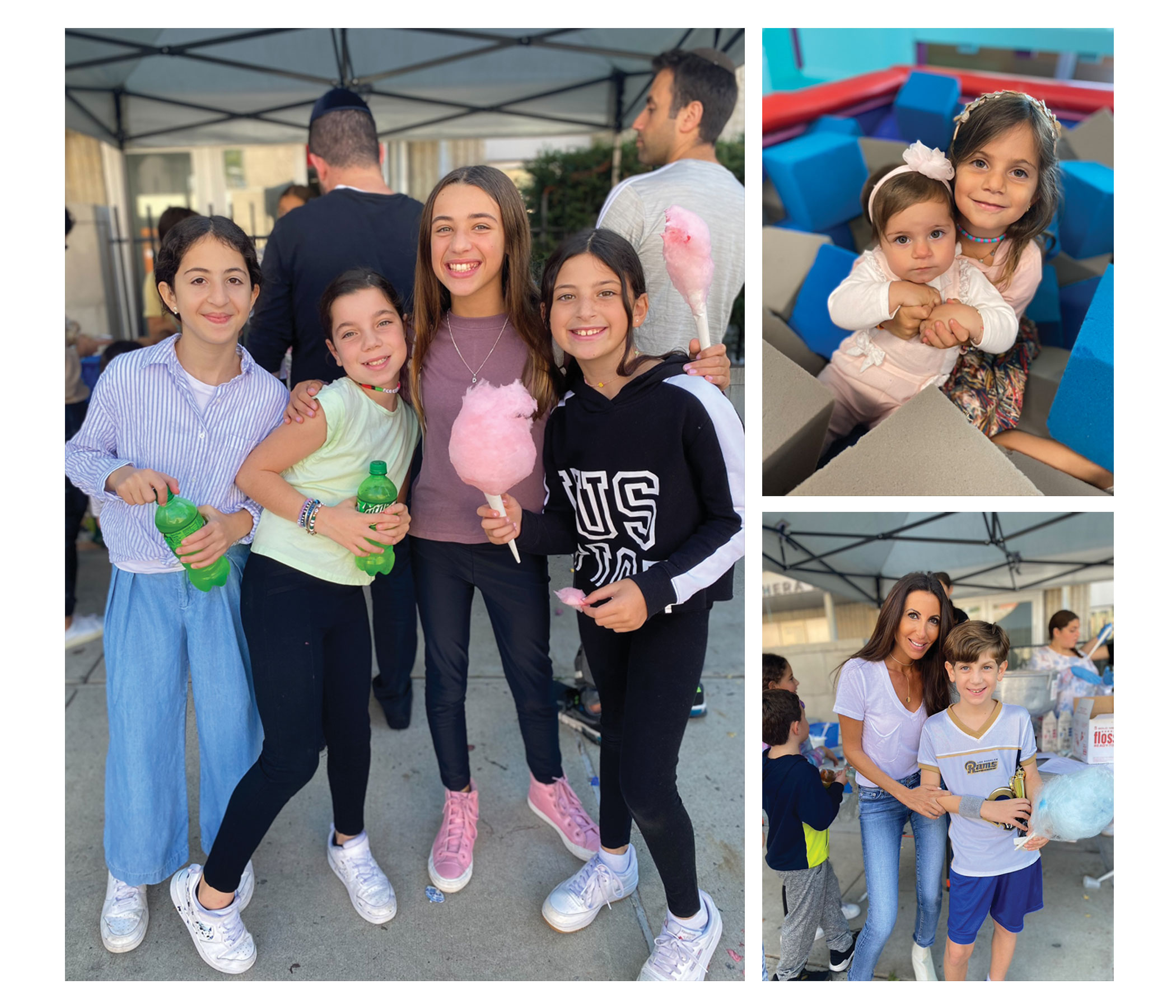
AFTER A LONG YEAR OF LIMITED PROGRAMS AND OPPORTUNITIES TO GATHER TOGETHER, THE CENTER DECIDED TO REOPEN ITS DOORS BY HOSTING A STREET PARTY! THE CENTER’S INSIDE OUT EVENT INCLUDED A MULTITUDE OF ACTIVITIES FOR ALL AGES, BOTH INSIDE AND OUT OF THE BUILDING.
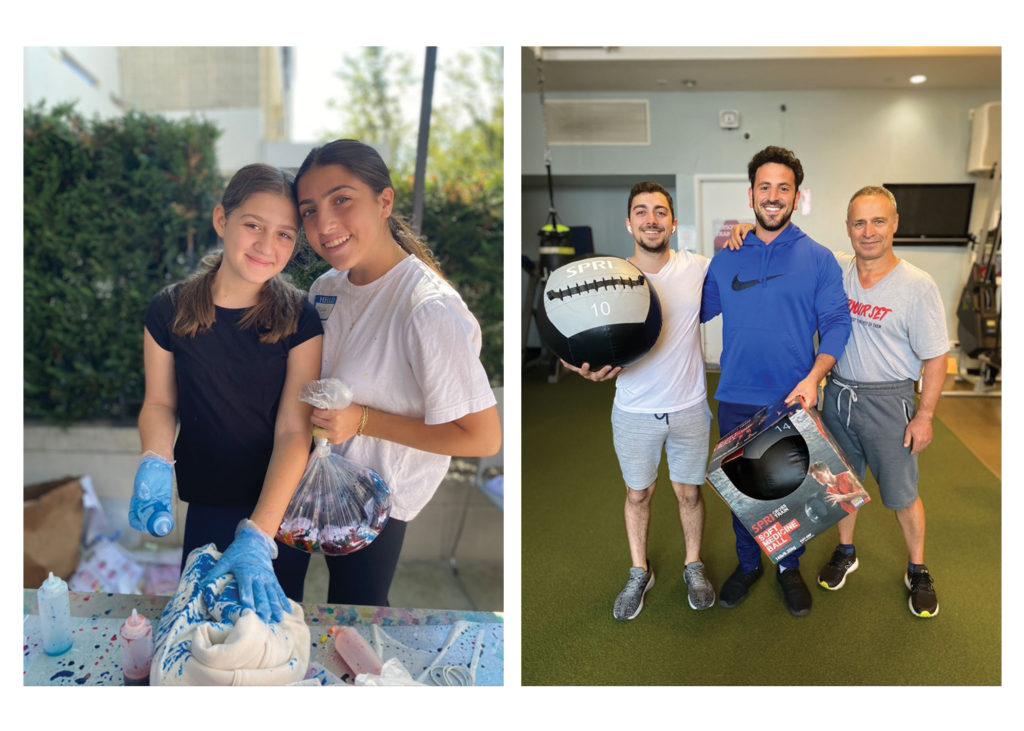
Some of the free-of-charge delights that over 3,000 participants enjoyed included cotton candy and popcorn, as well as candy bags. Members and non-members also had fun bouncing around in our bouncy houses, tie-dying their own shirts, decorating planters, competing in fitness competitions, and dancing to live music from our DJ and Encore music instructors. In addition, our newly renovated sensory gym was a hit among the youngsters; kids were quick to explore the many swings, slides, foam pits, and other features located in the sensory gym.
Simultaneously, the Center was packed with teens participating in basketball tournaments, men and women attending exercise classes, children attending birthday parties, and others wandering between all the excitement. It was truly an incredible day, and it was just the beginning of everything the Center has in store.
Do you have questions about the Center? Call us at (718) 627-4300. Follow @thecenterscc on Instagram to stay in the loop about future events, opportunities, and programs.
Mary Halabani, Marketing Manager at the Center, spends her time capturing every smile she sees inside and outside of the building. Mary has over 4 years of combined experience working in politics, publishing, and other non-profit organizations.
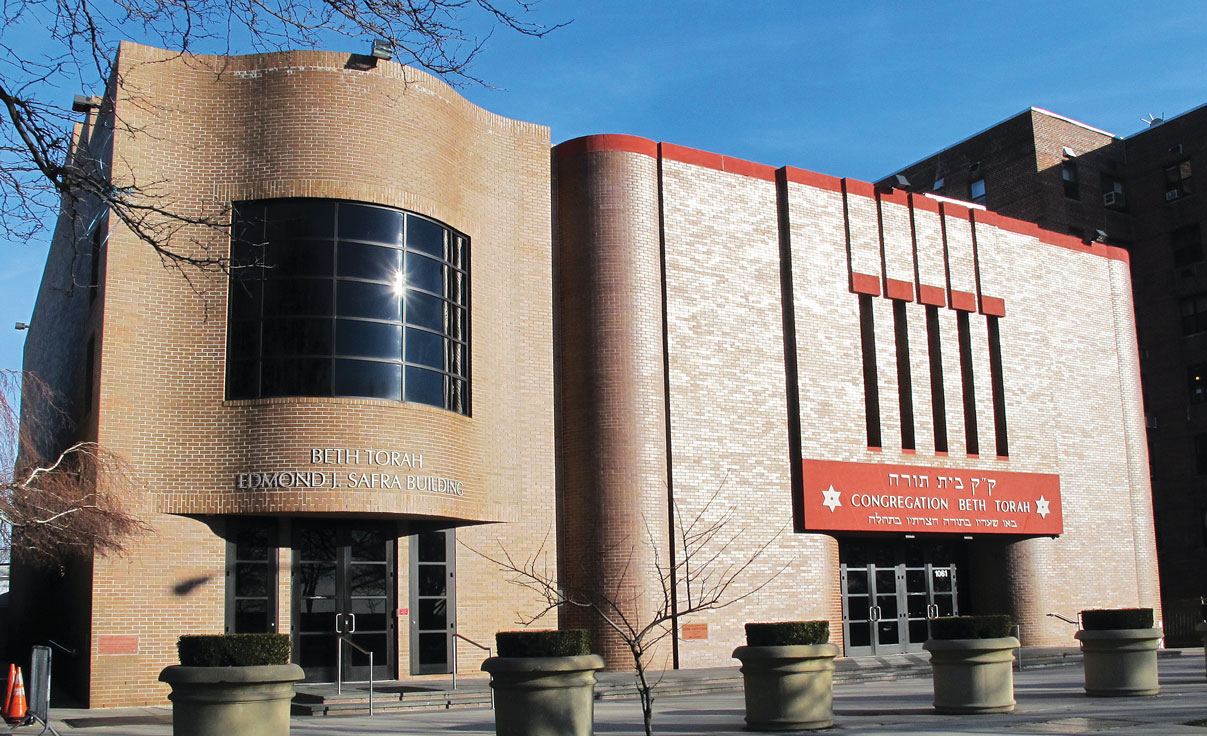
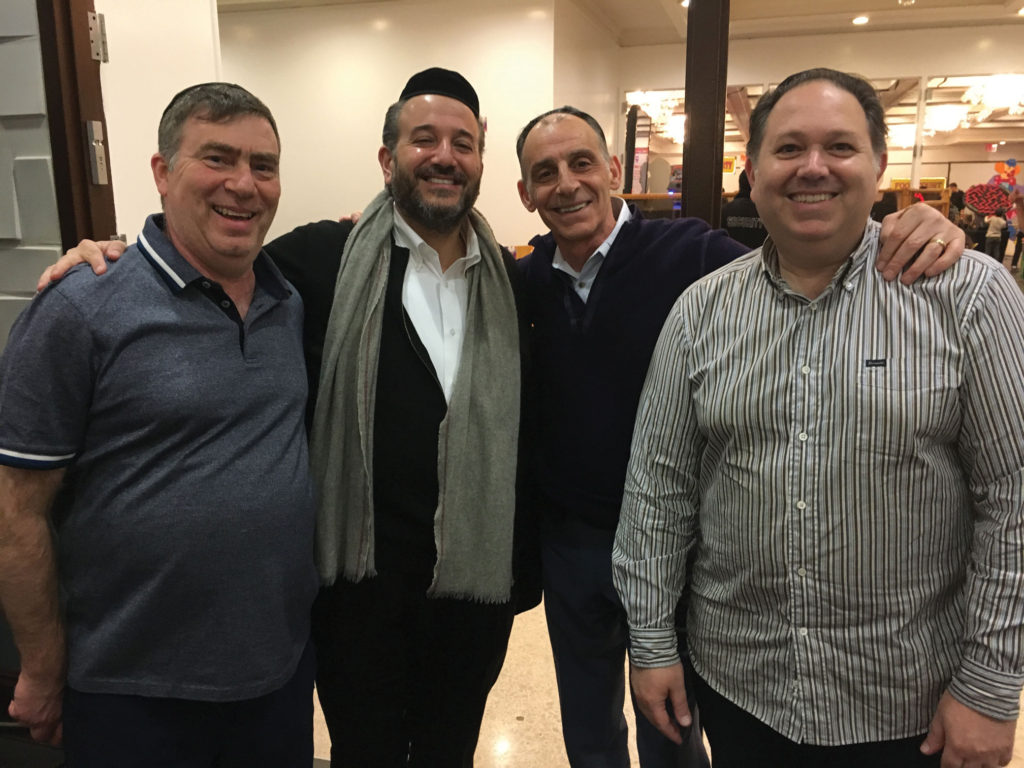
TWENTY-FIVE YEARS AGO, I BEGAN ATTENDING THE CHILDREN’S MINYAN AT CONGREGATION BETH TORAH ON SATURDAY MORNINGS WITH MY YOUNGEST SON. IT WAS A FEW YEARS BEFORE HIS BAR MITZVAH. AS WE WALKED IN THE DOOR, WE WERE WELCOMED WITH OPEN ARMS BY RABBI SHIMON COHEN A”H AND SEVERAL OF THE GUYS WHO VOLUNTEERED THEIR TIME DURING THE SERVICE. RABBI COHEN’S ENERGY FILLED THE ROOM AS HE HUGGED EACH CHILD, HIS WARM SMILE EMBRACING THEM WITH LOVE. THE VOLUNTEERS WERE THE UNSUNG HEROES WHOSE WORK ON SUNDAY MORNINGS ASSURED THAT THE SERVICE RAN SMOOTHLY, THAT THERE WERE TOYS, PRIZES, AND FOOD FOR THE FOLLOWING SHABBAT.
Ronnie Gindi happily gave out lollipops, stashed in all his pockets, and made crying toddlers happy, his smile beaming throughout the room. Then there was Moe Kishk, who kept my son on task, and others who assigned the weekly portions to the children so they could practice for the next week. The ambiance was of a warm welcoming home with the volunteers who made it happen, week in and week out.
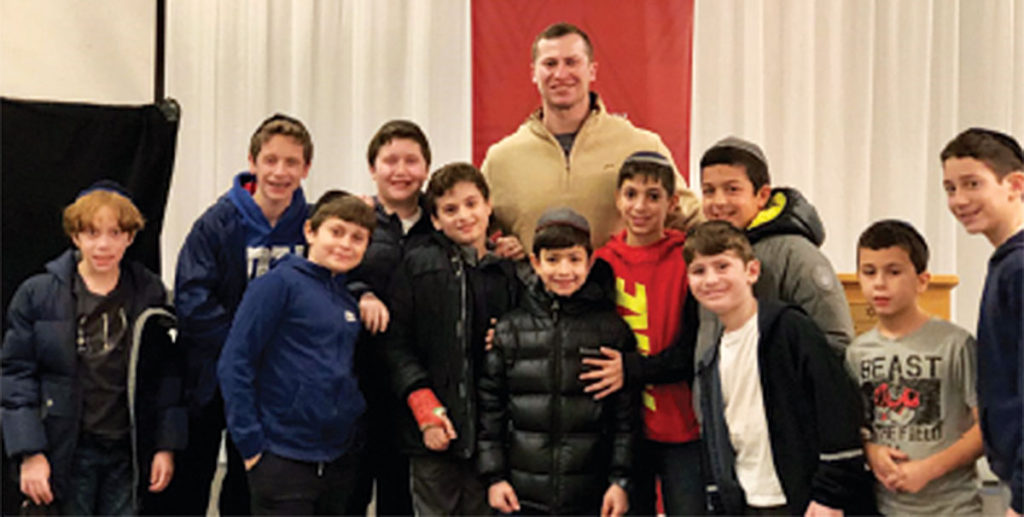
Gone was the stilted stuffy feel of simply praying. The children were motivated with positive reinforcement, a sense of accomplishment and rewards for their efforts. Of course, the underlying reason for the minyan was to teach Torah and community values. Moreover, the children wanted to be there. There was a sense of family and togetherness. And while many of the fathers may have preferred to sleep in after a long week at work, their children pushed them to attend services.
The Beth Torah Children’s Minyan began about 40 years ago with Dr. Ezra Cohen, Abie Hanono, Moe Kishk, Allan Menaged and another humble gentleman we shall call Mr. Hesed, because he asked to remain anonymous. Within a year, Abie Hanono had recruited Rabbi Cohen for the minyan and in turn, Rabbi Cohen recruited Ronnie Gindi as a volunteer. Of the original group, Mr. Hesed and Ronnie Gindi remain, while others have stepped in—Joe Chappan, Ralph Terzi, Sol Wahba, Victor Znati, Morris Varon, and others. Rabbi David Shelby was hired to fill the huge shoes of Rabbi Cohen, who passed on in 2016.
“We wanted to get the kids away from their television sets and into the synagogue,” said Moe Kishk. “The kids wanted to come to get the ice cream and toys, and they had to drag their parents. Some fathers who never came to shul started to come with their kids.”
“Before the minyan, we had kids roaming streets. They didn’t want to sit with their fathers in the main shul. Kids needs are different and they needed to be able to participate so we started something more interactive and participatory,” said Dr. Ezra Cohen.
“The future of the shul is our children. We gave them incentives. We held mini trips, went fishing, and had carnivals with prizes. Moe Kishk and I used to make tuna fish for seuda selushit. The rabbi gave them tapes to learn parts for the Shabbat service. We did silly things like give them tickets to a baseball game. With these incentives, they became regulars. Many of them continue to learn and have become leaders. Now they bring their children.”
Indeed, Rabbi Eli Mansour was one of those children. “Rabbi Cohen had a huge impact on me and my friends,” he said. “He had tremendous energy and we felt it. Because of him, we got to read, and we became more comfortable reading, and many are hazzanim today. We learned the minhagim and how to pray. He mentored us for several years and built our self-confidence.”
Indeed, Rabbi Cohen’s influence will live on for generations. The overwhelming majority of those students live Torah observant lives. Rabbi Cohen was the paragon of this virtue, going to endless lengths to connect to the essence of each child. The peripheral effect that this had on the many families of these students is staggering.
Rabbi Mansour said “It was the lay leaders behind the scenes who were instrumental in making it all happen. These were prominent men who could have prayed upstairs in the main sanctuary. If you ask them, they will say that the future of Beth Torah and or the community, is in the basement, not the first floor. They understood the importance of directing their energy to the youth.”
Ralph Terzi was a student of Rabbi Cohen when he attended Magen David Yeshivah. He said Rabbi Cohen encouraged him to come to Beth Torah when he was just 10 years old. Each week the Rabbi gave him tasks to do. “One week it was setting up chairs, then it was putting away books. Every week, he added a thing I had to do.” That was 25 years ago.
Now Ralph brings his three sons there and volunteers each week. “I want them to feel the same energy I did when I was 12. It all started with Rabbi Cohen. He loved working with the children and that satisfaction has propelled me forward. Every time I see a boy go up to the Torah and read for the first time, I am seeing the results of carrying our traditions forward to the next generation.”
“Rabbi Cohen loved every child no matter how old they were,” said Moe. “He hugged them and welcomed them as if they were kings. Every child got his big smile. I worked with him for 25 years. He attracted a lot of kids and they will never forget him. Rabbi Cohen was a walking mezuzah, everyone came to kiss him.”
BEHIND THE SCENES
The lay leaders in the synagogue, the volunteers who operate behind the scenes of Beth Torah Children’s Minyan, are there week in and week out, one for 38 years, another for 35 years, and so on.
Take Mr. Hesed. Responsible for the games, prizes, backpacks and toys at Simchat Torah, he works all year collecting items, making deals with toy vendors, and going to Costco or BJ’s to buy items. He devotes a full section of his warehouse to storing the items. Not by himself, others help as well because the job is too big for one person.
“One day he (Mr. Hesed) heard about a closeout and took his truck to go pick up the goods. He lost a half day’s work. He did it silently, by himself, and did not want any credit. He even goes to Carvel to get the kids ice cream,” said Dr. Cohen. “He is an unsung hero.”
Ronnie Gindi learned to give out lollipops and candy from his father, Jack Gindi, who did it years ago at Congregation Shaare Zion. He has been a volunteer at the Beth Torah Children’s minyan for 35 years, week in and week out.
“My job is to make sure no one goes home unhappy. We want the children to come back, to feel like the synagogue is the place to be,” said Ronnie. “We have about 300 kids each week and we give out about 35 prizes. We also supply Morah Etti, Ms. Stern’s group, Rabbi Joe Mizrahi’s minyan and others. We buy a lot of stuff in bulk, as well as candy and ice cream.
“We are world famous for the minyan. It’s a very big high for a father to see his son read and we make a big deal for each child. It’s unbelievably fantastic. The kid walks away and feels like he won the lottery.”
Ronnie Gindi was in Rabbi Cohen’s first class at Magen David Yeshivah. “He changed me as a kid,” Ronnie said. “He was a substitute teacher at Magen David in a particularly difficult class and the students challenged him. But he changed them. And they grew to love him. When he wanted me to help in the children’s minyan, I told him I was a rebel. I’m a big sports guy. I played high school and college basketball. I figured I would help for two weeks and be done. But now here I am, in my 35th year.
“When my kids began getting older, I wanted to go to shul with my adult children, Rabbi Cohen said ‘This is more important. You must stay with the kids’ program’ and it was a promise I made to him to keep the minyan thriving.”
On Simchat Torah alone, the volunteers prepare 1,500 backpacks for children who seem to come out of the woodwork that day. According to Ronnie, “One time I said to Rabbi Cohen ‘Most of these kids just come for the backpacks, they don’t attend. Rabbi Cohen said ‘Are they Jewish?’ Yes. ‘Are they children?’ Yes. ‘Then give them a bag.’ He taught us how important the children are.”
“It’s like a choreographed show,” said Sol Wahba, who among a thousand myriad tasks orchestrates the carnivals. “Who will do this and who will do that, every 15 minutes. Everyone does their part and no one gets credit. “Sometimes we run short and we have to run to BJ’s and buy candy, and some are putting thousands of dollars on their personal credit cards. Who wants to do that on a Saturday night? And then bring it back and unload it for the next week. But we do it for the children.
“It’s Hashem putting you in the place and you have the ability to do something others can’t. At the same time, there has to be a balance between praying, giving out candy and decorum. The main thing is to keep everyone happy and do it with a smile.”
“This past year or so was hard. We did drive-bys for Hanukkah and Simchat Torah, a virtual Chinese Auction and creative things to keep the children engaged.”
THE NEXT GENERATION: RABBI DAVID SHELBY
Not long after Rabbi Shimon Cohen became ill and then passed away, Rabbi David Shelby was recruited to run the minyan. Rabbi Shelby had big shoes to fill, as Rabbi Cohen was considered a giant.
The volunteers say he was a perfect fit, as he emanates the same warmth Rabbi Cohen did, his ear-to-ear smile welcoming the children.
“Rabbi Shelby has the same demeanor. His warmth attracts people,” said Ralph.
“It’s the biggest kids minyan in the community and he (Rabbi Cohen) was the greatest of the great,” said Rabbi Shelby. “He taught us how to sing in the rain instead of waiting for the rain to pass; I knew him my entire life. I worked with him in Magen David.
“I have a lot of respect for the volunteers who commit themselves to the service. It’s hard to volunteer. They get no glory or recognition, only aggravation. It’s noisy and there is a lot of action, and they still do it. You would think they would get tired.
“I think of it as a life lesson. When you park you are sitting still; when you drive, you are moving forward. The minyan is motivation in drive. We can’t sit back and pray and hope. We take action and do something. These volunteers have memories from when they were children, and they want the kids to have those same positive memories. The kids will remember an upscale Purim party or a fishing or basketball trip.
“These guys keep the legacy going. And besides the minyan, they do other things for the kids. Every Sukkot, Mr. Hesed buys extra lulav and etrogim. If a kid comes to shul without one because he can’t afford it, Mr. Hesed doesn’t want the child to feel out of place, so he gives them out. And not every child is as learning-abled as others, so Mr. Hesed pays for private tutoring for some kids.
The kids come to shul to get a prize and candy, but the underlying goal is to teach them, which in turn nurtures the heritage and preserves the traditions of our community. And these same volunteers help out all the other synagogues in the community, as well as those in Deal during the summer. It’s all about the children.
These volunteers are unsung heroes who make it all happen.
A genealogist and historian, Sarina Roffé is the author of Branching Out from Sepharad and cookbooks. She is President of the Sephardic Heritage Project, Co-Chair of the Brooklyn Jewish Historical Initiative and Chair of the Sephardic Research Division of JewishGen. Editor of the journal Dorot, Sarina holds a BA in Journalism, and an MA in Jewish Studies and an MBA.
THIS SUMMER AT THE HEIGHT OF ISRAEL’S LATEST CONFLICT WITH GAZA IT SEEMED EVERY CELEBRITY AND INFLUENCER WAS PUTTING OUT VICIOUS ANTI-ISRAEL PROPAGANDA, LEADING TO A NEW SURGE OF ANTI-SEMITISM HERE IN AMERICA.
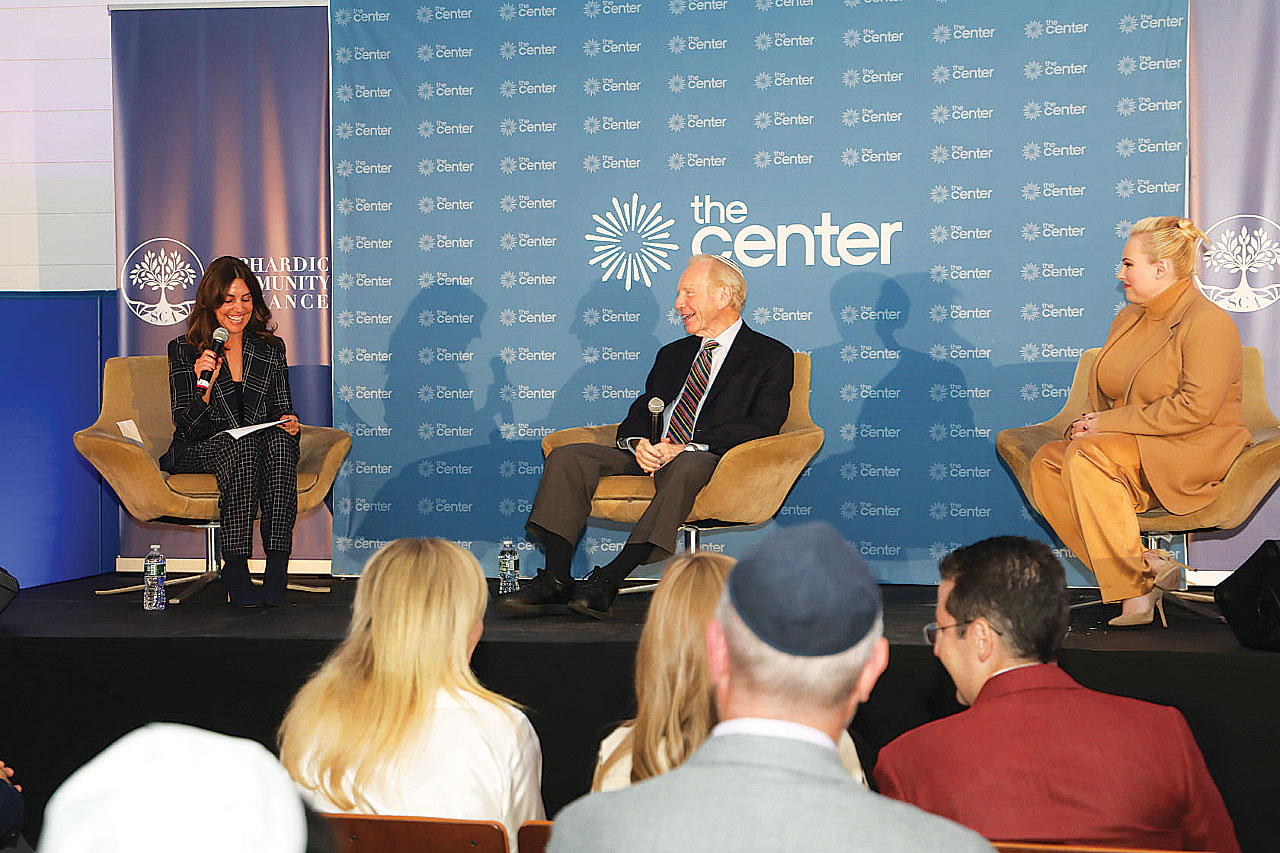
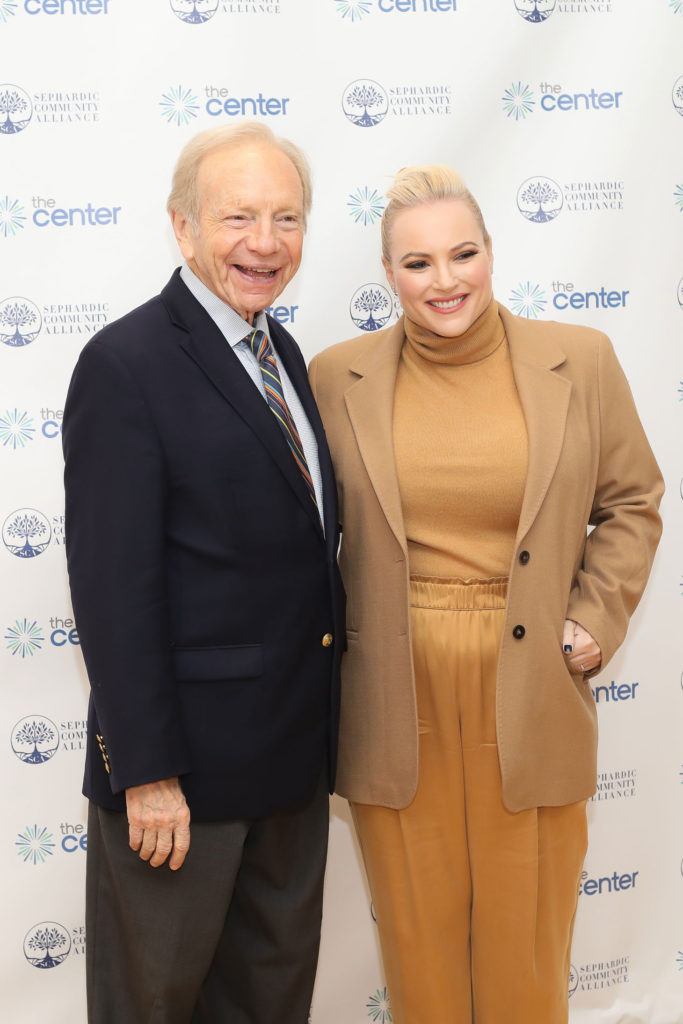
It felt like you couldn’t open social media without seeing dangerous misinformation and vilification of Israel. Where were the truth speakers? Where were the pro-Israel voices? Very few people were speaking out publicly for Israel or for Jews, and the silence was deafening. It was during this time that Meghan McCain posted a picture of her dad, former presidential candidate Senator John McCain, and Senator Joe Lieberman at the Kotel. Her caption, seen by over a million of her followers on Twitter and Instagram read “All my passion, everything I believe in my soul comes from the two of them−proud Zionist today, tomorrow, always.” This was not the first time McCain had showed her support for Israel, but it was the moment when we decided to bring her and Lieberman to the Sephardic Center to discuss “standing up to anti-semetism”
The Sephardic Community Center and the SCA joined together to bring these two strong Israel supporters to our community. Meghan, who is well-known from her time on ABC’s The View, as well as being a columnist and author, is also famous for speaking her mind and advocating for what she believes in.
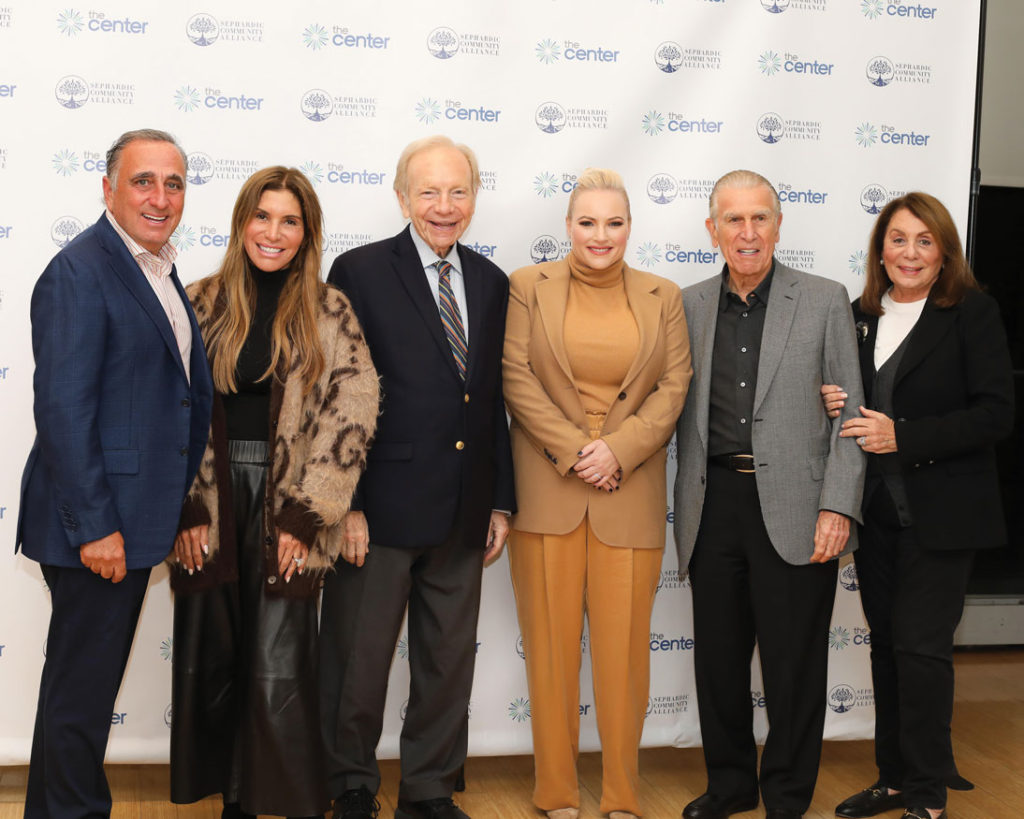
This was Lieberman’s second time coming to our Center, and his affinity and love for our community was apparent. He is known for his integrity and is the true embodiment of a Jewish hero. Ricky Novick, the president of the SCC said, “Bringing high caliber events like this to the Center has always been one of our priorities. As a community that cherishes our connection to Israel it was our honor to make this program a reality.“
Corie Adjmi, award winning author, moderated the event. She interviewed our guests with eloquence and warmth. It was obvious she cares deeply about this issue and put much thought and preparation into her role. The audience felt as if we were listening to a discussion between three long time friends.
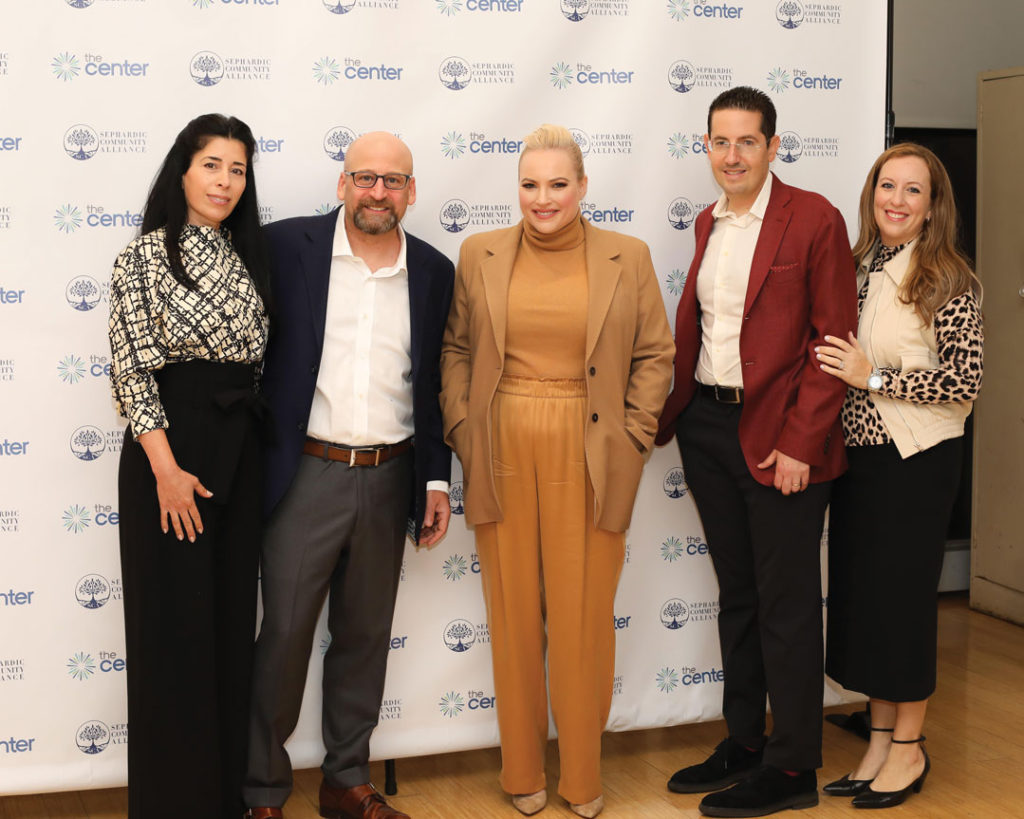
Jeffrey Beyda, president of the SCA said, “Advocating for Israel, fighting anti-Semitism, supporting those who speak out against it and preparing our young adults for the challenges Jewish Americans face on college campuses are part of the SCA’s core values and mission. The SCA is constantly working to fulfill that goal and working with like-minded institutions that share our values. It was our pleasure to invite a select group of young adults to participate in a meet and greet with the guests as well as ask them questions as part of the main program.”
The night was inspiring on many levels. McCain and Lieberman had an obvious love and admiration for each other. It was so special for our community to be able to bring them together. They spoke with intelligence and pride about a range of issues that affect the Jewish community. It was uplifting and educational to hear their perspectives. The audience was truly moved by the words of both guests. The discussion was at times a behind the scenes look at politics and media as well as a call to action to everyone present to get involved, not be silent and not be afraid.
Thank you to Kathy Shabot at the Center for everything you did to make sure this event was a huge success!
Irene Hanan is a board member of the SCA and program chair of the SCC’s Israel Advocacy department.
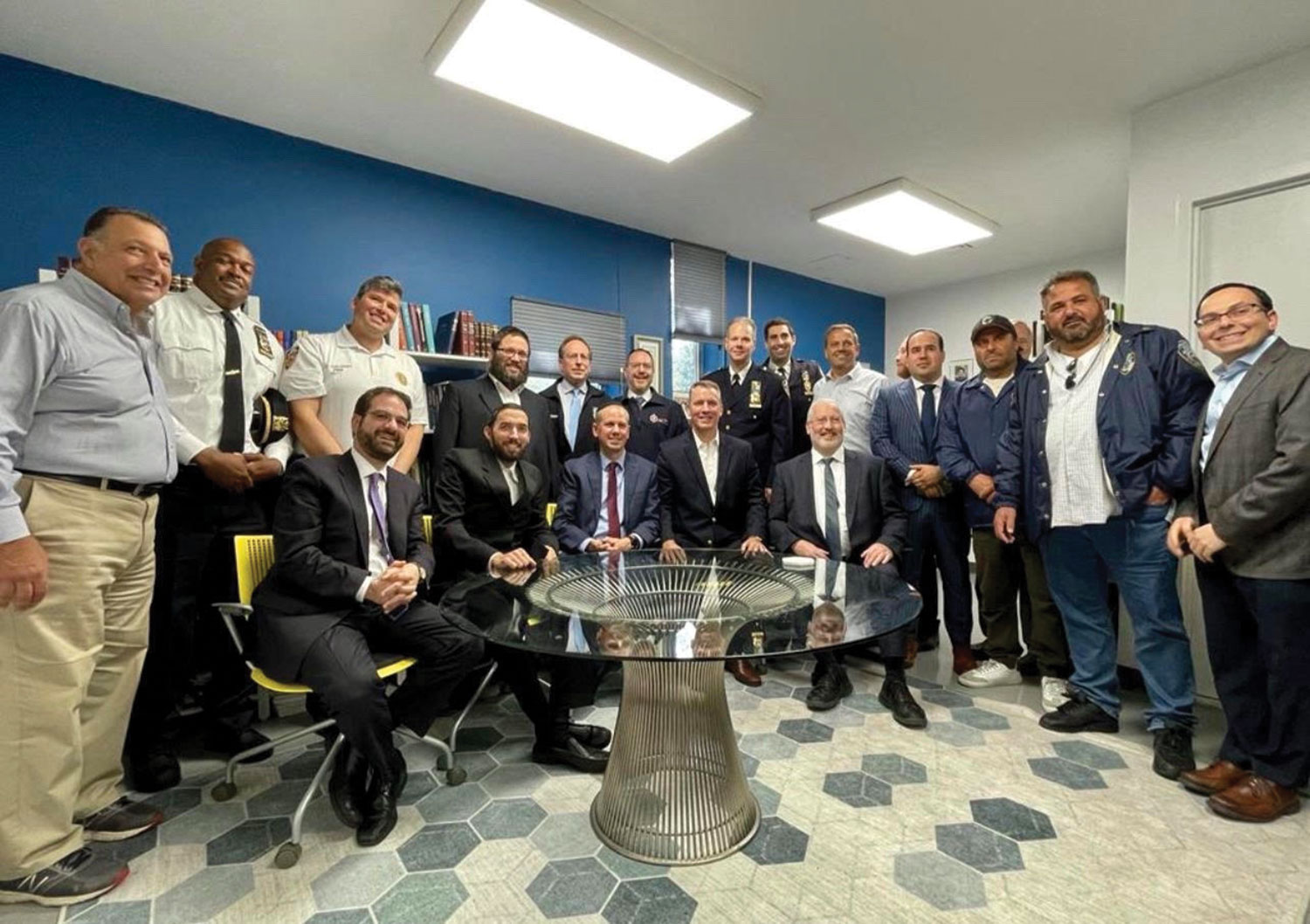
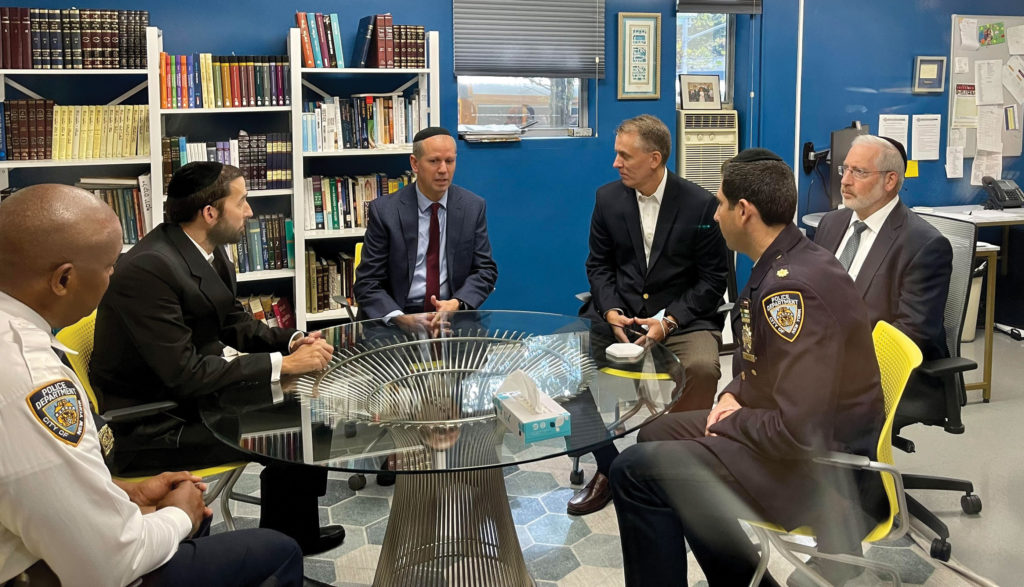
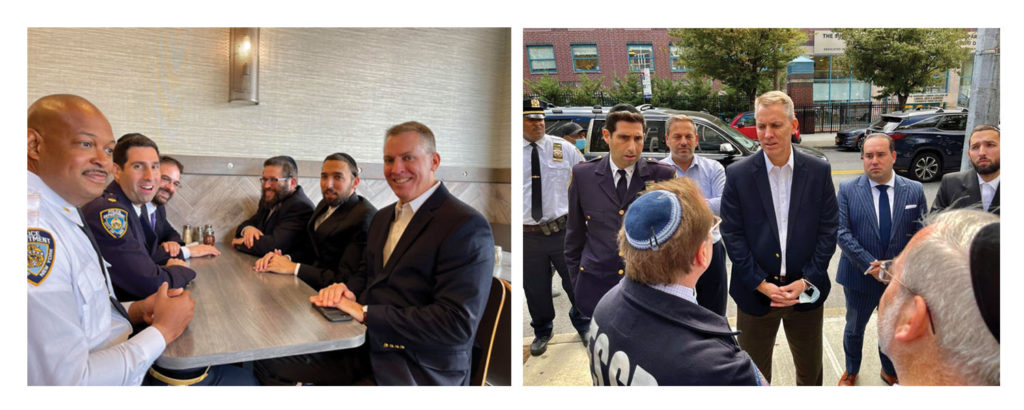
ON SUNDAY OCTOBER 17TH, NYPD COMMISSIONER DERMOT SHEA MET WITH ELECTED OFFICIALS, COMMUNITY LEADERS AND YESHIVAH OF FLATBUSH ADMINISTRATORS TO ANNOUNCE THE ARREST OF THE INDIVIDUAL RESPONSIBLE FOR POURING GASOLINE AROUND THE YESHIVAH AND SETTING IT ON FIRE THREE DAYS EARLIER.
Many important members of the police department, as well as politicians were in attendance, including Brooklyn South Commanding Officer Assistant Chief Michael Kemper, Commanding Officer of the 70th Precinct Inspector David Wall, Commanding Officer of Citywide Community Affairs Deputy Inspector Richie Taylor, NYPD Clergy Liaison David Heskiel, Assemblyman Simcha Eichenstein, Councilman Kalman Yeger, Mayor’s Office Assistant Commissioner Pinny Ringel, Head of Flatbush Yeshivah Rabbi Joseph Beyda, Flatbush Yeshivah Assistant Principal Rabbi David Galpert, Hatzalah CEO Yechiel Kalish, Flatbush Shomrim Coordinators Bob Moskovitz and Steve Weill, Flatbush Jewish Community Coalition Chair Josh Mehlman, Lieutenant Ira Jablonsky and community leaders Mitch Vilinsky, Joe Dweck, Judah Cohen, and David Assis.
The perpetrator, 39 year old Sharee Jones of Brooklyn was charged with reckless endangerment as a hate crime and arson for pouring gasoline around the yeshivah gate and lighting it on fire. There were no injuries Baruch Hashem, minor property damage was sustained to the sidewalk.
Deputy Inspector Taylor introduced everyone to Commissioner Shea, who received a very warm welcome. Commissioner Shea unequivocally pledged that any criminal act of hate in NYC will be thoroughly investigated and every appropriate resource will be utilized to bring those responsible into custody.
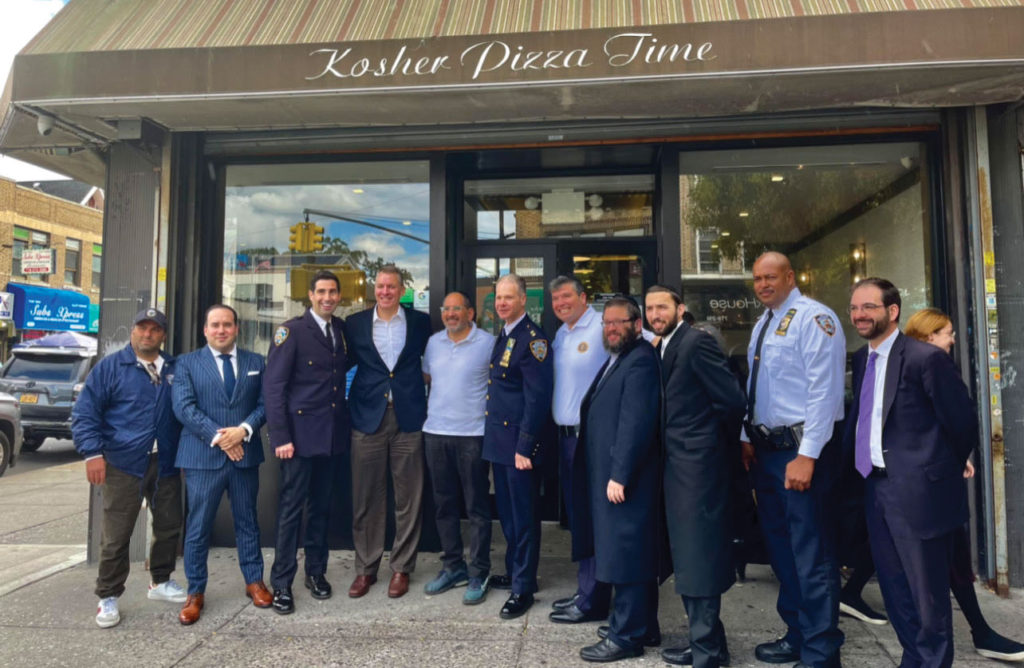
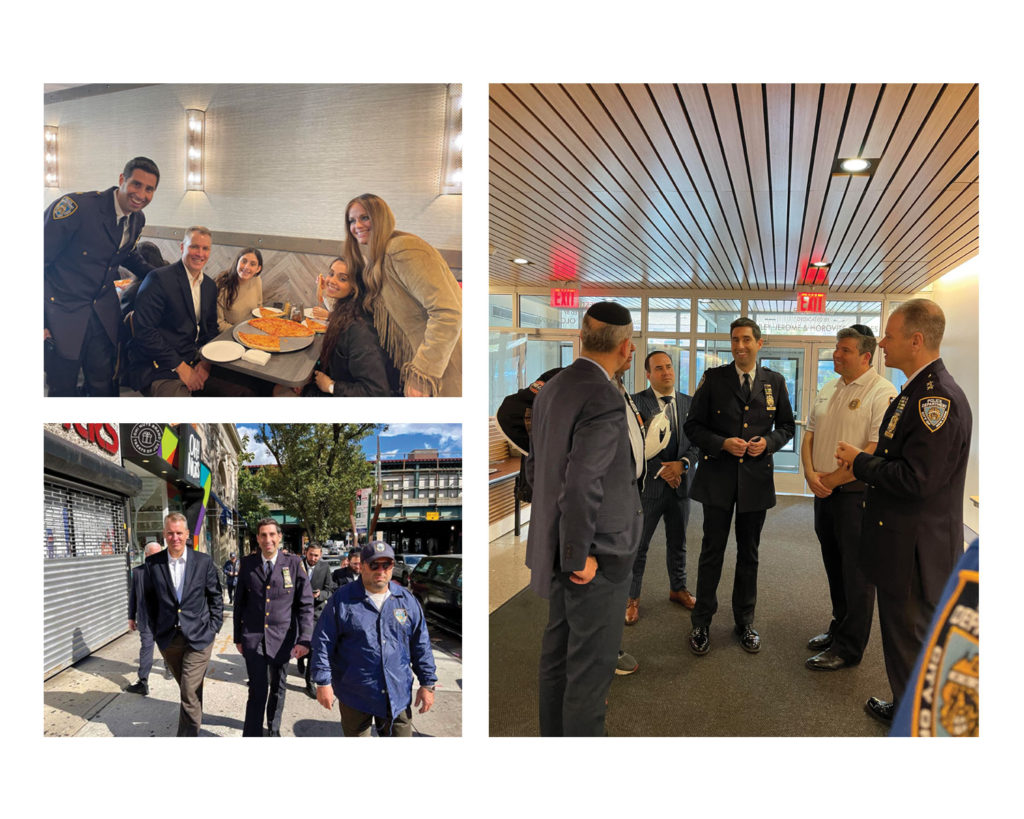
After leaving Yeshivah of Flatbush, Commissioner Shea and others walked along Avenue J, stopping to say hello to kids and pedestrians, demonstrating that the NYPD understands the community’s concern by bringing a sense of security and professional police presence to the area. Commissioner Shea stopped for lunch at Pizza Time (after being assured it was kosher), showing additional solidarity and sensitivity to the community.
He greeted dozens of pleasantly surprised families. One customer remarked “seeing the police commissioner here in our neighborhood just two blocks away from where that fire was intentionally started means so much, he really understands how we feel.” Another customer stated “We are truly blessed to have him as our commissioner. What a Mensch!”
STICKER SHOCK AT THE GROCERY STORE? PRICE HIKES AT THE PUMPS? PRICES ARE GOING UP AND SPENDING MORE FOR BASICS CAN BE STARTLING. DO YOU REMEMBER THE FIRST TIME YOU NOTICED PRICES INCREASING OR DID IT HAPPEN SO GRADUALLY THAT YOU MISSED IT? INFLATION IS OFTEN MORE COMPLICATED THAN WE REALIZE AND IT’LL BE WITH US FOR THE REST OF OUR LIVES. SO, WHAT COULD PRICES LOOK LIKE IN 2030? LET’S FIND OUT BY LOOKING AT SOME HISTORICAL DATA, AND PROJECTING HOW PRICES FOR THINGS LIKE FOOD AND HOUSING COULD GO UP.
Sticker Shock? HOW YOUR BILLS WILL RISE IN 2030
WHAT IS INFLATION?
Inflation is a measurement of how fast the prices of goods and services increase. As inflation rises, prices do too because it takes more dollars to buy the same things. Deflation is the opposite—it brings prices lower and increases buying power.
Both inflation and deflation are tied to a complex web of economic factors—such as supply and demand, wages, government spending, taxes, and more.
The Consumer Price Index (CPI) is a useful indicator of inflation and deflation. It’s sort of a cost-of-living index, looking at price changes, over time, for the goods and services used by households.
The prices and predictions that follow are based on historical averages going back to 2000 for different areas of spending.
HOUSING
Average annual inflation rate: 2.39%
Housing could be almost 27% more expensive by 2030. That means a house that costs $400,000 today could run you $506,388 in 10 years.
Depending on where you’re buying in the future, you could be paying much more than that. In fact, by 2030, the average home in Washington state will probably run you $782,708.
If you prefer the Aloha state, expect to fork over $889,627 for an average home. And topping the list for the fastest rising housing prices is California, where the average home will likely cost more than $1 million by 2030.
FOOD & BEVERAGES
Average annual inflation rate: 2.33%
Food and drinks may be about 26% more expensive by 2030. That means a trip to the grocery store that costs you $250 today could set you back more than $314.
If you like fresh fruit, your grocery bills could climb higher even sooner. That’s because prices for fresh fruit have been rising at about twice the pace of meat, poultry, and fish.
As food costs across the board continue to rise, they may not be the only thing about your food purchases that change by 2030. Your diet could, too. In fact, by 2030, more folks may give up red meat, replacing it with poultry and dairy products.
HEALTH CARE
Average annual inflation rate: 1.83%
Health care could be 20% more expensive by 2030. That means care costing you $5,000 today could cost you $6,000 in 10 years.
In 2021, a retired couple was projected to need $300,000 in savings to cover health care in retirement. In 2030, those costs could rise to over $350,000.
GAS & TRANSPORTATION
Average annual inflation rate: 1.38%
Fuel and transportation are likely to be nearly 15% more expensive by 2030. That means a car that costs $40,000 now could run you $45,858 in 10 years.
However, electric vehicles (EVs) could act as a price disrupter. There could be as many as 145 million EVs on the road by 2030.
Plus, some carmakers are working to cut the cost of batteries for EVs in half by 2030. Paired with self-driving technology, the transportation industry could look completely different in the next 10 years.
COLLEGE
Average annual inflation rate: 4.93%
A public four year university may be about 62% more expensive by 2030. Annual tuition and fees of $4,000 today for a two year college could cost $6,324 by 2030.
For a four year public university that runs you $20,000 today, you’re looking at $32,376 within 10 years. And a private four year university cost of $44,000 could increase to $68,022 by 2030.
However, the higher education industry is being massively disrupted by virtual learning and changing educational preferences. Within 10 years, these and other factors are bound to change, making higher education costs challenging to predict.
FINANCIAL LESSON
Like many things in life and money, inflation isn’t always bad, but it is inevitable, so figure out how to take advantage of it.
Inflation affects far more than up-front prices. It shakes up the costs of doing business and borrowing money. And it can affect savings, bonds, and plans for the future.
We often don’t notice these changes year to year, though. That’s because inflation comes in small doses. A few bucks more here, a couple hundred more there—it creeps up over time. It’s the reason why inflation has a well-deserved reputation as a “silent killer.”
Still, like many things in life and finance, inflation isn’t all bad. When steady and predictable, a moderate amount can be good as it can signal a healthy, growing economy.
Inflation causes problems when it increases suddenly and rapidly, or when folks haven’t planned for future price increases.
This article is for informational purposes only. It has been compiled from data considered to be reliable, but we do not make any guarantees regarding accuracy, adequacy, or completeness.
Ari Baum, CFP® is the founder and CEO of Endurance Wealth Partners, with over two decades of experience in the Financial Services industry. He brings his in-depth experience to Conceive. Believe. Achieve. for his clients.
Brokerage and Advisory accounts carried by Wells Fargo Clearing Services, LLC. Securities and Advisory services offered through Prospera Financial Services Inc. Member FINRA/SIPC.
THE YESHIVAH OF FLATBUSH FAMILY MOURNS THE PASSING OF RABBI DR. DAVID ELIACH ZT’L, PRINCIPAL EMERITUS OF THE JOEL BRAVERMAN HIGH SCHOOL (JBHS). RABBI ELIACH TRANSFORMED MODERN JEWISH EDUCATION AND INSPIRED THOUSANDS OF INDIVIDUALS AND A VAST NUMBER OF PROGRAMS WITH HIS INNOVATIVE PERSONALITY AND IDEAS. FOR THE YESHIVAH OF FLATBUSH, HIS PASSING IS A DEEPLY PERSONAL AND PAINFUL LOSS.
Everyone who knew Rabbi Eliach, knew that he was Flatbush; his vision, leadership and mission were at the core of the Yeshivah’s existence and purpose. “He was its ultimate resource, its sage advisor and its standard of excellence,” said former JBHS Associate Principal Jill Sanders. With a quiet dignity and respect for all, he guided Flatbush for almost 70 years.
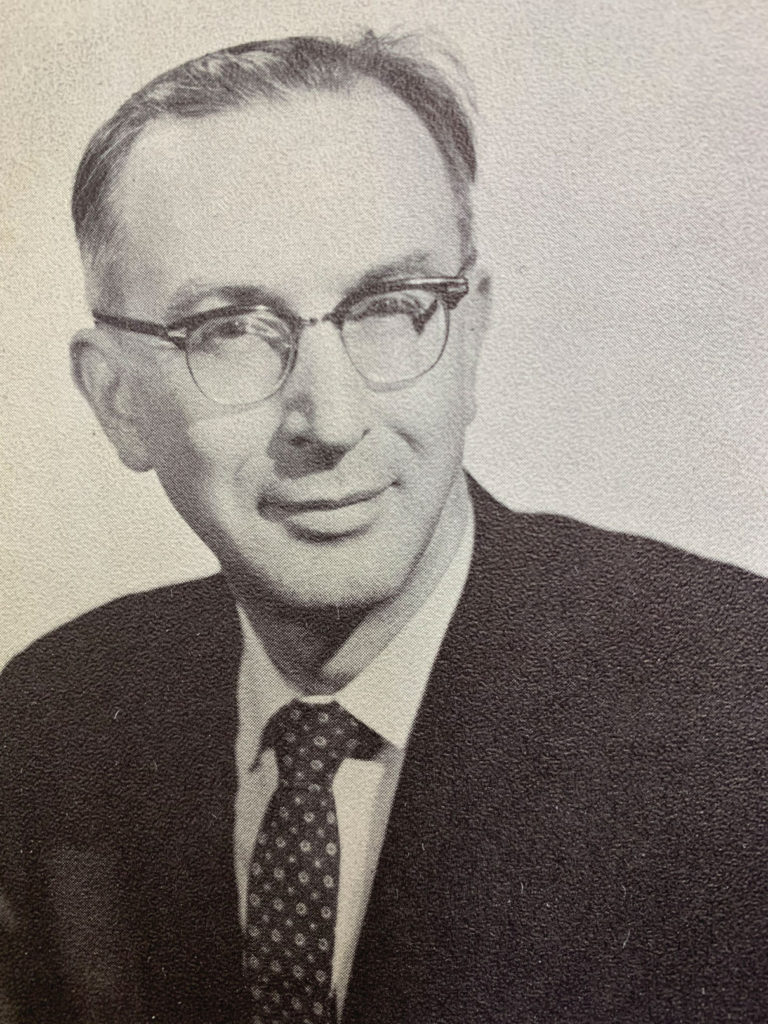
Rabbi Eliach, JBHS Principal in 1963
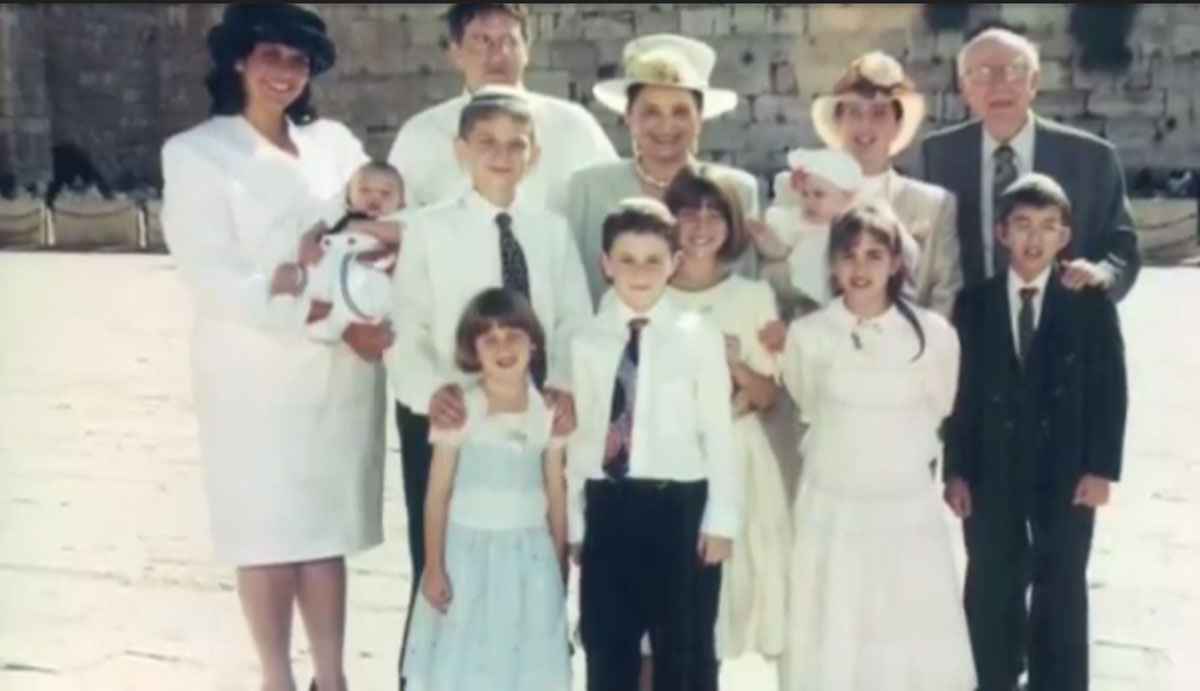
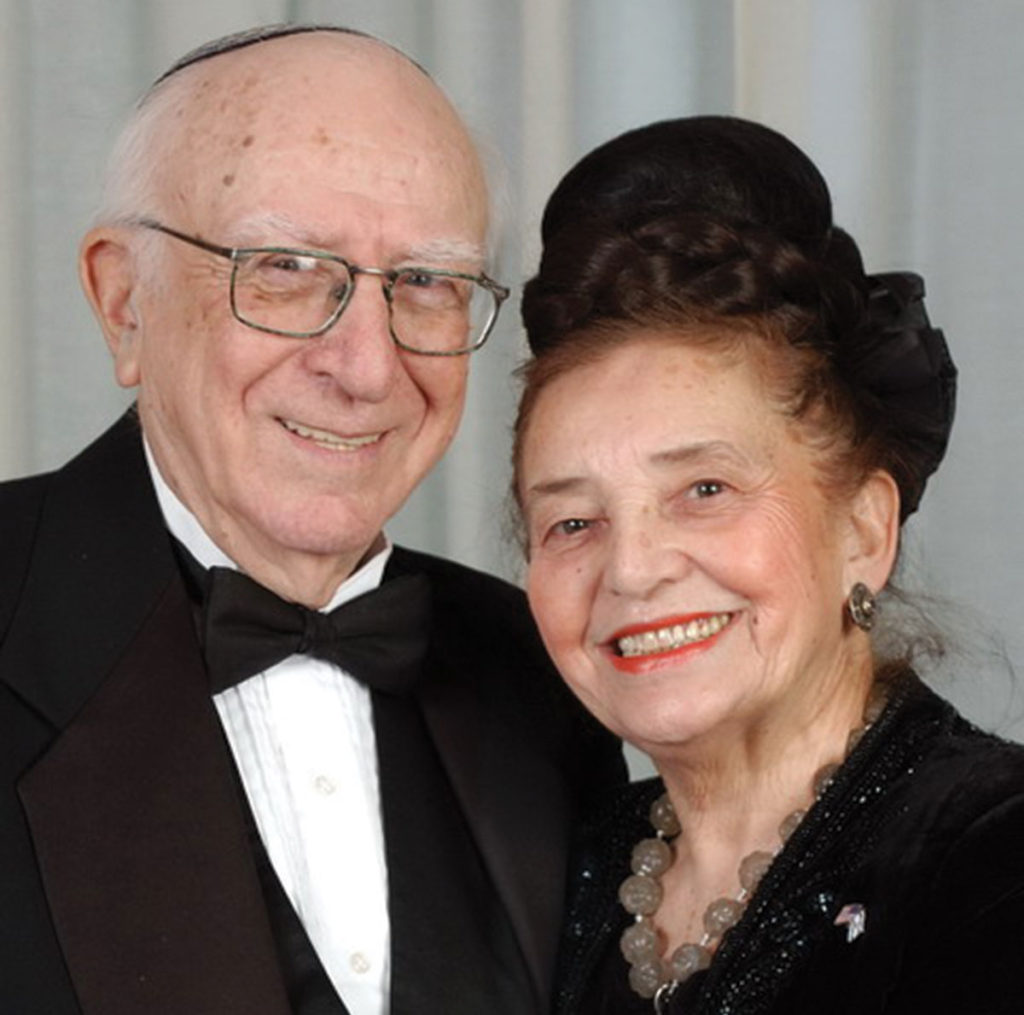
Rabbi Eliach was born in Jerusalem in 1922 to a Hasidic family. As a young man, he was one of the seven founders of the Yeshivot Bnei Akiva. In 1943, while he was studying for a law career, he was assigned to teach orphaned children of the Holocaust. He decided that he had to continue helping them and thus began his lifelong educational career.
“Learning permeated every aspect of his being,” observed Rabbi Eliach’s grandson Ayalon Eliach. His grandfather always began his conversations wanting to know what was on his grandson’s mind. “If I was going through a rough time, he would share a lesson that spoke to my particular pain. Our learning always started with a meeting of our emotional states.”
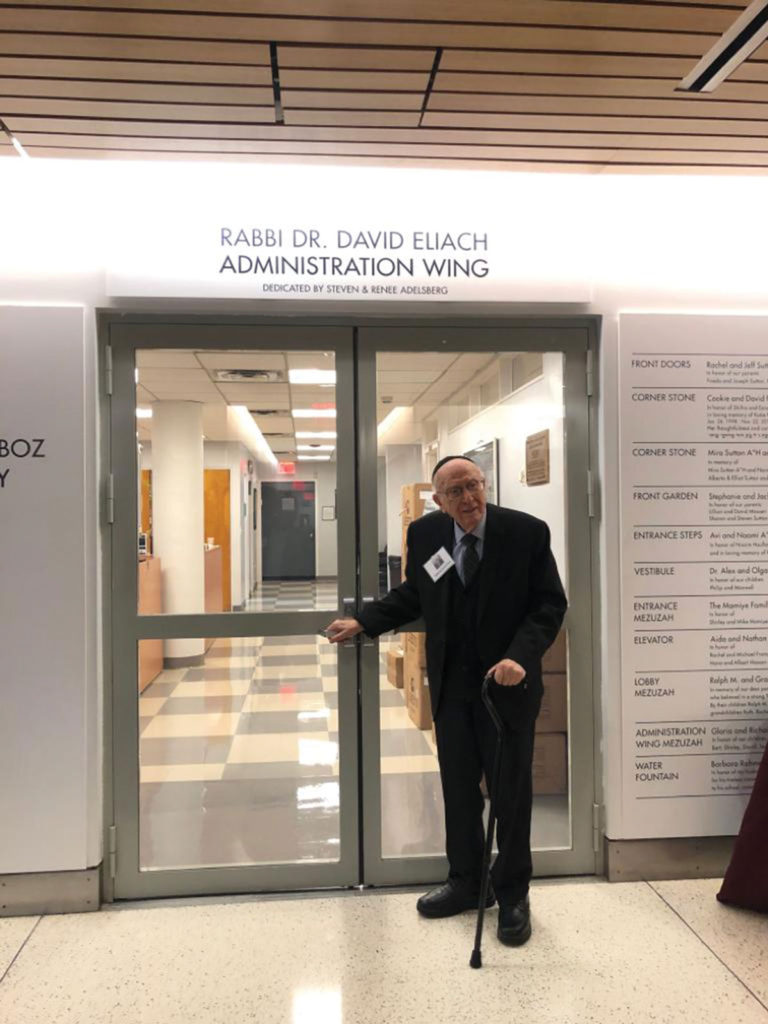
Rabbi Eliach in front of the JBHS Administration Wing that was named after him
During his tenure as principal from the early 1950s until late 1990s, Rabbi Eliach would open the door to every classroom on a daily basis in order to gauge the progress of the teaching and learning in all subject areas. “Rabbi Eliach was always a ‘teacher’s teacher’ who understood that the number one factor which influenced a successful educational experience was the quality of the teacher in the classroom,” said Rabbi Joseph Beyda, JBHS Head of School.
In Judaic studies, he expected to hear Hebrew and see a board that clearly mapped out the lesson using his own quintessential method that he taught new faculty, graduate students, colleagues and other professionals. He helped new teachers develop their own methodologies and classroom management and gave them opportunities to use their talents in creative and meaningful activities. Rabbi Eliach and his wife, Professor Dr. Yaffa Eliach A”H, historian, author, and scholar of Judaic studies and the Holocaust, often opened their home to students for Torah learning and conversation.
Rabbi Eliach and his wife Yaffa at a Flatbush dinner in his honor
Rabbi Eliach’s first priority was to instill in all students a love for G-d, the Jewish people, the State of Israel and the importance of hesed. Long before community service became popular, he instituted it as a high school graduation requirement. Thought-provoking speakers addressed school assemblies and faculty meetings at his request. When he initiated post-high school study in Israel, Rabbi Eliach went every year to visit the schools, review their curricula and programming and, most importantly, to meet with Flatbush graduates to hear about their learning and impressions.
“His scholarship, mentorship and leadership profoundly influenced the Yeshiva Day School movement in America,” noted Rabbi Haskel Lookstein, the Principal Emeritus of Ramaz. JBHS former faculty member Shifra Hanon recalled how Rabbi Eliach, anticipating the arrival of Russian and Syrian Jews, sent her for training in ESL and learning differences and added, “He was uniquely positioned to shape the education of generations of students. He rose to this new challenge, understanding and foreseeing the coming developments.”
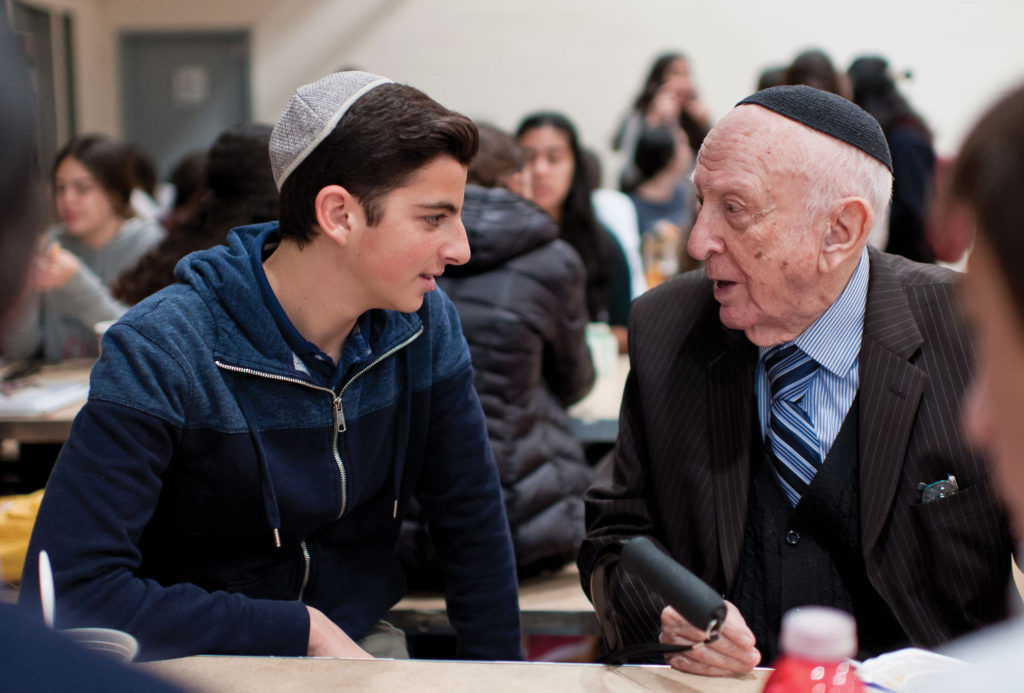
Rabbi Eliach deep in discussion with a student, Chaim Schvarcz Photography
In a 2012 interview, Rabbi Eliach spoke about antiSemitism; his words are eerily prescient. “We have to teach them why the Jewish people, Judaism and Zionism are important. The more you are educated and the more you know who you are, the more you can fight to defend what needs defending.”
After Rabbi Eliach retired in 1997, he continued working in the Yeshivah as a mentor for teachers. Even with his unparalleled depth of knowledge and experience, he spent hours preparing his sessions. The Rabbi was “infinitely patient, while maintaining a true standard of excellence and never tolerating mediocrity or complacency,” said Rabbi Binyamin Krauss, Principal of SAR Academy. Even during covid, he continued his mentoring by phone and never missed a session.
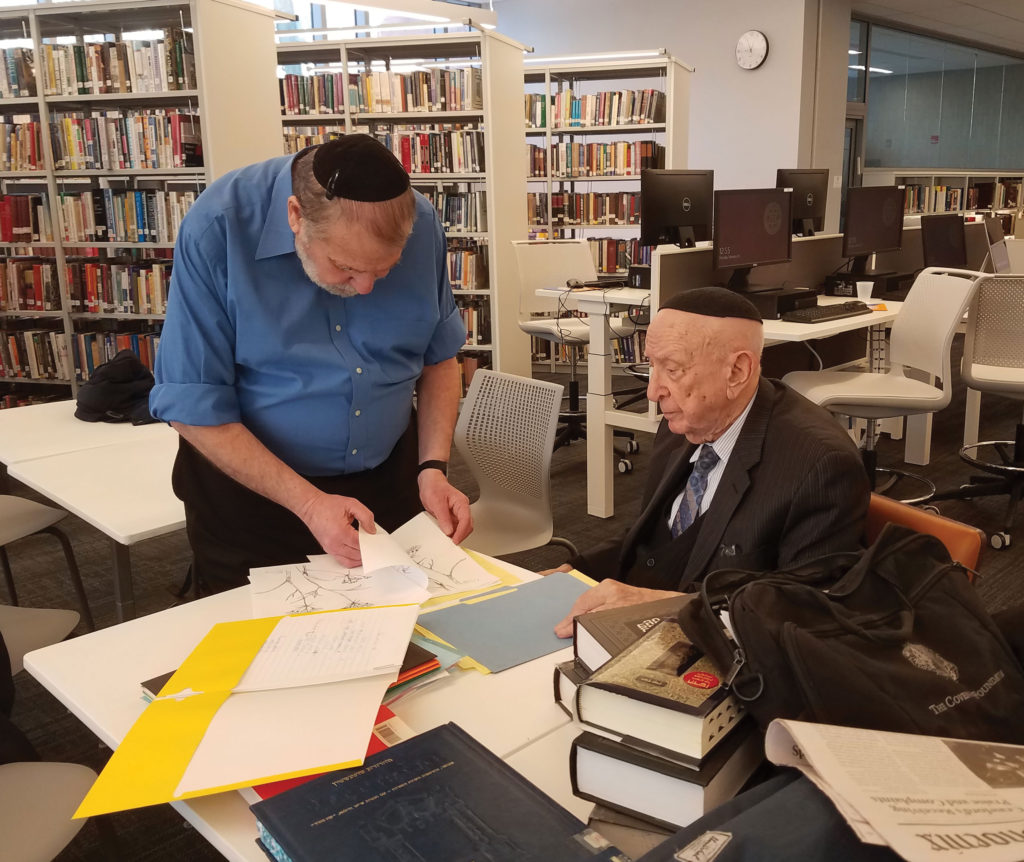
Rabbi Eliach working on his latest book
“With every passing day, we continue to hear stories of students and educators who were impacted by Rabbi Eliach,” noted Rabbi Dr. Jeffrey Rothman, Yeshivah of Flatbush Executive Director.
Former JBHS Head of School Rabbi Dr. Raymond Harari, himself a student of Rabbi Eliach, spoke at the funeral, which was held in the JBHS. “I was recently assigned a new office. There were two names on the door—mine and Rabbi Eliach’s, his name slightly above mine. I could not be happier to have a constant reminder of what I should aspire to.”
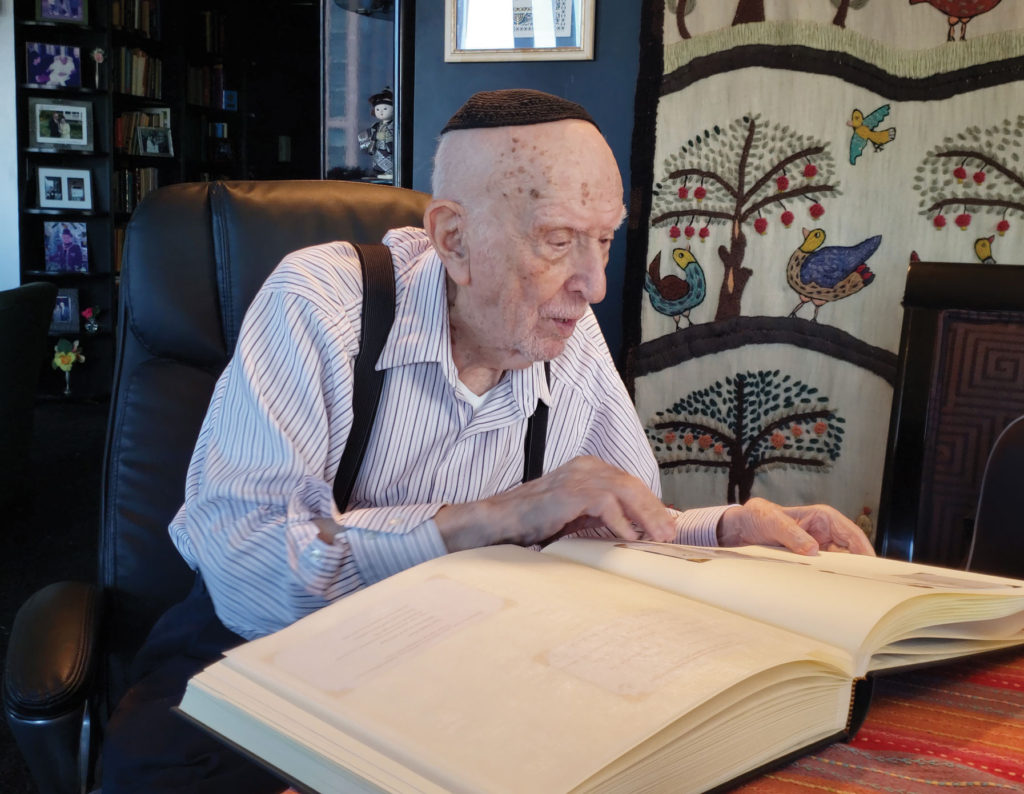
Rabbi Eliach reading from a book on his 98th birthday, Photo: Hila Stern
Rabbi Eliach is survived by a brother, three children, and many grandchildren and great-grandchildren. He published his Hebrew autobiography in 2018, Avar Shelo Avar (The Ever Present Past: My Journey from Jerusalem to Flatbush and Shurot,) a book of Hebrew poetry.
Several dedicated members of the Yeshivah of Flatbush team who worked with Rabbi Dr. David Eliach zt’l contributed to this story.
IT’S A RANDOM TUESDAY, AND A LUMP APPEARS WHERE IT SHOULDN’T BE, A BRUISE, OR TWO, A HEADACHE THAT JUST WON’T DISAPPEAR. WITH HASHEM’S HELP THAT DAY WILL NEVER COME AND WE WILL NEVER HEAR THE WORD CANCER SPOKEN AGAIN OUT LOUD, BUT IF IT DOES, G-D FORBID, KNOW THAT HELP IS JUST A PHONE CALL AWAY.
Nancy Sutton, founder and president of the Morris I. Franco Cancer and Referral Center, has been guiding community members through the medical maze for over 28 years, providing endless support, hope and understanding. It started with referrals and help for patients trying to choose the right doctors, hospitals and treatments. She followed up that work—more than a decade ago—with the founding of the Cancer Center, a haven that provides every patient with whatever they might need, before they even know they need it.
Compassionate and nurturing, Nancy and her team’s experience is vast and unmatched. Years of invaluable connections helped garner their relationships with both hospitals and medical professionals, leaving the Cancer Center with a data bank that is complete with the names, and often cell numbers of thousands of doctors, and is constantly updated. This knowledge provides a clear path to success for patients who are probably at the most vulnerable point of their lives.
Renee Zarif, a recipient of that care, explained, “From the point a patient gets diagnosed until the point they find an oncologist, the fear that overtakes them is incomprehensible. I was just 30 years old when I was diagnosed with Hodgkin’s Lymphoma; married nine years. You can just imagine what was going through our minds. There are many medical referral organizations and individuals, but when we got to Nancy, everything changed. The knowledge she has, the doctors on speed-dial, and the personal way in which she shared her thoughts—she was certain, when we were so uncertain. She actually found a way to put us at ease.”
A HAND TO HOLD Nancy not only guided the Zarifs, but also sat right by their side at the first appointment. Renee continued, “We were so serious and nervous, and she was just calm. When we walked in, she said, ‘let’s get oatmeal and coffee,’ like it was a breakfast date. I was a wreck, and she brought comfort; making everything more tolerable. We talked with the doctor, and once he said that I was going to lose my hair, I tuned out. I couldn’t even hear the rest of what he was saying. Nancy was there, thank G-d, to ask all the right questions; She is the expert, and that doctor was Hashem’s gift to me.
“Nancy and her wonderful staff took care of everything, from transferring files from one hospital to another, to finding the right insurance, to getting a wig ready for me, and getting meals cooked for our family, Nancy’s mind is like a computer. She knows which doctor and which hospital is right for each patient. She’s ten steps ahead, and when you can’t think straight, that’s more valuable than you can ever know.”
Rabbi David Ozeri “When a community member reaches out to me about a cancer diagnosis, the first person I tell them to call is Nancy Sutton at the MIFCC. I know that they will be getting the best medical guidance and have all their needs taken care of throughout their illness.“
Rabbi Joey Haber “When someone is sick, there are two parts to their disease, the physical ailment and the emotional pain. The beauty of the Morris I Franco Cancer Center is that you feel like you are in the best hands in the world with both!“
Herbert Pardes M.D. Executive Vice Chairman of NewYork-Presbyterian Hospital
“On the one hand you can give surgery, radiation, and chemotherapy. But if you pay full attention to the emotional and psychological needs of the individual like you do here at the Morris I Franco Cancer Center, you can expect a 20-30% improvement in the medical outcome.”
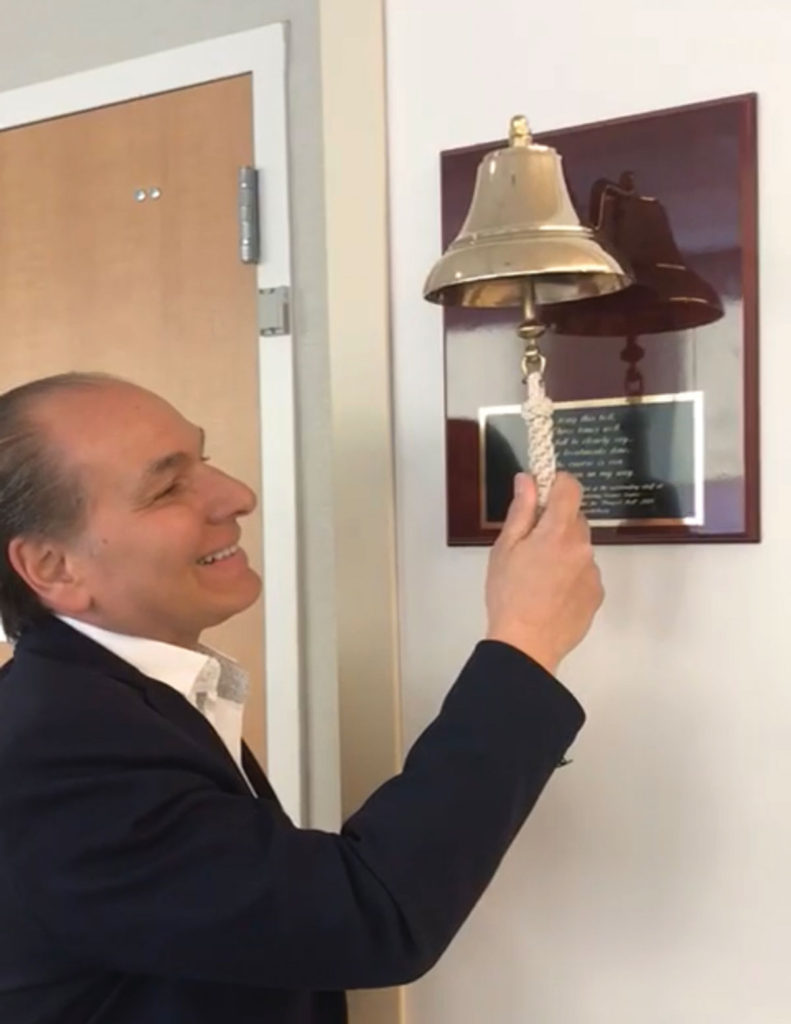
Joey Shamie ringing the bell at Sloan Kettering, symbolizing the end of treatment and the beginning of the road to recovery.
Ralph Tawil is another fighter, one who is just beginning his journey. On the second day of Passover, he told his wife Tami that he was having trouble formulating his words. After the CAT scan, the doctor came to their room with a chair in hand. They knew the news could not be good.
Tami recalled, “The ER doctor sent us to NYU, where a new doctor recommended surgery within a day or two. I did not say the word ‘petrified’ even once. I couldn’t go there. I just put one foot in front of another. But surgery? Is this the right doctor? I knew I needed the expertise only the Cancer Center could offer. Nancy picked up my call while with her grandkids at Universal Studios in Florida. She settled them, and sat down. ‘I’m all yours,’” she said.
“Once I told her the story, she said, ‘This is brain surgery! We need to research this! Give me some time.’ But when she called me back twenty minutes later, she was sure. This is the guy. Do it. Afterwards, Nancy and I were talking twice a day at least. This was the right doctor for the surgery, but we needed a course of action going forward. Nancy told me to come in to the Cancer Center and see dedicated staff member Margie Mathews to collect copies of the scans to send out. I used to volunteer there, so to walk in, and be on the other side as a patient advocate, was surreal. I expected to get the scans and a list of doctors. Instead, Nancy was standing there with a big smile on her face, a hug ready and a muffin in hand. I am good at many things, but doctors—definitely not my forte. Nancy sent our records all over America, and later on, she would usher us into Duke, in North Carolina. ‘Do you need a charter? We can arrange it,’ she asked. ‘What’s a charter?’ I answered. She would have been on the plane with us, if not for COVID. Instead, she joined us via Zoom. The whole time she acted as if we were doing her a favor, by allowing her to help us,”
Joey Shamie explained the magic of the Cancer Center and the love, concern and expertise that they provided when he needed it most. “When Adrienne and I faced the reality of my diagnosis, the first “911” call we made was to Nancy. She was in Israel on vacation, but of course, that didn’t stop her. She treated me like family—a brother—and gave 100% of herself. She made me feel like I had my own personal advisor and confidant, helping me to think things through to the best solution. Aside from that, she showed me first hand that we all love and care about each other in this community.”
CARING CONNECTIONS Rabbi David Ozeri recalled his first experience with the Cancer Center, ten years ago. “I brought in a patient truly traumatized by her diagnosis and Nancy took her by the hand, introduced her to the staff, and calmed her, in a way I never thought possible. I was amazed that something so complicated could be made so simple, and I never looked back. The patient received the best medical guidance and care available throughout her illness and she understood she was not alone; there was a light at the end of that dark tunnel. This is why the Cancer Center is always my first phone call in these situations.”
Nancy works in Brooklyn with her partners Sonia Didia, and Debbie Rahmey, and Gerrie Bamira heads up the Deal division. Together, with so many amazing volunteers, they have learned that healing comes not only from top quality medicine, but from people. From the very first meeting they are thinking of what the patient needs now, and later on. Is it counseling? A babysitter? A wig? A manicure or massage? Yoga? Meals for their family? Most helpful seems to be a connection that is made early on with other patients who have had similar experiences.
When Ralph was invited to a men’s group, and dinner, Tami was surprised he was open to it. “He’s so private,” she explained, “but Nancy managed to make him feel he was a part of something, and that she cared. It made him comfortable. I was also invited to a caregiver’s chat and get-together. Am I the caregiver, I asked myself? It’s an odd feeling to be part of a club I didn’t choose, but it’s comforting; it’s about showing you that somebody wants you to smile. It’s knowing we are in this together.”
Joey Shamie agreed, “We all love and care about each other, and have similar issues. We meet and talk on a regular basis. The Cancer Center treats us to beautiful meals, and the finest accommodations. It’s like they have an aerial view of what’s going on; because of their experience and dedication to the cause, they know how important it is for us to feel good. It’s a fantastic way of being able to heal, and help others to heal.”
When Nancy called Renee and said, “We’re doing a mosaics class, I want you to come,” she scoffed. Renee is a physical therapist, and like Tami, had been on the other side of the equation, working at the Cancer Center helping patients. Nancy begged, and she showed up. “I came, because I wanted to show my appreciation for all the Cancer Center was doing for me and my family. Meanwhile, it ended up being an incredible experience. I didn’t know anyone there, but quickly I became very comfortable. Who else could I talk to about the tricks to get through chemo? I laughed because I knew that Nancy had tailored that class to us, so we would lean on each other. It was a support group, incognito. We understood each other perfectly, and that helped.”
THE RED-CARPET TREATMENT While of course, the Cancer Center is focused on providing the best medical treatment, both physical and mental, there is another facet of care that is tremendously appreciated by the patients and their families. Zarif continued, “Nancy called me a few days before I was supposed to start chemo, and said, ‘I booked a Broadway show for you tonight, and dinner at La Marais.’ My husband was reluctant to accept the extravagance, but I knew it was a treat we could not refuse. That night was the first time in months that we did not talk about my disease, the chemo, or our problems. There were more dinners to follow, on a beach, by a pool, and even hotel stays, but that night was the first, and it had tremendous impact. We reflect on it often.”
Tami recalled a similar story, “At the end of April, Nancy invited Ralph and me to have a five-course dinner set in a lovely backyard in Manhattan Beach—just us and the waiter. She wouldn’t take no for an answer, and it was really magnificent. My husband is a quiet guy; he doesn’t like a fuss to be made, but this was nice. We got a cheesecake on Shavuot, flowers on Shabbat. There’s always something special, and it’s nice to know someone is thinking of us.”
Zarif continued, “Throughout my treatment, I kept asking Nancy, ‘What if it doesn’t work?’ and she would answer, ‘What if it does?’ When I was in the hospital for a month the Cancer Center helped get me a nurse, sent meals to my home every day, and delivered gifts to my kids—which really distracted them, and helped. When I finally came home, they set up a lunch for my husband and me by someone’s pool, and later on, a dinner on the beach. I had many food restrictions then, because of the treatment, but they paid attention to the details. It is a beautiful form of hesed, and it forced us to forget about everything for a little while. I can’t justify how much she helped me. It’s the medical part, yes, and they are unsurpassed; But more so, afterwards, emotionally. I’m self-sufficient, organized, and in control. I’ve been working most of my married life. To say I need help is hard for me. But Nancy and her team understood. They might be the only ones who did.”
YOUR FIRST PHONE CALL Joey Shamie continued, “Confidentiality is a burden that a cancer patient does not need. I encourage anyone that is going through these issues to open up and share, and accept the warmth and love that is around us. I am blessed with the amazing volunteers at the Cancer Center, my family, friends, and especially my wife Adrienne, who keeps me positive and helps me concentrate on my amazing life. Of course, I wish I never had it, but if I am honest, my experience over the last year has been the most rewarding of my life. Every person, gesture, doctor, nurse and technician has helped steer me towards recovery. From the head of the hospital to the young ladies who take my blood, I cannot thank them enough. Know that everyone is going through it with you. And that everything you put out there in the world, comes right back to you.”
Tami continued, “Ralph said that knowing that I had Nancy to hold my hand, was making his journey easier. Obviously, everyone’s taking care of him; but he was glad to know that someone was tending to me, too. From the beginning Nancy treated us like she had nothing better to do and no one else to worry about, no matter how busy she was. At a time when you’re so vulnerable, it feels good to have someone in your corner who is so experienced and knowledgeable. She continuously makes us feel like she is fully in charge of our care. It’s hard, but she makes it all a little easier.”
Adrienne Shamie said, “We sat in the doctor’s office calmly, awaiting a routine answer of ‘all is well.’ When the doctor gave us the news that my husband had stage 4 prostate cancer, we were shocked. ‘This is the kind of cancer you can die from, not the kind you live with,’ he said. I was sweating, and the whole room began to spin; we did not understand. We spoke with our children, and the next call I made was to Nancy Sutton. She picked up on one ring, from Israel. It was 2 am there. ‘What do you need,’ she asked. I was hysterical. The next day she had us in the very best doctor’s office, in Sloan Kettering. Nancy was by our side 24/7 and held my hand every step of the way. There were many complications, one after the other, but she was our guardian angel. Her expertise, connections and advice helped save my husband’s life.”
Dr. Herbert Pardes, vice chairman of NY Presbyterian Hospital explained, “On the one hand, you can give surgery, radiation and chemotherapy. But if you pay full attention to the emotional and psychological needs of the individual like they do at the Cancer Center, you can expect better overall results. It is all interconnected.” The Morris I. Franco Cancer and Referral Center helps their patients with anything and everything imaginable, going above and beyond, over and over again. Leaving no stone unturned, they are one of a kind; Their goal is to get their patients well, and they are very, very good at it.“
For more information about the Cancer Center and medical referrals, call (718) 787-1800 or visit us at nycancercenter.org.
Sophia Franco has been feeding her love of reading and writing for as long as she can remember through poetry, community journalism, and songwriting. She has written many songs.