Home Blog Page 104

Anxiety & Your Child with Special Needs

Watching your child overcome with anxiety is difficult. Watching your child with special needs overcome with anxiety is even more difficult—for so many reasons. Kids with special needs experience anxiety as many typical children do, however the way that the anxiety manifests, or is expressed, looks different based on the child’s communication and sensory processing skills associated with his/her diagnosis.

Many parents find themselves at a loss for ways to help. It can be very stressful for the entire family, especially when changes need to be made for one child and his particular needs.

Anxiety is defined as intense agitation filled with tension and dread. Many children with anxiety demonstrate the following symptoms: shallow breathing/hyperventilation, shaking or trembling, sweating, stomachache, diarrhea, vomiting, extreme agitation, crying, anger, hives, skin issues, loss of concentration, fatigue or lack of sleep, and avoidance of situations. Anxiety is different than fear, fear is specific, where anxiety is more tangible and nonspecific. If your child has special needs his/her symptoms may consist of everything previously mentioned and can also include increased stimming (short for self-stimulatory behaviors that include hand-flapping, rocking, spinning, or repetition of words and phrases), tantrums, or verbal responses.

Anxiety becomes a problem when it begins to disrupt the child’s ability to function in daily life. This includes refusal to go to school, refusal to leave the house, lack of friends, and limited social growth. It is natural to want to minimize the anxiety in our children and to try to identify the triggers in order to avoid them. Some children with special needs have communication difficulties, and the way these feelings of anxiety manifest may look different for each child—and even more different than a typically developing child.

To better understand the connections between special needs and anxiety, it is important to understand your child’s sensory system and how sensory overload may contribute to his overall behaviors and emotions. There are many different causes, symptoms, and treatments for anxiety. The ones that work for your child may not be the same as the ones that work for another child. Try to keep an open mind and be patient. Here are some tips: stay calm, I know this is easier said than done, especially if you are worried about your child’s wellbeing, but remember that your child doesn’t understand what is happening to him, and these feelings are very confusing. Take a deep breath, and calmly try to remove the child from the situation as soon as you can, to get him calm. It is important not to yell or demean him for his anxious thoughts or behaviors. If you are outwardly anxious you will feed into the child’s anxiety and make it worse.

If your child is verbal—communicate and listen—help him open up about his feelings, fears, and worries. Understand the value of tears, crying can be a great stress reliever. It can flush out bad feelings and ease tension. It’s hard to see your child cry and your first instinct will be to get him to stop, but be patient and wait. After he is finished crying, he might be in a more open and receptive mood for talking and sharing. Provide a soothing and sympathetic presence, but let the crying run its course.

Ask him what two or three things he is most worried about, and most excited about? Zeroing in on specifics will help your child sort through the array of fears and feelings. By asking what excites him, you will bring good things to light that may be drowned out by all the scary things the child feels. Acknowledge what he is feeling and show empathy. Don’t try and fix the problem, instead be supportive. Possibly even role play scenarios, so your child can experience the end result of the “what ifs” playing in his head and experience the outcome in a safe place.

Children suffering from anxiety feel comfort when they believe they have some control over the situation. If nothing else, you will ensure that your child won’t be afraid to talk to you the next time he feels this way. Let him know that he can always talk to you, no matter what, and you will not get upset or nervous.

Another important thing you can do is incorporate routine sensory diet activities throughout the day. A sensory diet is a carefully designed, personalized activity plan that provides the sensory input a person needs to stay focused and organized. Just as you may jiggle your knee or soak in a hot tub to unwind, children need to engage in stabilizing, focusing activities too. Some parents find it helpful to schedule quiet time to allow for downtime before the activities if the day gets too overwhelming. Deep touch pressure, whether it be through weighted clothing, compression garments, weighted blankets in bed, lap pads in the classroom, even putting rocks in his pockets helps. The positive input has positive effects on anxiety.

Try to learn your child’s signs of distress. It can even be nonverbal indicators telling you that he is quickly becoming over stimulated and anxious and needs your help regulating, before reaching the point of a meltdown. Create a portable sensory tool box to reduce sensory sensitivities and improve tolerance to stressful situations. It can consist of calming music with sound reduction headphones, chewy and crunchy snacks, weighted stuffed animals, essential oils, and preferred sensory fidgets.

Know when to get help, recognize the signs if it becomes a big enough problem to require professional help. Some signs can be change in sleeping and eating habits, attitude, behavior, friends, clothing, and music preferences. There are places that specialize in anxiety problems that you can take your child to. You can call the CARE office for recommendations. Keep in mind that childhood anxiety often has little to do with the parents. Let your child know that you’re always there to support him through these difficult feelings.

There are so many effective strategies that help with anxious feelings and each one is as individual as each child’s anxiety. Try not to focus on the big picture, look at the little improvements. We as parents need to support and understand that these wonderful children, who constantly struggle with anxiety, just need extra time, and a supportive loving and encouraging voice to remind them over and over that they can and will accomplish anything they set out to do.θ

Solving The Tuition-Crisis One Transaction At A Time

When it comes to education, we all want the very best for our kids. Due to rising tuition rates at all levels of schooling, that wish is becoming harder and harder to fulfill. Deep down we all know and understand that just as the price of food, clothes, rent, and virtually everything else has increased over the years, so has the price we must pay for a quality Jewish education—but that certainly doesn’t lighten the load on our wallets or the stress we feel!
Thanks to the United Children’s Education Foundation (UCEF), that is about to change.
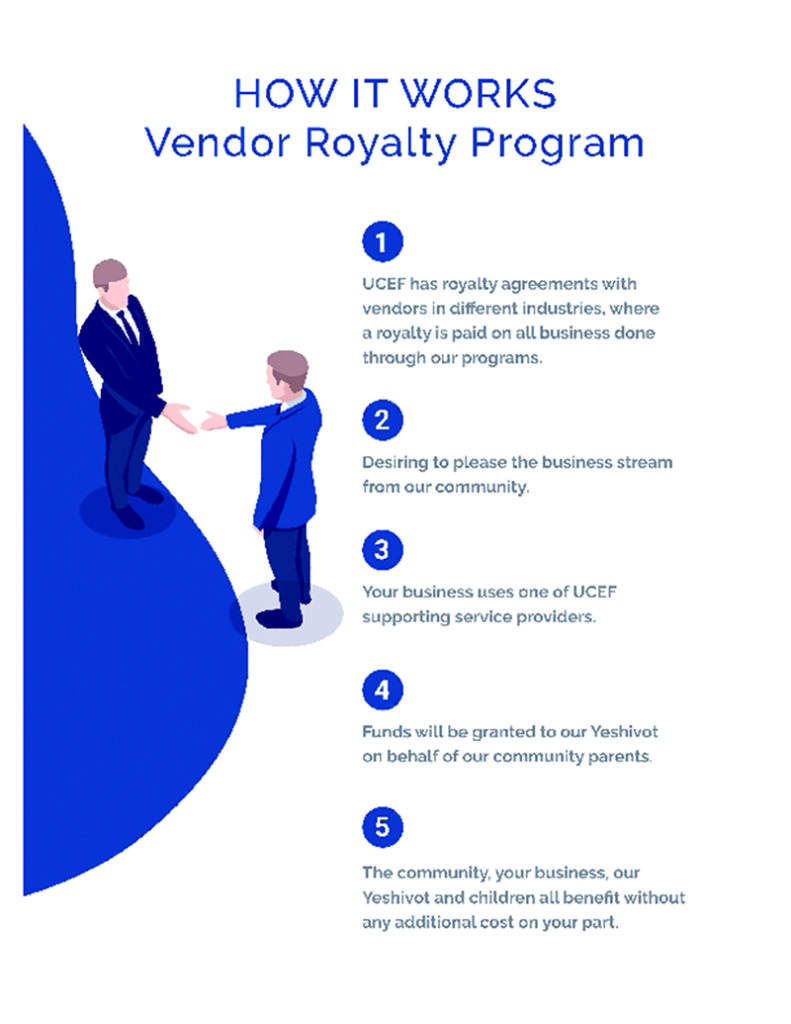
A few years ago, a group of community businessmen decided that the time for action had come. Together, they put into motion a whole new concept of how to raise and distribute money for education to families throughout the community. UCEF uses everyday transactions within community-based businesses to soften the impact that tuition can have on families. The result is quick and simple aid to the families of our community.

Using What We Have To Build A Better Solution

Instead of the traditional model of setting up an education grant program from the ground-up, UCEF is set-up to function like a business, collecting royalties from a network of vendors that are put directly toward families’ tuition invoices. The key to this whole operation is taking advantage of the tremendous buying power of our community. UCEF currently has 17 vendors within its royalty network who sell to local businesses of all types and then pay royalty contributions from the sales they make. The organization even helps startups or newer businesses find reputable vendors from within its network if they don’t have them already secured.
All of UCEF’s vendors are thoroughly vetted through a highly selective, board-backed approval process designed to ensure that our community’s businesses are working with the very best partners in their respective fields and receiving competitive pricing.
“We joined with UCEF about two years ago,” said community member Morris Dweck, CEO of Bentex Group Inc. “It’s not only about money, it’s about quality, and service. Why not try it? There’s no downside.”

Bringing Big Ideas To The Real World

To better understand how UCEF’s vendor network system operates, it can be useful to look at some real world examples. From business owners to individual families, almost anyone can get involved, such as:
• A community importer working with a UCEF forwarder, negotiate as they normally would, and UCEF would get a royalty of that deal.
• Anyone who accepts credit cards in their business—why not work with UCEF’s vendor? You may even save money while helping them generate money towards the fund.
• There are 17 unique vendors in all different industries. Visit www.ucef.com to learn more.
Nobody is expected to spend a dollar more than they currently are—only work with UCEF vendors if it makes sense for your business.

An Idea Bigger Than Business

By choosing to work with and support UCEF, you are also intertwining your business with tzedaka. You are giving back to the community without even knowing it, while at the same time helping your business flourish.
In the short time UCEF has been operating, the model has already proven to be an absolute success.
UCEF has generated approximately 1.5 million dollars in three years without any solicited donations to aid community parents with tuition bills. All this, with only a small percentage of community businesses currently using its vendors.
“I feel as though we have only scratched the surface,” said UCEF Executive Director Sammy Esses. “I estimate in the near future, we will be able to fund millions in tuition bills. The only question is how long it will take. That is all up to the community.”

Simplifying How FamiliesSecure Grants

The guidelines for eligibility are extremely inclusive and fairly simple to secure. Once a family applies and is given the green-light for a tuition grant, UCEF sends the money to the children’s school and the family sees a deduction on their tuition bill automatically .
The organization uses a third party vendor to determine if a family qualifies, so your financial info is completely confidential. Grants are distributed evenly amongst all qualifying children, with no favoritism or bias going to families of any demographic or socioeconomic status.
“I don’t know what I would do without UCEF,” said a parent who received a tuition grant. “I wasn’t sure how I was going to send my kids to camp, but when that grant kicked in, it suddenly became doable.”

How To Get Involved With UCEF

Tapping into our business buying power as a community is only the start of what UCEF can be.
Ultimately, the goal of UCEF is to ensure that if money is being spent in this community—be it business transactions or personal purchases—a portion of that money should be reinvested in our children.
Families, businesses, and individuals are encouraged to give UCEF a call to see how they can get involved and start putting their spending towards the greater good, now. Every time you pay a bill or swipe a credit card, you should first think—am I making my money work towards a greater goal? Could this be better spent through UCEF to educate our children and help our community thrive?
“This started as just a thought, an idea, but I knew instantly, this must happen and it’s truly a no-brainer,” said Vice President of UCEF Joe Levy. “The amount our community spends annually between the business expenses and personal spending, there is absolutely no reason why this model shouldn’t work if everyone takes the initiative to become involved in it.”
We already have the buying and spending power, to resolve our own crisis. Now, we as a community should get behind this project and propel it to what it can truly become. The model works, it’s been proven, now it’s up to you to step up and see how you—yes you reading this—together with UCEF, can make a brighter tomorrow.
The time has come for us all to stop complaining about the tuition crisis and to start being a part of the

SOLUTION.

If you are interested in using one or more of UCEF’s royalty vendors or would like to become a UCEF vendor, we encourage you to get in touch with UCEF today at connect@ucef.com or 212-641-0501.θ

Teach NYS Ambassadors

Teach NYS, a project of the Orthodox Union, was formed in 2013 with a singular purpose: securing government funding for nonpublic schools. Through grassroots advocacy, Teach NYS says its secured $450 million in state funding for New York nonpublic schools. This year’s budget includes $15 mil-lion for nonpublic schools to hire Science, Technology, Engineering, and Math (STEM) teachers—a $10 million increase over last year, when the program began. It also includes $15 million to strengthen security in nonpublic schools.What exactly is grassroots advocacy?

According to Teach NYS Grassroots Engagement Director Annie Watman, it means getting Jewish community members to register, vote, and speak to their legislators in large numbers. Teach NYS has initiatives to engage the community in each of these ways, and Watman says they are always look-ing for more community members to get involved.In 2016 and 2018, Teach NYS ramped up its voter registration and “Get Out the Vote” activities.

They educated day school parents through partnerships with over 50 yeshivah day schools, and made tens of thousands of phone calls reminding Jewish parents through-out the state to register and vote. Last year, they launched an online platform using Turbovote, which allows community members to register and get reminders to vote on their phones, tablets, or computers.In addition to voting activities, every year Watman and the Teach NYS grassroots team organize a Mission to Albany. Teach NYS brings hundreds of community members, teachers, rabbis, and students to meet with their state legislators and request funding for day schools.

“Legislators are bombarded all day by lobbyists and political operatives,” Watman said. “So legislators pay close attention when their constituents come in-person to explain why our schools need state funding.”This annual event complements Teach NYS’ Ambassador Network program, which pairs community members with legislators to build lasting, impactful relationships.

“Teach NYS Ambassadors give a human face and voice to New York State’s 1.7 million Jews, which is crucial for showing legislators that we’re more than just another interest group,” Teach NYS Director of Lay Network Development Avi Spitzer said. Consider Abe Sultan.

He’s no lobbyist or political operative—he works in real estate—but in February 2018, Abe was sitting in the office of Assemblywoman Alicia Hyndman explaining why she should support security and STEM funding for New York day schools. Four months later in June, Abe brought the assembly-woman to the Yeshivah of Flatbush to see how the state’s STEM will be spent—in the school’s computer lab, robotics program, and math enrichment initiatives.

“She had never been inside a yeshivah before, but when I took her through, she was very impressed and reaffirmed her commitment to help in any way she could,” Abe said.Joey Braha is another one of Teach NYS’ roughly 50 Ambassadors; he is paired with State Senator James Skoufis, whose district in Orange County encompasses the heavily Satmar Hasidic village of Kiryas Joel. Braha said school visits by legislators go a long way towards dispelling myths about yeshivah day schools, such as Jewish schools are monolithic, ignore secular education, or are for wealthy families only.

“Elected officials may have a certain image of how a yeshivah operates—from the students to the administration to the curriculum,” Braha said. He continued, “That’s why it’s imperative we take the initiative and show legislators how a modern yeshivah functions. Once they witness firsthand that our children are well-versed not only in Judaic studies but also in STEM, English language, and the arts, then they generally understand what we would like to accomplish with their help. It’s crucial to have strong relationships with elected officials,” he added, “because that’s how we communicate the centrality of Jewish schools to our communities.

Fostering those relationships is what the Teach NYS Ambassador program is all about.”Joey Oved, another Teach NYS Ambassador, said building relation-ships with legislators is eminentlydoable. “It’s meeting with your assigned legislator once or twice per year, making a phone call or email every few months, and hosting them at your home or school once per year.”

All told, Oved said, it’s an investment of about 5 to 10 hours per year. Each hour Ambassadors invest has an outsized impact thanks to the hard work and expertise of the Teach NYS staff. “You don’t need to be a political genius or formulate the strategies because Executive Director Maury Litwack, Annie Watman, and Avi Spitzer have already figured that out,” Abe Sultan said, referring to the Teach NYS team. According to Abe, the staff pairs Ambassadors with legislators, coaches them on the policies, suggests when and where to schedule school visits, and gives regular reminders to contact their elected officials. Teach NYS Director of Lay Network Development Avi Spitzer said he works one-on-one with the Ambassadors to ensure they are fully equipped and comfortable with their roles.

Joey Oved said Ambassadors’ relationships with elected officials, like all meaningful relationships, should be long-term. For years, Oved has had a relationship with Tish James, former NYC Public Advocate. James’ help was instrumental in a successful push last year to create a $1 million kosher free lunch pilot program for pub-lic and nonpublic school students.

Last month, James took office as the New York Attorney General, and Oved said he looks forward to continue working with her for many years to come.According to Avi Spitzer, the high impact of the Teach NYS Ambassador Network program means they are always looking for more Ambassadors. “If you’re not sure about becoming an Ambassador, join our Mission to Albany on March 12, 2019 and try it out.

”The Missions to Albany make a huge difference, Joey Braha said. He related how two years ago the Teach NYS group was addressed by Governor Cuomo, who took the opportunity to announce $25 million in security funding for non-public schools. “It’s important to understand that the legislators in Albany, along with their staff, are keenly aware of the Governor’s where-abouts at all times. When Cuomo speaks to our group as he did then, that puts us on the map. I’m not aware of any other school group doing this.” And the fact that many participants choose to become Ambassadors is a nice bonus, Spitzer concluded. For more information please visit www.teachnys.org

Read Jewish Image Magazine Online – April 2019

Read Jewish Image Magazine Online – April 2019

Click Here

To View Jewish Image Magazine in PDF

Click here

RABBI SHLOMO BRAUN PRESENTS THOUSANDS OF DOLLARS TO BENYAMIN MAZOOR IN BETH SHEMESH THIS PURIM

Benyamin Mazoor moved to Beth Shemesh close to five years ago from a secular area in Israel so that his children can have an Orthodox education.  Under no circumstance was he able to find a school suitable for his children due to their Sephardic background. After searching for a proper solution, he was introduced to the distinguished great Tzadik and well known spiritual and major community leader Hagaon Rabbi Chaim Fogel Shlit”a.  Rabbi Fogel remembers and admires the love and concern of the first Grand Rabbi Yoel of Satmar O. B. M. had for our Sephardic and Yemenite brothers and sisters.  He told Mr. Mazoor that his only choice is to create a new Yeshivah for Sephardic children in Beth Shemesh and that he is obviously prepared to help him to make it a reality.

Within a year Talmud Torah Toras Chaim was established. Which is the only Ultra-Orthodox Sephardic School in Beth Shemesh and surrounding areas accommodating 70 students in six classrooms with a policy that  “No Child Will ever Be Left Behind”. This past year Mazoor also founded the first  Orthodox Sephardic Girls School with 30 students. A year ago Rabbi Shlomo Braun who has succeeded in assisting many organizations and individuals in the past 50 years, learned about the uniqueness of this school from some friends in Brooklyn and decided that on his next trip to Israel he will visit the Yeshivah.  During the last Chanukah season Rabbi Braun appeared unannounced to the Yeshiva, and Benyomin Mazoor gave him an impressive tour and invited Rabbi Braun to interview and test the children’s knowledge of their learnings.  Rabbi Braun having visited many Educational institutions in his lifetime was pleasantly surprised and considerably amazed at their behavior, self confidence and above all how much these children have absorbed in themselves the knowledge, respect and admiration of their Torah teachings.  The distinguished administrator, Mr Mazoor later shared with Rabbi Braun that the driver who transports morning & evening ten children from an area where there is no Orthodox education has not been paid for over one year.  it is unfortunately due to the severe financial burden on the Yeshiva and the poverty level of their parents that caused that the driver has not been paid. The driver gave an ultimatum that if he doesn’t receive the funds owed to him soon, he will have no alternative except to cease transportation services for these children, (which may have left them uneducated).  All other children of this school live in walking distance and have no need for transportation. 

Mazoor also mentioned to Rabbi Braun that the  small  house on Rechov Sinai 30/B in Beit Shemesh where the current Yeshiva has been for the past for years is unable to accommodate many additional children on the waiting list because there is no room for them. The School has an opportunity to purchase the house adjacent to them but needs a minimal fund of $100,000 for a down payment.

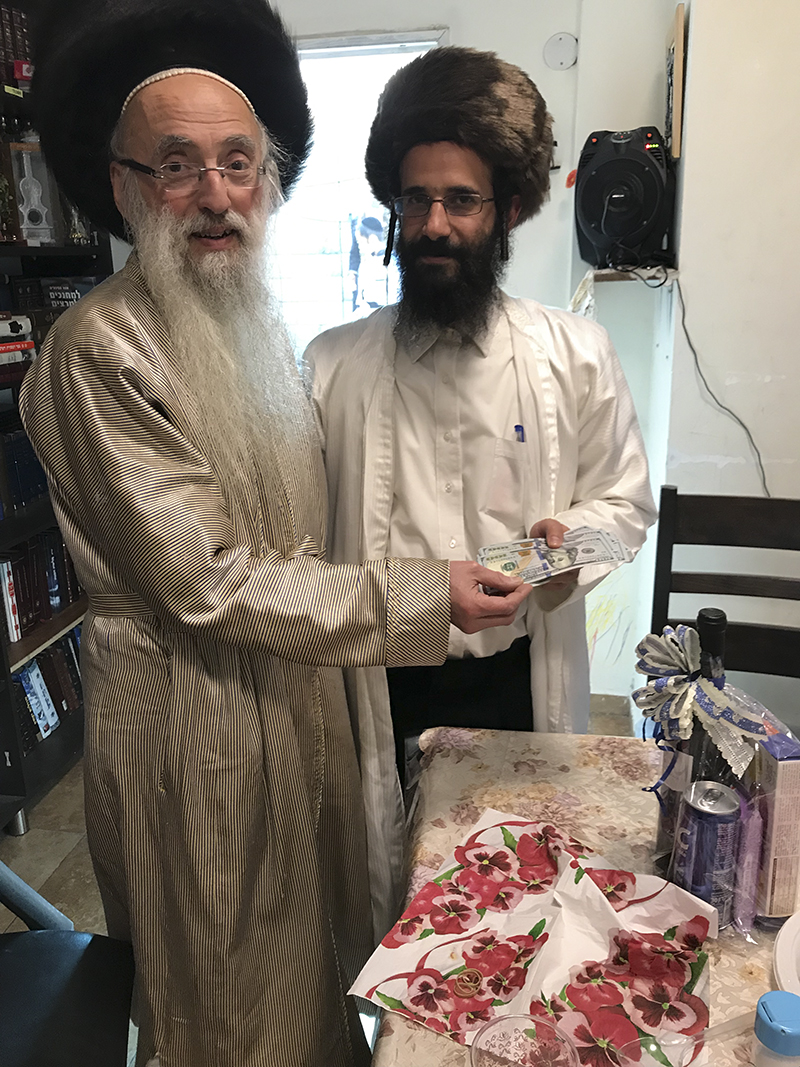
The first request about the transportation Rabbi Braun accommodated by bringing on the recent day of Purim several thousand dollars in cash! To pay out the entire balance owed to the driver. (See photo)  As Rabbi Braun presented him with the unexpected amount of money Mazoor stated, “it is extremely difficult to convince tourists from the USA to pay a visit to this outstanding school”.  He is certain that Rabbi Braun was a messenger sent by the one and only, and therefore came to visit our school earlier this year and returned again with the generous gift that he raised in the USA in the Boro Park in the main Satmar Congregation on 53rd Street.

Mr. Mazoor thanked Hashem for his unusual success in the past four years and prayed to almighty G-D that he be blessed with a few additional friends like Rabbi Braun. 

The second request is being addressed.  Everyones help is desperately needed. For additional information please call 0533122354 or email to Benyamin Mazoor at mmm96362@gmail.com

Laura’s Lessons. Don’t Fall Victim To Winter Weight Gain

Do you gain weight during the winter? If so, you’re not alone. Researchers have found that it’s extremely common to gain five to seven pounds during winter months. There are many reasons why the pounds sneak on when it’s cold outside. As a matter of fact—the cold—is a reason. Many people who exercise outdoors stop when the temperature drops.

Another reason—Hanukkah and Hanukkah parties. Hopefully you didn’t eat too many potato latkes and donuts.
More reasons we gain weight: comfort foods, office treats, summer fruits are out of season, and big sweaters hide winter weight.
Here’s what you can do about the lack of exercise, comfort foods, office treats, etc.

If you want to stay active, ask someone to exercise with you—even if you just go for a walk a few times each week. It’s hard to get motivated to get bundled up to walk, especially when there’s snow on the ground, but it’s not as difficult when you have a friend to walk with

When the temperature falls, we tend to say goodbye to light meals and hello to comfort foods like hardy stews and big bowls of pasta. You don’t have to give up these foods, if you prepare them with low calorie and low fat ingredients and control your portion size. If you add a bunch of vegetables to your stew, it will be a thick, chunky, and healthy meal.

Often, in the winter, associates and employers send cookies and candy to the office. These treats can be hard to resist, especially around three in the afternoon. One thing you can do to help you stay away from them is have a healthy snack around two, so when three o’clock rolls around, you won’t be thinking about food. If, however, you must eat something fattening, have a bite or two.

While summer fruits are delicious, there are many great winter fruits, too, like oranges, apples, and pears. You may be surprised by how much you like them. They make great snacks.
If you follow these little tips, you won’t gain weight this winter. Of course, you can still wear big, cozy sweaters, and you’ll be happy that they’re not hiding extra pounds.

Gesher Yehuda Launches State-of-the-Art Programming and Enhancement

Portrait of smart schoolgirls and schoolboys looking at the laptop in classroom

Gesher Yehuda Yeshiva, a K-8 special education school, has implemented a range of cutting edge improvements designed to offer a state-of-the-art education to children with learning challenges. After careful review of new pedagogical and therapeutic research, the changes are designed to contribute to an exciting learning environment.

Changes include:

• A sensory gym that will meet student needs in innovative ways. It will feature a variety of swings, a crawl tunnel and a rock climbing wall.

• A cutting-edge NeuroNet program designed to build neural pathways, enhance critical math, reading, and handwriting skills and facilitate higher-levels of learning.

• ClassStars a computer-based program that allows teachers to record behavior in real time facilitating classroom management.

• A 3 Cs program that rewards children for good behavior and diligence as it contributes to a joyful school learning environment.

• A fully elaborated information technology platform including smart classrooms, a computer lab and universal WiFi. Now in its 26th year, Gesher Yehuda Yeshiva educates children with learning differences in a comprehensive program.

A dual curriculum of Judaic and General studies is tailored to provide students with appropriate instruction within a personalized and encouraging setting. Gesher Yehuda views each student as an individual whose interests and abilities motivate their desire to learn.

Through a flexible and comprehensive interdisciplinary approach, Gesher devises learn-ing strategies based on students’ strengths. Our professional staff provides clearly structured, multi-sensory experiences in all subject areas. Small class settings, tailored groups and innovative individual instruction provide opportunities in a challenging yet nurturing environment. For more information about our programs or to schedule a tour please contact Sury Fleischman at info@gesheryehuda.org or visit gesheryehuda.org.

Help Sick Kids GIGG’L

What’s GIGG’L?
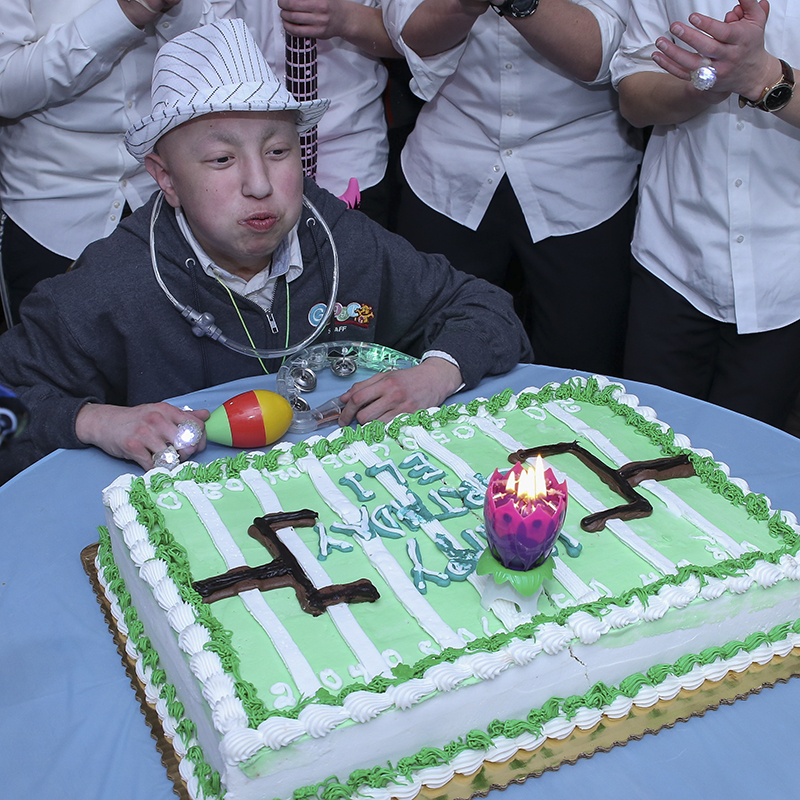
GIGG’L is an acronym for Giving Inspiration Giving the Gift of Life. It is a Brooklyn-based organization, which specializes in Putting smiles and laughter on the faces of brave children, battling life-threatening illnesses!

How do they do this?
By arranging stunning parties and events, complete with delicious food and magnificent entertainment, allowing the patients and their families to escape harsh reality for a precious few hours.

To whom do they cater?
GIGG’L serves a plethora of families in the tristate area and beyond, with children who are battling dreaded diseases.

Who runs it?
GIGG’L is run by its Founder and President, Menachem Tzvi Roseman, under the guidance of its board of directors and with close rabbinic consultation.

How did Menachem Tzvi Roseman come to be involved in a project of this nature?
Menachem Tzvi began his career of cheering ill children when the daughter of a close friend, Rabbi Yisroel Landsman, took ill and battled a dreaded disease for several years. Throughout this long and arduous road, Menachem Tzvi continuously searched for ways and means to bring cheer and good spirits to Rabbi Landsman’s daughter, and her family, at large. Menachem Tzvi was there for them 24/7—liter-ally.Sadly, four years after Nechama was diagnosed, Rabbi Landsman was diagnosed, as well, with a dreaded disease and passed away only a few short months after his dear, beloved daughter.This experience, and his upbringing in a warm, caring home, where looking out for your friend, neighbor or acquaintance, and going the extra mile for them, was stan-dard protocol, provided Menachem Tzvi with the impetus to embark on this ambitious, arduous undertaking and create GIGG’L, which he founded in 2013.

Have you seen the organization in action?
We were at one of GIGG’L’s parties and it was absolutely amazing! I’m not sure what the kids enjoyed most, the beautiful array of happy lights, the superb props, the fantastic, colorful costumes, the delicious, plentiful food, the lively music, the trained, dedicated and professional volunteers, the exciting games, the fun toys, or the generous gifts that they distributed.

What I enjoyed most was the giggles and the smiles on the faces of the children and their families! We were awestruck by the outpouring of love and care exuded by GIGG’L, and this feeling is clearly reflected on the children’s radiant faces! It’s absolutely an amazing, mind-blowing experience! GIGG’L utilizes many avenues to stretch each dollar spent to the maximum. For example, the organization is staffed entirely by volunteers, which cuts down significantly on the costs. Another example, Menachem has built many valuable relationships with vendors and venues over the years and can often get a very reduced rate on services, products and venues—again significantly cutting down costs. Finally, GIGG’L does not employ professional fundraisers, ensuring that every dollar raised is directly applied toward helping the children and their families.

And yet, GIGG’L is dependent on the public’s generosity to continue their blessed work. It is the broader community that it depends on to fund their activities and enable them to continue to bring smiles and relief to the ill children and their families. If you would like to donate to GIGG’L, or perhaps would consider sponsoring a party, or would like to assist in any other way, please contact them! You’ll be glad you did. GIGG’L is a 501c3 approved organization.

To learn more about GIGG’L, please visit their webpage: www.giggl.org, or follow them on Instagram at giggl_official, or email Menachem Tzvi Roseman, directly at menachem@giggl.org. Please make checks out to: GIGG’L. Their mailing address is 515 East 9th street, Brooklyn, New York 11218.

The Magic of Music for Your Child with Special Needs

Have you ever felt very relaxed when listening to music? Have you listened to music that instantaneously brought up strong feelings, or brought you back to a special time in your life? Have you felt a sense of inner strength or spirituality when listening to music? Have you sung a lullaby to help comfort a crying baby, or the alphabet song to teach a young child? If you answered “yes” to any of these questions, it’s because you have experienced the power of music.

Music can evoke emotions, memories, spirituality, social connections, a sense of security, and comfort, as well as provide a means of expressing feelings. Music also provides a fun way for children to learn. Music has a powerful impact on people, and for those reasons music therapy has served as a healing method for physical illnesses for generations. Music has the ability to neutralize negative feelings and enhance the body’s natural stress tolerance level. People of all ages are candidates for music therapy.

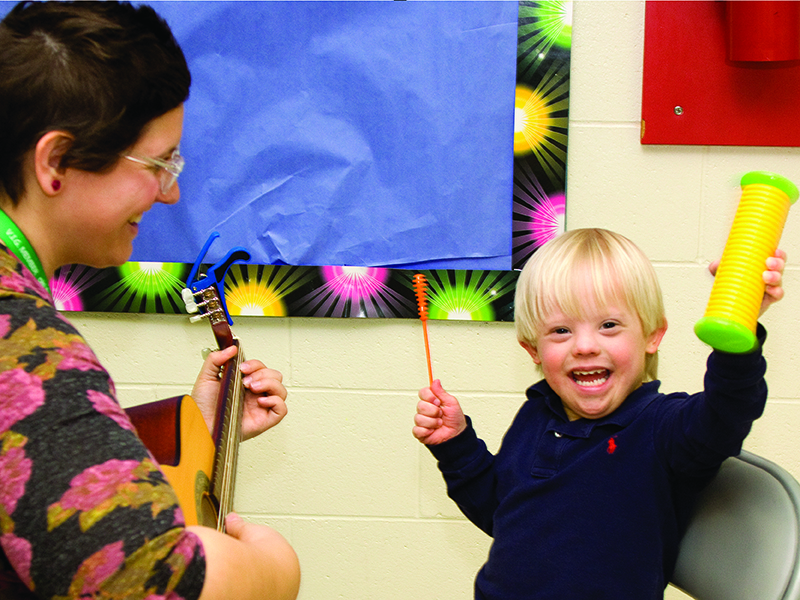
Traditionally, music therapists work in institutions, such as hospitals, nursing homes, and schools for children with special needs. Music therapy uses music as a vehicle to achieve non-musical goals. When a child has special needs, music may be one of the most powerful ways to reach him or her (we’ll use him from here on), and help him function at his full potential.

Music therapists work with individuals of all levels of abilities and challenges, including disorders such as autism spectrum, cerebral palsy, Down syndrome, developmental disorders, ADD and ADHD, to mention a few. Common music therapy goals include improving motor skills, communication, academic skills, social skills, attention span, improving behavior and mood, following directions, and eye contact. Music therapy can sometimes be covered through the I.E.P. (Individual Education Plan), Medicaid waiver reimbursements, and sometimes must be paid out of pocket.

Both sides of our brain experience the benefits of music, it bridges the gap between our brain’s right and left hemispheres, appealing to the whole mind. Music has the power to stimulate the senses, because when we experience music almost all our brain’s functions work at once. Children can more easily absorb information, and communicate better through music or song, and improve cognitive activity and self-awareness—which is a neurological dream come true, and which also helps explain music’s soothingly therapeutic benefits. While music has long been recognized as an effective form of therapy, parents, caregivers, and family members can use it to treat physical ailments, reduce stress, and to do a whole list of other things.

Listening to music helps develop the brain.Popular songs can be used to teach. You can take the song “BINGO” and change it to spell the child’s name. The tempo of a lullaby matches the tempo of a heartbeat. Lullabies can be used to comfort crying babies and help them feel secure. Incorporating lullabies into a bed-time ritual can help children make the difficult transition into sleep. Calm, quiet music can be used to reduce stress and enhance relaxation. Simply having relaxing music in the background can change the way you feel. Play relaxing music in the morning to reduce the stress of the morning routine. Even around dinner time, it can calm children, and help them unwind from school. This will help you relax as well.

Relaxing music can be used to reduce anxiety prior, during, or after surgery or in any medical situation where you or the child feels anxious. As children grow older and listen to more music, they will begin to have preferences. We all have favorite songs that we identify with. These songs may express an emotion that we feel, or talk about an experience we are coping with. Music is an expression of emotion and the words an expression of thought. Periodically, listen to your child’s favorite music with him.

This is a good way to communicate with your child. Asking why he enjoys a certain song can help you get a sense of things that you may not be aware of, or know about your child. Singing or playing music as a family can be a fun way to enjoy being together. Where words fail, music speaks. Music can change the world, because it can change people. It’s the one language we all speak.

Read Jewish Image Magazine Online – March 2019

Read Jewish Image Magazine Online – March 2019

Click Here

To View Jewish Image Magazine in PDF

Click here

(*It may take a while to download the flash file for users with slow Internet connection)

Lives in the Balance, The Stories of Women

These are the women of our community, here are their stories.

Meet Rachel, a psychotherapist in our community

Rachel’s story is relatable and inspiring to all women. She attended Columbia University. Although she was interested in pursuing a graduate degree in medicine, Rachel’s parents encouraged her to go the traditional route and marry upon graduation. For the next ten years, Rachel put her career on hold while raising four children and becoming immersed in communal life. She actively volunteered at her children’s schools and became very involved at Sephardic Bikur Holim (SBH).
When her youngest child turned two and was enrolled in a three-day preschool program, with the support of her husband, Rachel decided to refocus on her career. Inspired by her volunteer role at SBH, she decided to enroll in a social work program at New York University. Very mindful of her personal commitments to her husband and children, she attended school on a part-time basis, over a 3-year period.

After graduating with a master’s degree in social work, Rachel opened her own private practice in psychoanalysis and psychotherapy. She obtains a lot of gratification helping clients work through life’s issues. Rachel describes the signing of her office lease as a pivotal moment in her professional life—it was momentous to see her name on the document. She was 35 years old.
As Rachel’s children grew and were spending more time in school, she devoted more time to her practice and embarked on a four-year fellowship program in intensive psychotherapy and psychoanalysis

When asked if this choice has been a deterrent to family life, Rachel acknowledges that some days are difficult. However, she asserts that integrating a professional role and maintaining a family-life are definitely worth it. She emphasizes that she sees herself as a positive role model to her children, especially to her two daughters. Rachel points out that a working woman’s life is a balancing act.
She confides that being a working mom will lead to some feelings of guilt, but the satisfaction of having a career and contributing to the household income far outweigh the drawbacks.
“Women leading this integrated life are actually benefitting their children by teaching them to be responsible and independent, which will bode well for them when they embark on their own journeys into adulthood,” notes Rachel.

If you are interested in a career, please reach out to PROPEL and we can help you fulfill your professional goal. You can call 646-494-0822 or email info@thepropelnetwork.org.

How Two Community Members Worked Hand In Hand To Secure $28,000,000 for Yeshivot in NY State

In 2013, Governor Cuomo proposed a $2 billion bond titled The Smart School Bond Act. These general obligation bond funds, to be paid for by tax levy dollars, were earmarked for the construction of new schools and upgrading technology across the entire New York State school system. It was a major funding plan, usually reserved for new highways or dams.  There was just one problem: non-public schools were excluded from the bond proposal even though the Bond Act would be funded by our tax dollars.

In November 2013, the Sephardic Community Federation leadership received a call from the Catholic Conference. The Conference and Agudath Israel were focused on passing a School Tax Credit bill. They decided that the tax credit would be the only request from the State Legislature and Governor Cuomo, on behalf of non-public schools. That strategy precluded them from advocating for the inclusion of non-public schools (and yeshivot) as part of the Smart School Bond Act. For this reason, the Catholic Conference reached out to their friends, The Sephardic Community Federation (SCF). They asked us to spearhead securing the inclusion of funding for non-public schools in the proposed Bond Act. It is well known that a request like this usually takes months of lobbying by all of the affected constituents and most often, the efforts are not successful.

In this true “David versus Goliath” challenge, the road to success began with jelly donuts. SCF President Sam Sutton along with Co-Chairman Ron Tawil, received an invitation through the good auspices of our Assemblyman, Steven Cymbrowitz. The invitation was to enjoy a Hannukah morning get-together with the then Speaker of The State Assembly who truly enjoyed sufganiyot (jelly donuts). The Speaker would allow us to discuss one pressing issue with him.

Sam and Ron routinely nurture strong relationships with dozens of elected officials to promote the benefit and welfare of our community.  Essentially, they were being called upon to persuade the Speaker (the second most powerful man in New York State) to include an additional $75 million of funding to the Smart School Bond Act.

To their pleasant surprise, only four weeks later, the New York State Assembly proposed budget added $200 million to the Smart School Bond Act, and included non-public schools. The final version which was passed by the State Legislature in March 2014 (and approved by a public vote in November 2014) remained at $2 billion but was revised to include technology funding for all schools, including non-public schools.

From the date of that vote, it took four years to finalize the allocation details. The Sephardic Community Federation, along with Agudath Israel, were repeatedly called upon to ensure that our schools would not be excluded on any technicalities. The final result was that every school is eligible to apply for $196 per child for technology assistance from the state, in the same manner as they would receive aid for textbooks.

This is how two men, aided by the power of sufganiyot and working L’shem Shamayim, were successful in securing $28 million for yeshivot throughout the State of New York. 

The SCF develops relationships with legislators, and advocates on behalf of policies that benefit our community. Through cultivating these relationships, the SCF succeeds in making great strides for our community.

Israel Meets The Luxe Factor

Visitors traveling to Tel Aviv have found new levels of premium accommodation in The Setai, Tel Aviv and The Setai, Sea of Galilee. The two new five-star deluxe hotels mark Nakash Holdings’ first and second properties in Israel, and the third globally, with the ultra-modern Setai, Miami Beach.

“The Setai, Sea of Galilee was the first step in the Nakash brothers’ vision of bringing their prestigious hotel brand to Israel. After many years in which no new hotels were built in this region at all, the Nakash Group built an amazing hotel in a key area that links the Sea of Galilee, the Galilee, the Jordan Valley, the Golan Heights, and Mt. Hermon,” said Avi Hormaro, CEO of the Nakash Group in Israel

The Setai, Sea of Galilee is a 5-star deluxe resort located in the foothills of the Golan Heights, and provides an exceptional vacation experience among the very finest in Israel and around the world, together with unmatched views of the Golan Heights and the Sea of Galilee. Opened in May 2017, The Setai, Sea of Galilee offers 110 luxurious villas with private pools or outdoor hot tubs. One of the most remarkable features of this resort is its heated infinity pool, which overlooks the Sea of Galilee, and appears to flow into it.

Spread over 12 acres, The Setai, Sea of Galilee represents the coupling of modern luxury with ancient history. Surrounded by archeological ruins and stunning nature reserves, this luxury resort is recognized as the most romantic destination in northern Israel, with adjacencies to boutique wineries serving local wines reminiscent of Napa Valley, as well as the largest and most state-of-the-art spa facility in Israel. Visitors to The Setai, Sea of Galilee can relax with a massage or a dip in the indoor mineral pool; unwind in the Turkish Hamam (bath) or detoxify in the dry sauna. The surrounding Golan Heights area offers adventure-seeking travelers a picturesque destination for hiking, biking, ATVs, water sports and—in the winter season—skiing. Following an extremely high demand, 47 new villas with private pools are slated to open mid-2019.

The newest property, The Setai Tel Aviv, is nestled on a historic 13th century historic site known as the Kishle, and was originally constructed by the Turkish Empire to be a prison on the site of a Crusader fortress. The hotel joins The Leading Hotels of the World Ltd.’s prestigious collection of independent luxury hotels.

“We are thrilled with the successful opening of our third property, The Setai, Tel Aviv,” said Avi Hormaro. “The 13th century structure that is the foundation of this prestigious and sophisticated hotel is unlike any other, and we took meticulous care in preserving and infusing important historic elements into the transformation of the building.

The hotel’s exceptional design vision, led by the London office of Ara Design, is ‘old meets new,’ and blends Middle Eastern and Mediterranean elements with a contemporary style. To maintain this vision, Ara Design incorporated modern oak and leather furnishings into guest rooms that feature outer walls made of their original stone, balanced with antique Arabic patterns on walls and carpets.

Separated from the bedroom by an innovative electronic LED glass partition, the bathrooms can be privatized electronically at the guest’s demand. The lobby lounge includes a bar flanked by reclaimed timber from the building’s original roof.

Upon acquisition, the Nakash team commissioned comprehensive research to properly preserve the historic structure. Preservation efforts included extensive archeological digs, carried out by the Israel Antiquities Authority, which unearthed remains dating back to the Crusader Period through the Ottoman era. Feigin Architects, an Israel-based firm, led the architectural planning and execution of the hotel, transforming the historic site into a five-star luxury property. A large arch at the hotel’s entrance bears the seal of Abdul Hamid II, 34th sultan of the Turkish Empire. The original Kishle, including wooden ceilings and ironwork, has been preserved, while wooden doors and windows have been recreated to emulate the original. Former prison yards were meticulously restored and now serve as the hotel’s front and rear courtyards.

Accommodations at The Setai, Tel Aviv include 120 rooms and suites with premium options offering views of the Mediterranean Sea. Amenities include a restaurant with first-class Israel-centric flavors and Mediterranean cuisines, a spa offering a variety of treatments and massages, a Turkish bath and a swimming pool overlooking the Mediterranean Sea. The hotel also serves as an ideal venue for business conferences or private occasions, with nine spacious event and banquet halls designed to accommodate 15 to 150 people. Just steps away from The Setai, Tel Aviv, guests will find all of the lively, culture-rich surroundings of the city, including authentic restaurants, boutiques, flea markets and bustling ports.

For more information about The Setai, Tel Aviv, and The Setai, Sea of Galilee, visit www.thesetaihotel.co.il, email Israel@jordache.com, or call (646) 383-8264.

Read Jewish Image Magazine Online – February 2019

Read Jewish Image Magazine Online – February 2019

Click Here

To View Jewish Image Magazine in PDF

Click here

(*It may take a while to download the flash file for users with slow Internet connection)