
Kylie Ora Lobell
The phrase has entered the pop culture lexicon, but what does “mazel tov” really mean?
You’ve heard the phrase at a bar or bat mitzvah. You yelled it when the Black Eyed Peas’ “I Gotta Feeling” came on at a friend’s wedding. “Mazel tov!” is widely used throughout the Jewish world and the phrase has entered the pop culture lexicon as well. But what does “mazel tov” really mean? Where does it come from? And when should it be used?
The Meaning of “Mazel Tov”
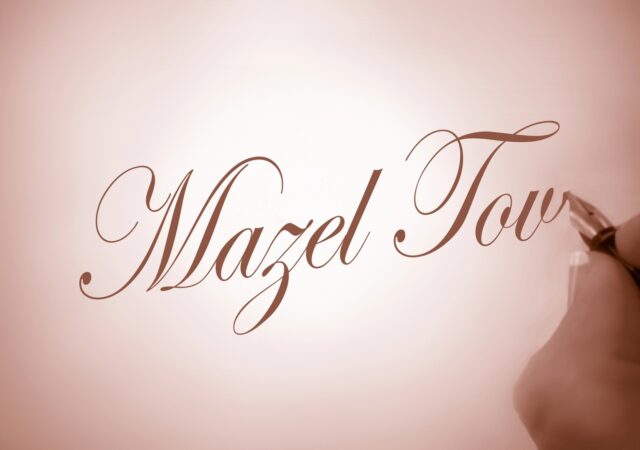
In Hebrew, mazel tov means “good luck” but it is used as a way to say “congratulations!” Some people – usually Ashkenazi Jews – will say MA-zel tov, while Israeli or Sephardic Jews will say ma-ZAL tov, emphasizing the last few letters when pronouncing it.
The Hebrew word mazel means “a drip from above” or “an alignment of stars,” referring to the fact that everyone is born under an astrological field. In fact, the Zodiac signs in Hebrew are called “mazalot.”
Our mazel, our luck, is determined when we are born. However, when G-D changes Abram’s name to Abraham, He shows the first patriarch of monotheism the night sky and says, “See if you can count the stars.” G-D uplifted him above the stars, out of the sway of the astrological signs, and changed his identity. This was because Abraham lifted himself out of the system of false idolatry and chose to believe in G-D, the singular source of existence. G-D thereby lifted the Jewish People, the progeny of Abraham, out of the natural system, putting them above “mazel.” By following the commandments, doing good in this world, and praying, you have the power to transcend your “mazel.”
When we tell someone “mazel tov,” we are acknowledging that the stars have aligned for them and something wonderful is happening in their life.
When We Say “Mazel Tov”
We say “mazel tov” when we are celebrating a special occasion, like:
• A wedding
• A birth
• A brit
• An engagement
• A bar or bat mitzvah
• A graduation
You may have heard the song “Siman Tov u-Mazal Tov” play at Jewish celebrations. Or you might have seen it in pop culture, like when Adam Sandler sang it in “The Wedding Singer” or when they sang it in “Legally Blonde: the Musical.” Bravo TV host Andy Cohen is a huge fan of the word “mazel,” using it on his show “Watch What Happens Live.”
“Mazel tov” is written in Hebrew like this: מזל טוב .” When responding to wishes of “mazel tov,” you could say “thank you” or “toda rabah,” which is “thank you very much” in Hebrew.
You may hear someone say a person has good or bad “mazel.” In this context, it does mean luck. If you want to wish someone good luck on a future endeavor, you could say, “b’hatzlachah,” which means it should be with success.
Jews do not typically say “mazel tov” when finding out a woman is pregnant. Instead, say, “b’sha’ah tovah”, “it should be at a good time”, as a way to avoid the ayin hara, the evil eye. “Mazel tov” is said when the baby is actually born. Interestingly, many Jewish women will not hold a baby shower because of the ayin hara, and instead will choose to celebrate once the baby is born.

Feeling the Mazel in Our Own Lives
You feel happy and fulfilled when you celebrate a milestone or a special occasion. If you’re married, how did you feel on your wedding day? How was it to become a bar or bat mitzvah? Wasn’t it amazing to have a child or graduate from school or get a great new job?
Jewish mysticism teaches that only a ray of our soul is in our body. The main part of our soul, our mazel, is shining down on us from above. When we have a special occasion, our soul from above shines extra bright, making us feel more fulfilled and connected to G-D. We are able to see the deeper meaning of our life and what our purpose truly is.
By wishing someone “mazel tov,” we are instilling them with a blessing and hoping that they receive only more and more blessings for the rest of their life.
Kylie Ora Lobell is a Los Angeles-based writer as well as president of KOL Digital Marketing, where she does publicity and marketing and helps clients share their unique stories with the world.