
Growing Up During the Iranian Revolution
Sarina Roffé
Regine Tessone was born in Tehran, Iran, in January 1970 to a wealthy family. It was a decade of tremendous prosperity for Jews. The decade ended with the Iranian Revolution, which was years in the making, the overthrow of the Shah of Iran, Mohammad Reza Shah Pahlavi, in 1979, and the beginning of an Islamic republic ruled by the Ayatollah Khomeini.
Regine’s maiden name is Omid Olhadj, which means, “I hope to make the hajj (pilgrimage).” Regine’s mother is Sonia Yedid Lawi, who was born in Beirut and is very educated. She speaks many languages fluently. Her brother, Max Yedid Lawi a’h, helped Syrian Jews escape from Syria to Beirut and then to Israel. He later settled in Brooklyn, New York.
Regine’s father was a dentist, Dr. Eshagh Omid a’h. He studied dentistry and international law in various schools in France. Of their four children, Regine is the only girl. Her paternal family’s ancestry hails back to Jerusalem, having been exiled with the Jews to Babylon since the destruction of the Temple in Israel. Her paternal great-grandfather, Agha Mordehai, changed their surname from Gohar Sinai during a period of severe persecution against Jews.
From the age of five, Regine, whose Farsi name is Monavar, meaning Aura, attended the Lycée Razi.
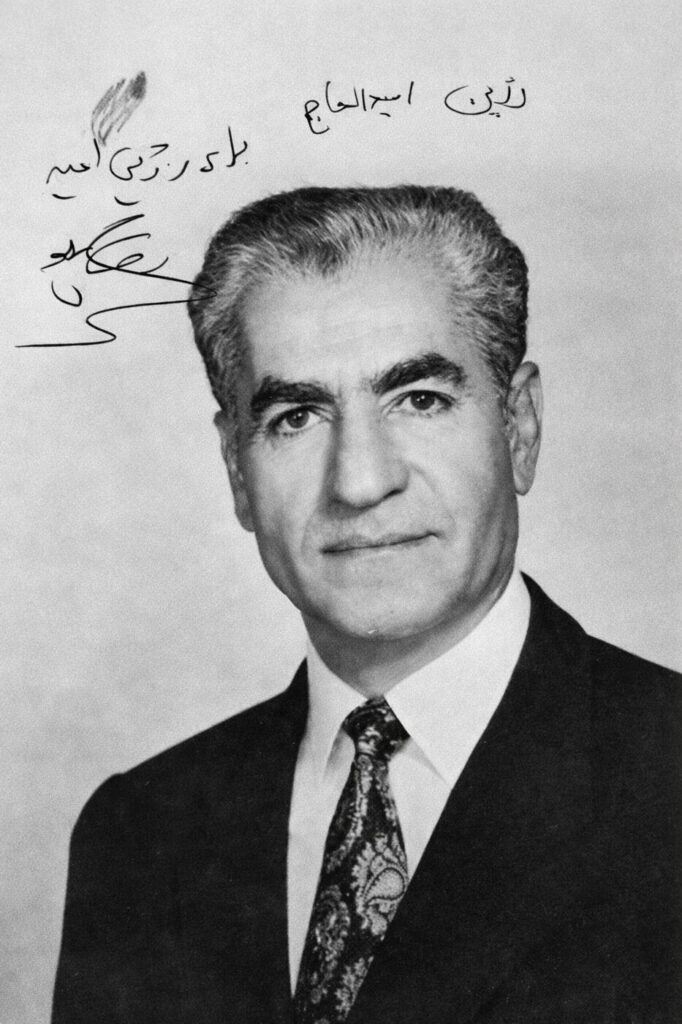
“My father spoke many languages, German, Yiddish, French, English, Farsi, and some Hebrew. He knew many people in government and he got me into that school. We were raised to believe that the Shah loved everyone, all Iranians. He was like a father figure. His photo was on the first page of all our schoolbooks,” said Regine.
The Lycée went from preschool to high school. It was a magnificent school with a large cinema, lake, and numerous pools. It was fun to go there, even in the summer. Regine learned varied arts, including weaving small Persian rugs.
“I met the Shah in my school in 1978. It was quite emotional for me to see him because we were taught he loved us all. They told all the children to stand in line and when the Shah came, we were to bow and not look him in the eye, as it was considered disrespectful. I was curious and I looked up. The Shah looked at the principal, who said she is Jewish, she doesn’t bow. The Shah was a very handsome man.”
At school, Regine learned fluent French and Farsi. She also learned respect. Regine said, “In kindergarten, I didn’t like my French teacher. If she asked me to bring her scissors, I would bring her paper. After doing this a few times, the principal called my father. When he addressed my father, I responded in fluent French, so he knew I understood. To teach me a lesson in life, the principal made me stay in kindergarten another year. The principal explained that no matter how much I like the teacher or not, I must do what is asked of me. From a very young age, I learned discipline and to be respectful of my teachers.”
Jews were considered integral to Iranian society. Jews owned and operated stores in the bazaar, owned factories, had professions such as lawyers, doctors, and accountants, and were members of the Majlis, the Iranian parliament. Most Jews in Tehran were wealthy. The Shah allowed Jewish men and women to attend universities in Iran, where they excelled in their studies.
“My father lived in poverty as a child; he had to share shoes with his brothers. He went from poverty to extreme wealth. His credo was education and diligent, honest work will lead to success.
“We lived in a very large flat with numerous rooms, porches, and verandas. My mother never cooked. We had a chef, a chauffeur, and a maid nanny. Ornate Persian rugs decorated our walls and floors. We attended Yousef Abad Synagogue. The synagogue was located on a street named after Yosef from the Tanach. My mother worked as a secretary in a French company that sold construction machinery to the government of Iran, and that’s how my father received contracts,” she said.
The family spent their summers in Israel with both her maternal and paternal families, as there were direct flights from Tehran.
The revolution was developing for many months. Dr. Omid saw the signs and began preparations for travel to America. Post-revolution, among the items he sent were Regine’s schoolbooks, including the one with the Shah’s photo in it, at risk of his life, as he wanted Regine to retain her Farsi language.
In the summer of 1978, Regine and her brothers vacationed in Israel for three months. Her parents traveled to Europe and at the end of August arrived in Israel to accompany them back to Iran.
In Iran, taxi drivers know the pulse of the city. On the cab ride back from the airport, her father asked the driver what was new in Tehran. The driver said they burned a library, nightclub, and local cinema, and described what was happening with the revolution.
It was then that Dr. Omid knew they had to get out of the country and he began to prepare. He instructed everyone to pack a suitcase and put it under their bed. They didn’t know when they would need to leave, but it could be any day.
From September 1978 to February 1979, safety and quality of life in Iran deteriorated rapidly. The children went to school and there was a bomb threat, so Sonia took them out of school. Having grown up in Beirut, she knew about political dissention. Regine noted that her mother was a quiet, reserved person and she never saw that side of her. “She said, if teachers or anyone call, give me the phone.” She did not allow Regine to converse on the phone with anyone she deemed suspicious.
During this period in Iran, everyone was deemed suspicious, as many Iranians switched sides from being pro-Shah to pro-Khomeini.
Esfahan was the first city in Iran to witness tanks rolling in, as early as spring 1978. Many Jews left at that time to places like Europe, Israel, and America.
Those who had children learning in American universities told them to remain there, as it was clear the country was headed toward a revolution.
Mashhadi Jews were repeatedly persecuted by their Islamic neighbors throughout the years. Often, Jews were framed for crimes they never committed. If a Muslim boy was killed, neighbors would bury him in a Jewish person’s backyard and blame them for it. The Jewish community would have to pay exorbitant fees to release the accused from jail. This time, the persecutions proved more severe, as the Islamic regime empowered extremist neighbors further. Many migrated to Italy, Austria, and America.
“During those few months, we saw graffiti in our Jewish neighborhood that read ‘Death to the Shah,’ ‘Death to the Jews.’ I couldn’t see my friends from shul,” said Regine. “The shul remained closed on most days. My Muslim neighbor threw a rock at my back. I didn’t understand why. Everything was one big no. No school, no after-school activities, no playdates, no parties, no shul. Nightly curfews were placed in Tehran, accompanied by sounds of gunfire and Khomeini’s Islamic sermons played on car loudspeakers throughout the city. There were frequent blackouts and long lines for food at grocery stores.
“People saw my mother with a small child and let her go ahead of them. My mother stocked massive quantities of food, afraid of shortages. One time she sent my brother to get milk. He was gone for four hours and was out past curfew. He was stopped and showed them the milk. They took him for interrogation. Khoda-ro shokr (Baruch Hashem in Farsi), they let him go once he proved his innocence.”
Iranian militants seized the U.S. Embassy in Tehran on November 4, 1979, taking 66 hostages. Fourteen were later released, while 52 were held for 444 days. The Shah had come to the United States for medical treatment, and Islamic militants demanded his return to Iran.
In synagogues, “The heads of our Jewish community in Tehran pleaded with utmost urgency to send the women and children out. There were midnight rescue flights to Israel every Saturday night. In late fall 1978, the Israeli shlichim who served in the congregation and schools left Iran,” she said.
“After tremendous delays en route to the airport amid total upheaval in Tehran, our family boarded the last flight out of Iran on Air France, the same flight that brought Ayatollah Khomeini to Iran. We left February 1, 1979. We stayed in Paris for one month. My mother did all the paperwork for us to come to America. Her brother David sponsored us, and we had to show we could support ourselves. We moved in with our maternal grandparents in Brooklyn.
“We left at the peak of the hostage situation. Upon arrival at the airport in New York, there were long lines and we were not allowed to get a drink of water until we passed customs. A guard asked my mother and me to go to a room for a private search. She asked me to undress and my mother scolded her and said absolutely not, that she could check me fully dressed. They were not kind and it left a miserable dent in my memory. It was a bitter pill. My mother had to prove we had money to live on. We were not refugees. We lived off my parents’ money for three years.
“My father left us at the Paris airport as we boarded the plane for New York and went back to Iran for a year. I didn’t understand why until years later, after he passed away. It was a difficult year. My mother and I cried often, as we did not know if my father would survive. He had previously been placed on a government blacklist. I vowed to become observant if my father survived. And I did.
“Years later, my husband and I were invited to Great Neck to lead holiday services, as my husband is both a rabbi and hazan. That Rosh Hashanah, Rabbi Z, name withheld, whom we knew for years, invited us for the first night seder of Rosh Hashanah. He revealed that he was a former Mossad agent placed in Tehran in the early 1970s. He told us my father helped many people get out of Iran by giving much needed information to the Mossad so they could expedite the departures of those families first.”
While Sonia and her children settled in New York, they still worried about getting Dr. Omid out of Iran safely. Many people left using the land route to Turkey, as the airport was mostly closed. They needed a note from a school principal, backed by a doctor, stating Regine was sick and needed urgent surgery and that Dr. Omid needed to go to the United States. Many doctors refused to write this falsehood, fearing license revocation. One angelic doctor agreed. The notes were not used, and Dr. Omid was extracted to Turkey, then made his way to Paris. He became sick and was hospitalized. It was Passover when the family flew to Paris to be with him. They were elated to see him, albeit gaunt. He had lost tremendous weight.
In America, the freedom to speak and live as you wish empowered Regine. “In Brooklyn, my mother enrolled us in Magen David Yeshiva,” she said. “Some teachers understood what we went through, but the children didn’t. By Persian standards, they were very immature. I never acclimated to the mindset, the way you look at life. My son said I don’t think like a Westerner. I never take no for an answer. No means perhaps to me. G-D is big and anything is possible.
“In Magen David, they placed me in first grade and every month moved me up. After five months, I was in fourth grade. I learned Hebrew and English fluently. I finished eighth grade, spent two years at Flatbush High School, and then my parents couldn’t afford it anymore. I continued at Lincoln High School. The Jewish principal saw I didn’t belong there and told me I could come to his office anytime. I completed two years in one year and graduated. Subsequently, I attended the Fashion Institute of Technology to study fashion design.”
“The United States has never felt like home to me. It’s like a beautiful hotel that took care of me and pampered us with freedom. I feel tremendous gratitude to G-D and the United States for the blessings I received here. In Iran, no one dared speak badly in public. They could be held for sedition. Here, freedom is empowering. Now, after forty-seven years, the Iranian regime may topple. I await the day this evil regime collapses and a brighter future rises for us all. Israel remains my home in my soul.”
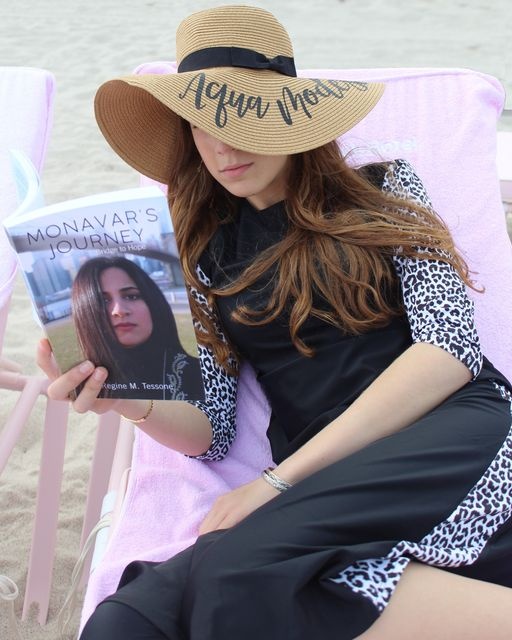
After graduating FIT, Regine married Rabbi Moshe Tessone. They have three sons and a daughter. Years ago, she founded and pioneered a business selling modest swimwear and activewear named Aqua Modesta.
“My husband and I traveled to numerous states over the years as part of his Sephardic outreach work. On one trip, we stopped at a farm in Maryland to purchase vegetables and fruit. As my skin is dark olive, particularly in the summer, the farmer offered me the items for free. He seemed anxious to get rid of me and told me to take everything. I left disappointed without taking anything. It is sad that people look at me, think I’m Spanish, and feel afraid. They can’t differentiate between Spanish, Persian, or people from the Middle East. You’re just the other. The foreigner. It never makes you feel at home.
“When I go to Israel and get into a cab, they immediately play Persian music. I ask how they know I am Persian, and they say, ‘You look Persian.’ I’m always impressed. They just know. And they don’t look at you as the enemy. It’s different. It’s endearing.”
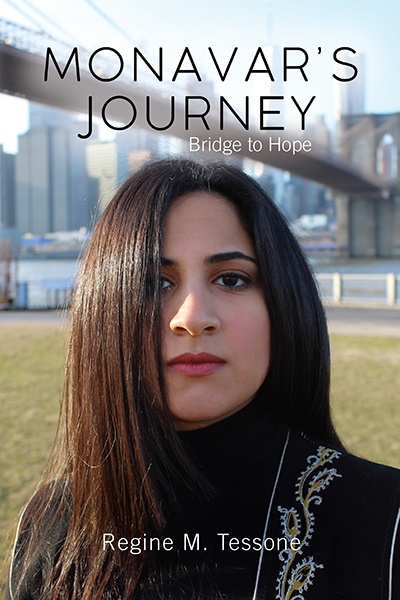
Read more about her inspiring journey and exodus from Iran in Monavar’s Journey: Bridge to Hope, a memoir by Regine M. Tessone.