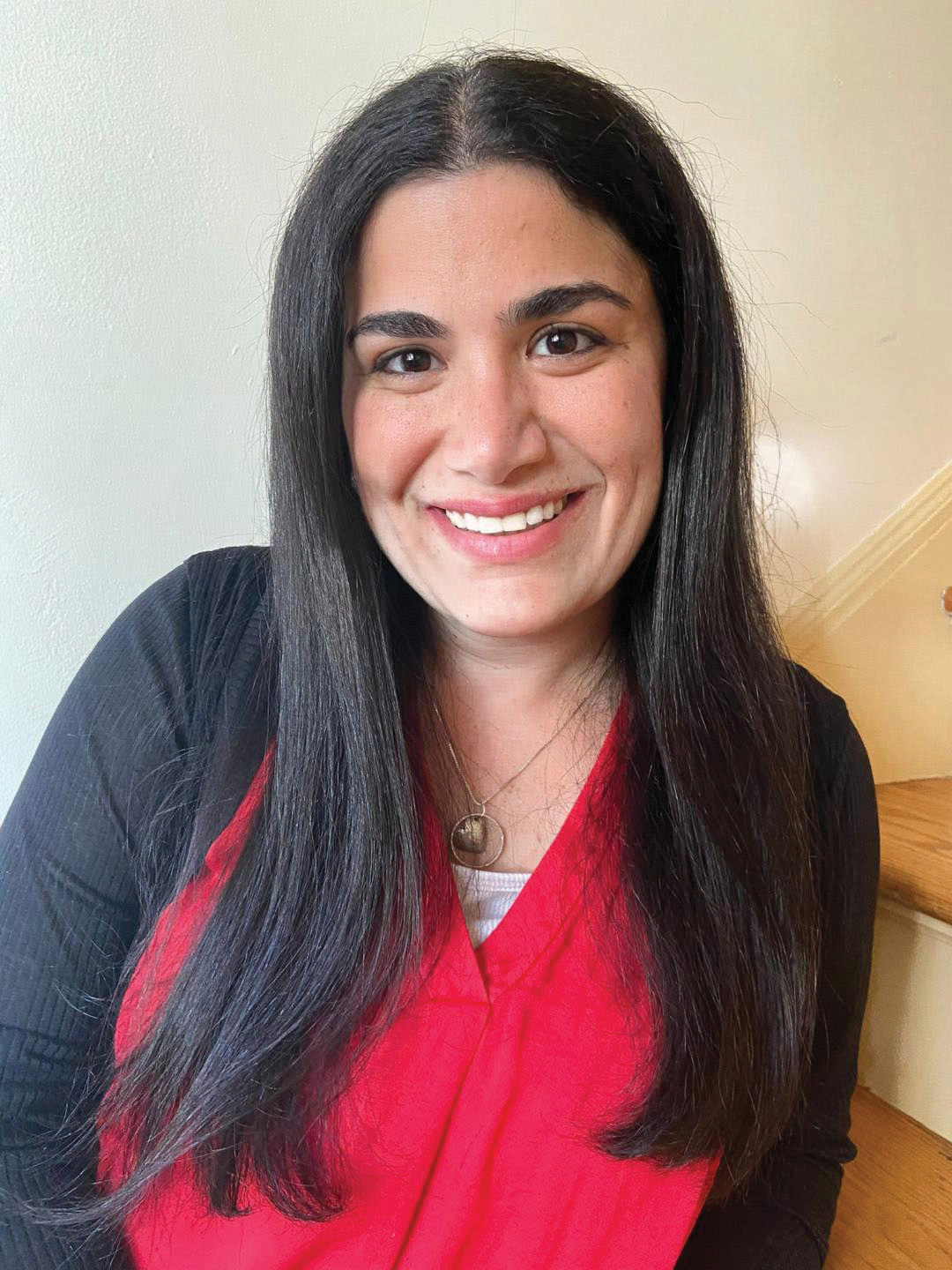
“AS I WALKED THE HALLS OF BHI, THE SOUND OF CHILDREN LEARNING, SMILING AND CONNECTING WAS EXHILERATING,” MS. ADINA FENDEL SAID. “CREATING A SAFE, HAPPY ENVIRONMENT FOR KIDS TO LEARN IN IS OF UTMOST IMPORTANCE TO ME, AND I WAS SO HAPPY TO SEE THIS PERMEATING THE HALLS OF BHI. I AM TRULY LOOKING FORWARD TO BEING A PART OF THIS AMAZING TEAM.”
Ms. Fendel is the renowned “Morah Fendel” who spent 18 years teaching in YCQ. Simultaneously, she is the women’s director of Emet Outreach—both of these positions have made her intimately familiar and connected with the Queens community.
Next year she will be joining Be’er Hagolah as the Judaic Studies Educational Coordinator for Elementary School.
Rabbi Mordechai German, Dean of BHI, said, “We are thrilled to bring on Morah Fendel as the Elementary School Judaic Studies Educational Coordinator. She joins BHI at an exciting time as we continue to realize our vision of building a BHI that helps ensure a bright future for all our students.”
ACADEMIC SUCCESS COMES FROM WARMTH “We live in a confusing world,” said Ms. Fendel. “Our children are searching for structure and love.” Her goal as a teacher has always been to build children with success.
“Children should feel cool for succeeding, not acting out,” she added. “They need a structured classroom filled with love and positive reinforcement. They should feel happy to go to school, that is a safe place for them.” And this is exactly what Be’er Hagolah parents want.
“My kids have gone from having to go to school to wanting to go to school. They’re waiting for it,” said BHI parent Victoria Kol. If any of her kids have a problem, their rabbi is on call to solve it.
“In the beginning, I was very concerned because I thought that in public school, the academic level is higher. But I was wrong – they really care about the academic status. Be’er Hagolah students are ready to graduate and go to college,” Victoria says.
She continued, “I think when kids learn how to respect parents and respect the rabbis, it affects their whole life. They just think twice before they do something. It’s a very loving and caring environment. It’s just a second family.”
A SOLID EDUCATION IN A SAFE ENVIRONMENT “What makes Be’er Hagolah attractive to parents is that they know their children are getting a solid education in a safe environment,” said Rabbi Mordechai German, Dean of Be’er Hagolah.
“They learn and are safe,” said Zina Khaimov, a BHI parent.
“They’re around their own people, and they feel love from the rebbeim and teachers. My son in high school has his favorite rabbis that he could just go over and talk to—you don’t get that in public school,” she concluded.
READY TO TAKE ON THE WORLD Most BHI parents want their children to be educated, attend college, and embark on professional careers. Their children get that in BHI – but they also get much more.
“It’s not just that they’re ready for college. It’s that they’re ready to take on the world, whether it’s college, whether it’s going into business—whatever they want to do, they’re ready for it,” stated Michael Nisanov, a BHI father.
That’s exactly what Rabbi German is aiming for. “A graduate of Be’er Hagolah will not only be college-ready, but also life-ready,” said Rabbi German.
He believes that a strong education must include a focus on the social and emotional growth of the child. And every day, his staff builds an incredible support system to give over personal and life skills to each student.
“In the morning, sometimes I bring my son here, and I see Rabbi German standing in front of the school greeting the children,” said Erit Semah, another BHI parent, adding, “They really care about giving them values—family values—and teaching them middot tovot.”
INSPIRING STUDENTS TO GO FURTHER “Be’er Hagolah actually offers the great combination of religious and secular education. Coming from a communist country, I could never imagine that my kids could be obtaining an education which is much superior to any secular education. They’re really inspiring students to further advance education in different areas,” said BHI parent Daniel Lerner.
Just about every BHI student goes on to college, and many become professionals in the career of their choice.
Graduates are going to nurse school, PA school, occupational therapy, speech therapy, becoming dentists and lawyers. This is the pride of BHI.
Chani Kahan is a copywriter who helps nonprofits to reach the heart of their target market with memorable copy. Before starting her freelance business, Chani worked as the Associate Editor of The Circle children’s magazine. After a successful career planning creative content and working with writers, Chani now researches and writes campaign-focused copy for nonprofits.
Hacham Yom Tob Yedid lived an epic life of courage and devotion through his decades as Chief Rabbi of the glorious Halab (Aleppo) community. As the community’s leader during its last days, he courageously faced challenges, torture, and threats. Amidst the confusion and turmoil, Hacham Yom Tob had the enormous responsibility of keeping his community devoted to Torah and tradition. And he accomplished the impossible: Halab remained as it had for centuries, a city where everyone kept Shabbat, prayed in the Bet Knesset, and stayed connected to Torah. How did he do it? How did a young man, thrown into a role with great responsibility, respond so fearlessly, demonstrating wisdom and leadership well beyond his years? The ArtScroll biography For the Sake of Heaven takes us on an epic journey from Halab of old to tree-lined Brooklyn streets. With its fascinating twists and turns, this is a biography that reads almost like a novel, leaving us awed as we see so clearly the impact of one who devotes his life to teaching and studying Torah. In this Inside ArtScroll interview, Rabbi Meyer Yedid, son of Hacham Yom Tob, speaks about his father’s incredible story of heroism, courage and the power granted to one who is totally devoted to Torah.
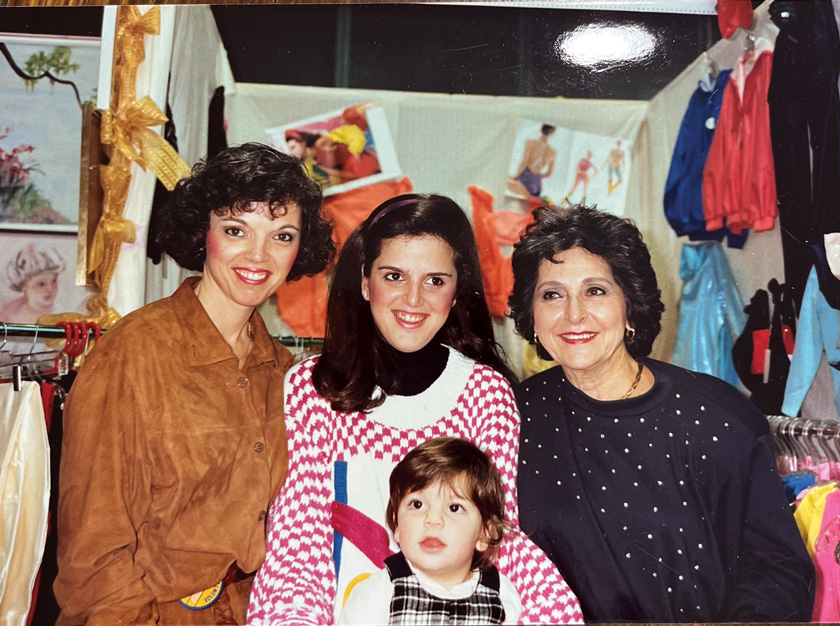
FRANCINE DWECK’S VOLUNTEER JOURNEY BEGAN IN 1972 AS A BROWNIE LEADER WHEN HER DAUGHTER VALERIE JOINED THE BROWNIES, AT SEVEN YEARS OLD. AFTER THAT, THEY BOTH MOVED ON TO THE GIRL SCOUTS. “I LOVED DOING PROJECTS WITH THE GIRLS THAT HELPED THEM TO GET THEIR BADGES,” SAID FRANCINE, WHO ROSE IN THE SCOUT RANKS TO BECOME COOKIE CHAIR FOR BROOKLYN’S SOUTHERN DISTRICT.
“I remember, I was very young, maybe 7 years old, and our garage was full of boxes of cookies,” said Francine’s son Morris A. Dweck. “I sold Girl Scout cookies door to door.”
Francine joined the PTA at PS 236, and then at Roy H, Mann Junior High, following her daughter through grade school. In 1979, Valerie was a freshman at Sephardic High School when Francine became president of the first PTA. By the time Valerie finished high school, Francine joined the Sephardic Community Center family as part of the Adult Education Committee.
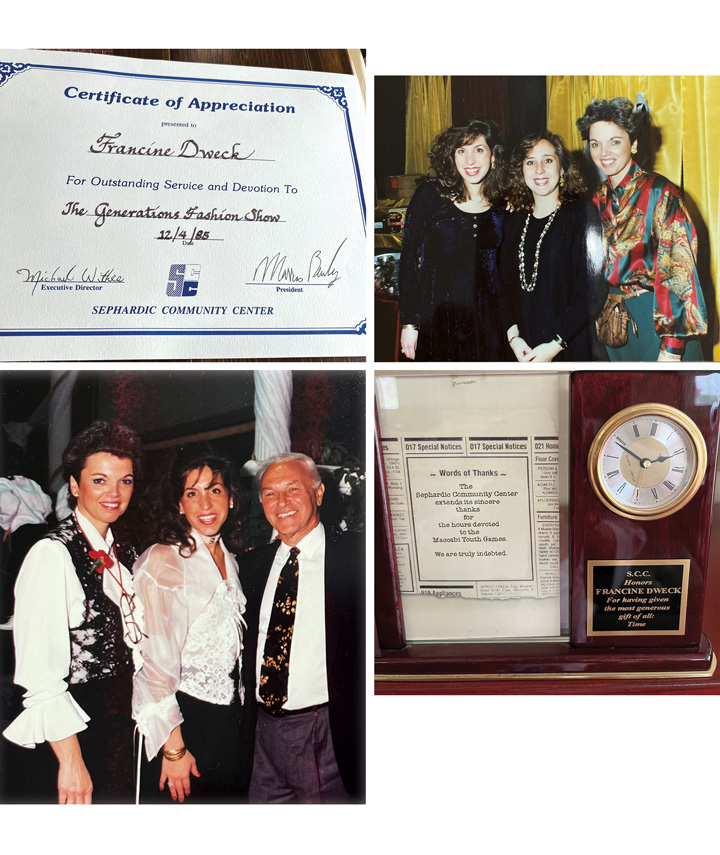
In a very few years at the Center, with Francine’s leadership qualities and ideas, she formed the Special Events Program; and with a great bunch of women, ran many beautiful events. In 1985, with an audience of hundreds of women, she chaired the Generations Fashion Show; and then the Beautiful Table. In 1986, she chaired the Boutique Showcase with over 50 venders, an event she managed for a decade. The list of events she planned for at the Center grew and included Book Fairs, Gourmet Expos, Back to Bradley Beach, and The Generations and Celebrations shows. Each had between 300 and 400 participants, and audiences of several thousands of our community’s members.
“I am a people person,” Francine said. “I love talking to people and I was able to recruit volunteers to help with events. Many of my volunteers grew to be chairwomen of different departments at the Center. It was very gratifying to be part of their learning experience.”
Francine became part of the Center’s Board of Directors in 1986, while continuing to run many special events, overseeing all details to make each event successful, she became concerned about the needs of special children. She organized “Just for Me” in 1998, a program for children with learning disabilities, hiring special education teachers for the program.
Francine was also interested in travel and wrote about the trips she took with her family and husband Albert, who was president of Congregation Kol Israel. The first trip she wrote about was a Passover trip the family took together in 2000. IMAGE readers have enjoyed Francine’s articles about their travels.
Other charities Francine worked on included SAFE, managing fundraisers to help them get started, at Stanley and Cookie Chera’s house. She won several awards at the Center and mentored young girls after taking classes in leadership. In 2001, she chaired the social events of the Maccabee Games at the JCC of Deal, New Jersey.
Francine says her motivation started with the Brownies and was encouraged by her husband Albert. She says the most important thing she learned throughout the years was to accept people for who they are. Everyone has a different personality and we need to accept people for what they represent.
“When you are part of a volunteer core never say ‘I’, everything is ‘we’; it shows you are working as a team and respect each other’s contributions. If someone asks a question, tell them you’ll find out the answer and get back to them.
“I loved working with the professionals. Their outlooks on life were different; and I learned to respect people who came from different backgrounds. Their lessons were invaluable and a great part of who I am today.”
Francine Dweck had modest beginnings, living in an apartment house on Ocean Parkway with her siblings and parents, Harold and Violet Sutton. She went to PS 215, Boody JHS and Lincoln High School. Her parents gave her respectable character traits such as honest work habits, a taste for learning and how to be responsible and give to her community.
All three Dweck children learned from their parents. Today, Morris works closely with Rabbi Eli Mansour, helping build a new synagogue; he created Torah.org, and is a founder of YDE and Community Security Alliance. Valerie is an Assistant Teacher at Reach for the Stars, and Harold works closely with Sephardic Bikur Holim. And of course, Francine’s husband Albert continues to work for this community in many capacities.
The experience of working with people, organizing and planning inspired Francine to do more and be of service to the community she loves dearly. She is truly an inspiration to others.
A journalist, genealogist and historian, Sarina Roffé is the author of Branching Out from Sepharad (Sephardic Heritage Project, 2017), Sarina holds a BA in Journalism, MA in Jewish Studies and an MBA.
WHAT’S THE HARDEST LESSON YOU’VE EVER HAD TO LEARN ABOUT MONEY? WHAT’S THE MOST POWERFUL ONE? FOR MANY FOLKS, THESE LESSONS COME FROM HARD-EARNED EXPERIENCE. THEY AREN’T TAUGHT IN A CLASSROOM. INSTEAD, MANY FOLKS GO TO THE SCHOOL OF HARD KNOCKS. IT’S THE LEARN-AS-YOU-GO WAY TO UNDERSTANDING PERSONAL FINANCE. AND THOSE LESSONS WE PICK UP CAN SHAPE HOW WE THINK ABOUT AND HANDLE MONEY. THEY CAN STICK WITH US FOR LIFE.
So, what are the money lessons that you are never too young to know? Are there any that you still have to learn or better at? Let’s find out. These essential finance lessons aren’t typically taught in school, but they’re still incredibly valuable to know as early as possible. And they can take some people a lifetime to learn.
LIFE’S BIG MONEY LESSONS What Do You Know & What Do You Need To Learn?
Accountability Is Key Financial accountability means responsibility, honesty, and recognizing how your choices affect your financial outcomes. It requires planning, routine check-ins, knowing the consequences, and a commitment to try again when things don’t go your way.
Pay Yourself First Invest in your savings, retirement, and insurance before spending on anything else. Make them mandatory expenses. If you do, you can re-order your other spending around these financial priorities. Ask Yourself: What do my financial safety nets look like? Am I on track to retire when I want to—or keep enjoying my retirement the way I want to? Example: “I’m going to automate monthly deposits into my savings, retirement, and health savings accounts. And I’m going to check in on those deposits quarterly to see if I should make any adjustments.”
Money Isn’t The Only Thing Wealth gives us options, but money alone won’t fulfill us. Time, relationships, and our well-being can matter far more than money when it comes to our long-term happiness. Ask Yourself: When and why do I prioritize money over my relationships or health? How can I change that? Example: “To get a better work-life balance, I will not check work emails after a certain time every day, and I’ll commit to getting a certain number of hours of sleep every night.”
Understanding Your Money Mindset Is Critical A money mindset is the beliefs and attitudes about money that unconsciously shape financial behaviors. Knowing your money mindset can be the first step to improving it and making better financial choices. Ask Yourself: When I think about my financial future, do I feel more anxious or optimistic? When I run into a financial issue, do I procrastinate or focus on solutions? Example: “When I start feeling stressed about a financial decision or issue, I’ll take a step back and wait until I’m more relaxed to address it.”
Don’t Be Intimidated By Your Money You do not need to be a personal finance pro to make smart choices for your future. A solid strategy, commitment, and a willingness to learn can go a long way towards financial success. Ask Yourself: What aspects of personal finance confuse or overwhelm me? What could I learn more about—taxes, retirement, interest rates, or inflation? Example: “I’d like to get a better handle on tax planning or retirement planning, so I’m going to take a class or talk with a professional.”
We have to practice life’s important financial lessons to make them work for us.
FINANCIAL LESSON: How Money Lessons Help Us Make Sense of Life Were any of these lessons new for you? Have you heard them all before? Familiar or foreign, learning these lessons about money isn’t like memorizing a simple fact. It’s not a one-and-done deal. It’s more like honing a life skill.
We have to practice life’s important financial lessons to make them actually work for us. And the lessons we need the most can change at any point in life.
In fact, even those of us who are pretty savvy with money still need to reconnect with the key lessons of finance from time to time, because new situations and challenges that test us can pop up at any time.
After all, in life and finance, things can change quickly. That can mean we end up facing new complex financial choices that we never expected. If or when that happens, you don’t have to learn your next important financial lesson the hard way. And you don’t have to jump into any decision blindly or stand at the crossroads alone.
Investing involves risk including the potential loss of principal. No investment strategy can guarantee a profit or protect against loss in periods of declining values. Past performance does not guarantee future results. This material is for information purposes only and is not intended as an offer or solicitation with respect to the purchase or sale of any security. The content is developed from sources believed to be providing accurate information; no warranty, expressed or implied, is made regarding accuracy, adequacy, completeness, legality, reliability, or usefulness of any information. Consult your financial professional before making any investment decision. This information is not intended to be a substitute for specific individualized tax advice. We suggest that you discuss your specific tax issues with a qualified tax professional.
Ari Baum, CFP® is the founder and CEO of Endurance Wealth Partners, with over a quarter of a century of experience in the Financial Services industry. He brings his in-depth experience to Conceive. Believe. Achieve. for his clients.
Brokerage and Advisory accounts carried by Wells Fargo Clearing Services, LLC. Securities and Advisory services offered through Prospera Financial Services Inc. Member FINRA/SIPC.
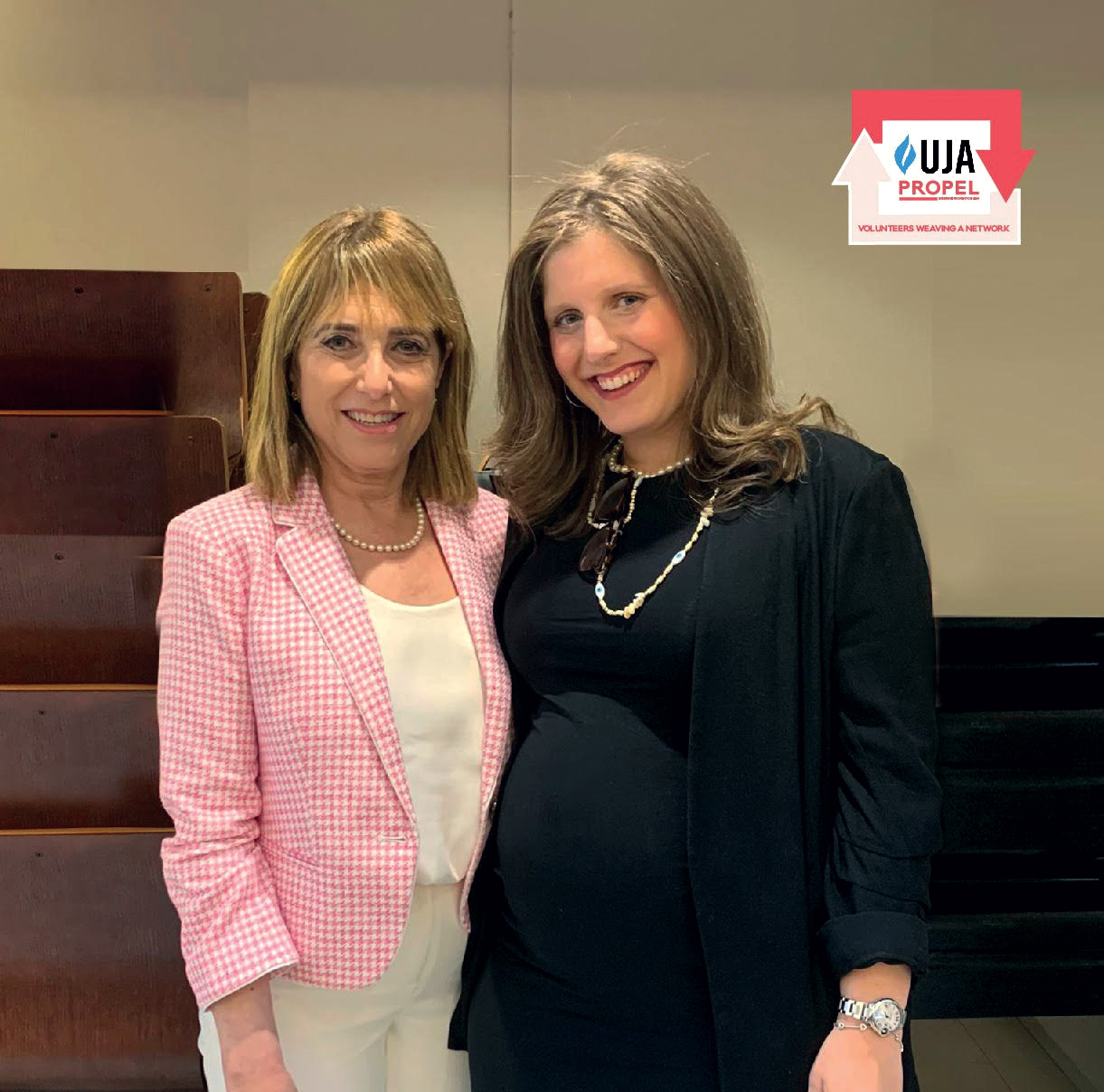
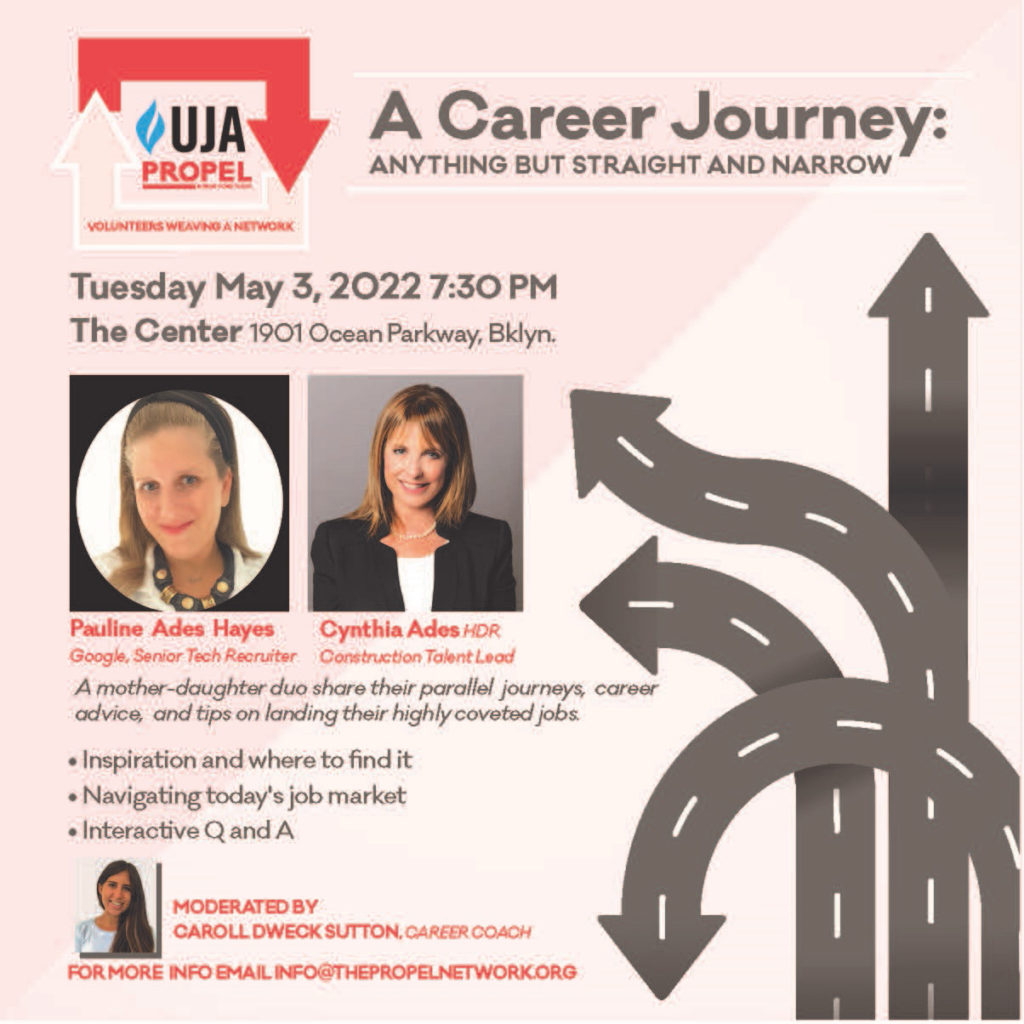
THIS INSPIRING, LIVE-STREAMED PROGRAM, A CAREER JOURNEY: ANYTHING BUT STRAIGHT AND NARROW, FEATURED MOTHER-DAUGHTER DUO, CYNTHIA (CINDY) ADES AND PAULINE ADES HAYES. IT WAS WONDERFUL TO SEE CINDY’S AND PAULINE’S HUSBANDS IN THE AUDIENCE, EXUDING PRIDE OVER THEIR WIVES’ ACCOMPLISHMENTS. THERE WERE MANY FAMILY MEMBERS AND FRIENDS IN THE AUDIENCE AS WELL, CHEERING ON THE PANELISTS!
Alissa Shams, Co-Executive Director of PROPEL, began the program by lighting a candle to recognize Yom Hazikaron, commemorating and honoring all those who gave their lives for the State of Israel.
The program was moderated by PROPEL’s career coach and true superstar, Caroll Dweck Sutton. Caroll began by asking each of the panelists to describe her career journey.
Pauline grew up in Deal and attended Hillel Yeshiva. She said that when she graduated high school, she “somehow convinced her parents to let her go to Binghamton for college.” Pauline majored in accounting and she obtained an internship at Deloitte & Touche. Upon graduation, she secured a full-time position at Deloitte, but, after two years of working there, she realized accounting was not the profession for her. After some self-reflection, Pauline deduced that she really enjoyed mentoring and recruiting. She decided to change her career course! It was not easy, but through networking, Pauline obtained a job as a headhunter, initially focusing on recruiting for accounting and finance positions.
Pauline explained that she took a leap of faith—along with a pay cut—as she pivoted and started down a different career path. After over three years as a headhunter, Pauline ecstatically described that she was fortunate to obtain a position as an in-house recruiter at Capital One. After several years at Capital One, Pauline moved to Google. She is currently a recruiter at Google, where she supports recruiting for senior software engineers. She lives in Englewood with her husband and two children.
Cindy initially worked in the retail industry, but she stopped working when she was married and had children. She was a stay-at-home mother until her youngest child, Pauline, started kindergarten. At that time, Cindy felt it was financially prudent to have a part-time job to help pay for the extras her children needed (such as dance and baseball lessons). As her children grew, Cindy’s part-time position developed into a full-time position in a corporate retail organization, Ritmo Latino, where she held various purchasing responsibilities.
After 14 years of working as a purchasing agent/director, Cindy pivoted into a new role that was offered to her at the time within the same organization. She was offered an opportunity to become a human resources director where she was able to expand her knowledge and experience working on employee benefits, recruiting and hiring, employee relations and payroll. Cindy took a chance with her motto being, “I have nothing to lose!” After three years in that position, she decided she needed a change and focused on obtaining a position doing what she really enjoyed—recruiting and hiring. She feels grateful that others took a chance on her at a large construction engineering company and gave her an opportunity ten years ago by hiring her.
Today, Cindy has extensive experience in human resources, which includes talent acquisition for large global construction and engineering firms. She is truly passionate about the industry and is always looking to learn more, so she can better assist and understand the needs of the business. Her accomplishments include: running recruitment for the entire construction management organization within AECOM, and leading national recruitment for Skanska, including the ramp up of their largest project in history for LaGuardia Airport.
The audience applauded and cheered when Cindy shared that she is in the process of completing her bachelor’s degree! She explained that she was in college when she got engaged to her husband and had put her education on hold.
Caroll asked the panelists about being able to maintain a work-life balance as a woman and mother in the workforce. The panelists stressed that being organized and proactive in terms of meal planning and activities is extremely important. Additionally, Caroll questioned Pauline about how she felt about having a working mother when it was not so traditional for mothers to work in the community. Pauline responded honestly that it took some getting used to, as most of her friends’ moms were home when they got off the school bus. However, Pauline said that her mother was probably more attentive and available than those other moms. Cindy was determined to spend quality time with her family!
In terms of fear of changing a position, Pauline noted that you need to evaluate your general happiness in a position. Cindy shared that you always want to be able to learn and grow at your job.
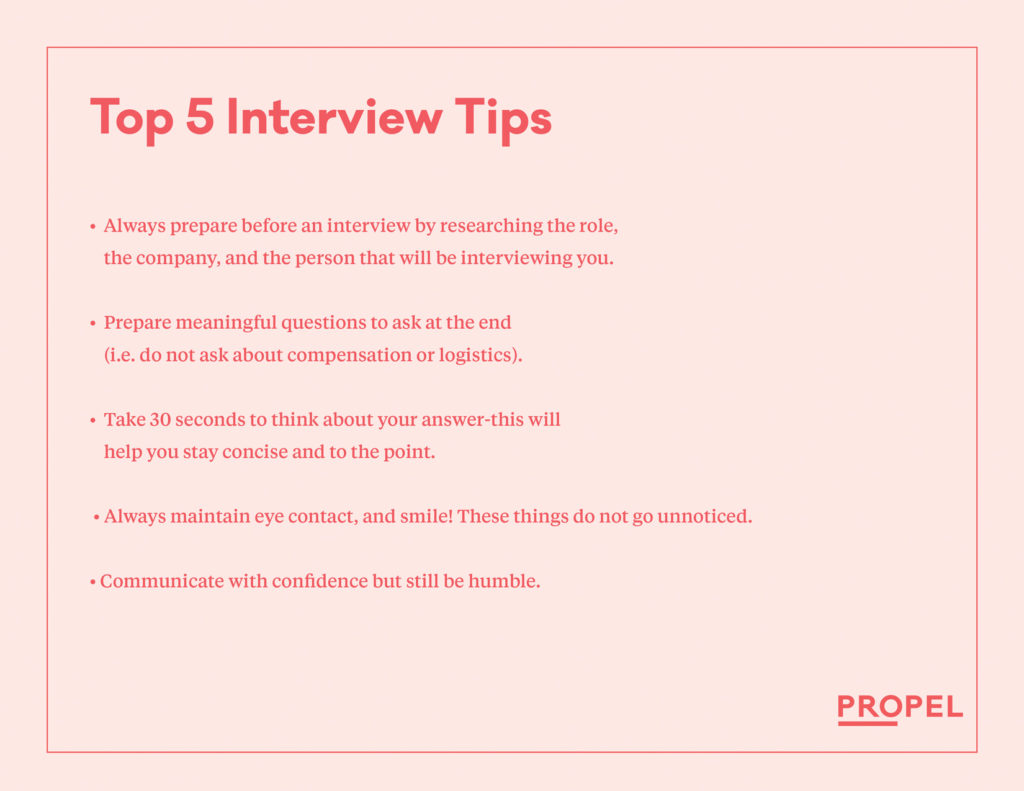
Imparting very valuable information, Cindy and Pauline shared their five top interviewing tips. (See above.) They also shared key resume tips and general advice. The panelists stressed that it is important to be energetic when interviewing for a position—showing that you are motivated is key. It is also essential to prepare before an interview, researching both the company and position you are applying for.
Additionally, the panelists stressed that you should never stop learning and obtaining new skills. Cindy emphatically mentioned that she was fueled by people who doubted that she could achieve something in the workplace—she made it her goal to prove those people wrong by learning and being diligent!
If you missed this inspirational program, you can still watch it on PROPEL’s Instagram @PropelNetwork!
REACH OUT TO PROPEL If you are interested in a career or career advice. We can help you take the steps to fulfill your professional goals and dreams.
If you are interested in joining PROPEL’s cohort of mentors in PROPEL’s “Weaving a Network: Women Helping Women” program or being paired with a mentor.
SEFA, SEPHARDIC EDUCATION FOR ALL, IS A GRASSROOTS MOVEMENT UNIFYING COMMUNITY RABBIS, INSTITUTIONS, TOP LAWYERS, TAX PROFESSIONALS, AND LAY-LEADERS, ALL JOINING TOGETHER TO ACHIEVE OUR COMMON GOAL—A COMMUNITY-WIDE MEMBERSHIP THAT WILL ELIMINATE TUITION.
The program is designed to spread the cost of Torah education across the community to relieve the enormous burden on parents. Contribute $3,000 per year, per person in the family, regardless of age. (Exact amount based on community participation.) If you have four unmarried children—you and your spouse equal six people. The total would be $18,000 for everyone, which is less than the full tuition for one child. We need 60,000 members signed up to launch.
This is a fundamental change in the way our schools are funded. It will be beneficial for the parents, yeshivot, and students. Not just for today; but for future generations as well.
We need the support of everyone in the community to make this happen. It is in our own best interest to lift this burden.
So why should you sign up for SEFA even if you do not have kids in school?
If you are a young adult or a newlywed couple, paying for the membership will seem daunting but still in your best interest. When you are ready to start a family, you will be confronted with serious question:
How can I pay the $25,000 per child for their education? How are we going to do this? How does everyone else afford to pay for this?
This moment has happened to every parent in the community at some point, and it will continue to happen—unless we do something about it!
With SEFA, you could be the first generation that won’t experience the tuition nightmare. Now, if you’re already a parent with children in school, this is definitely for you!
We all want to give our children a yeshiva education at the highest level. We don’t want anyone to consider public school because of the high cost of tuition. We don’t have to let tuition make decisions for us anymore. By joining SEFA, we can increase each other’s quality of life by leaving the tuition crisis behind.
But how about those who are already finished paying tuition for their children?
This problem is increasing yearly. Every year tuition is up by 4%. You have already suffered the pains of paying tuition in the past.
What about your children and grandchildren? This is a problem that will not solve itself. And we have the power to solve this now for all future generations.
Even if no hero stepped forward and bailed you out when it was your turn, now you have the chance to be the hero and help save others. We can feel secure knowing that our children and grandchildren will get the yeshiva education they deserve.
So what should you do next?
Now that you have all this information, the next thing to do is go to getsefa.org, sign up, and spread the word by sharing this with your friends and family members.
No payment is necessary to sign up. Don’t wait to sign up. The sooner you sign up, the sooner this will be a reality.
Let’s keep the legacy alive by keeping and supporting the community together. We can be the generation that fixes the tuition crisis forever.
Join us as we eliminate tuition! Visit Getsefa.org.
WHETHER YOU ROOT FOR THE METS, YANKEES, GIANTS OR JETS, NEW YORKERS ARE RENOWNED FOR OUR FIERCE ENTHUSIASM FOR SPORTS. WHILE IT IS UNDENIABLE THAT SPORTING EVENTS CAN BE A CELEBRATION OF SORTS, BRINGING LOVED ONES AND FRIENDS TOGETHER FOR A SHARED EXPERIENCE FULL OF EXCITEMENT AND ENJOYMENT, THERE IS ANOTHER COMPONENT ENTANGLED IN THE WORLD OF SPORTS: SPORTS BETTING.
Sports betting has been a popular pastime for generations, and with New York State’s legalization of online sports betting this past January, the state has already seen billions of dollars in tax revenue and, more notably has seen a large increase in individuals seeking help for problem gambling behaviors.
Since January 2021, OASAS (Office of Addiction Services and Supports) has reported a 46% increase in calls to its gambling helpline. Michelle Hadden, assistant executive director of programs with the New York Council on Problem Gambling, stated in a recent New York Times article that, “Many of the bettors who signed up in recent weeks were new to gambling, including young people who are not educated, not prepared and easily swayed by the advertising.”
So, what is gambling vs. problem gambling? Gambling is defined by OASAS as, “the act of risking something of value on a game of chance for the desired result.” Problem Gambling is defined by the National Council on Problem gambling as, “gambling behavior patterns that compromise, disrupt, or damage personal, family or vocational pursuits.” Known as the hidden addiction, problem gambling is often undetectable to others until extensive consequences begin to surface, consequences that can amount to more than monetary losses.
Although online sports betting may be the newest facet in the sphere of gambling, gambling is not limited to that. Gambling includes casino table games and slot machines, lottery, scratch-off tickets, sports betting, bingo, raffles, office pools, card games, and online gaming.
How can you tell when gambling is becoming a problem for you or your loved one? Here are warning signs to watch for as outlined by New York Council on Problem Gambling: • Using gambling to cope with certain stressors or boredom • Disrupted sleep, work, or other forms of daily life caused by gambling • Arguments, frustrations, or self-destructive thoughts causing one to gamble • Borrowing, stealing, or collecting insurmountable debt to maintain gambling habit • Unfulfilled promises that one will stop gambling • Time lost with family/friends due to time spent gambling
With online sports betting becoming increasingly prevalent within the adolescent population, certain signs, and behaviors to watch for in that age group as outlined by New York Council on Problem Gambling are: • Absences from school/classes—can be tied to a decline in grades or ability to complete assignments • Changes in their personality/behavior • Bragging about winning at gambling • Unusual interest in newspapers, magazines, periodicals, sports scores • Unaccountable explanation for new items of value in possession • Borrowing or stealing money • Withdrawing from family and friends • Exaggerated use of word “bet” in vocabulary and/or use of gambling language in conversations
Problem gambling is an emotional issue that contributes to severe financial strife and has the power to adversely affect the lives of gamblers and their loved ones. If you believe you or a loved one is dealing with a gambling addiction, it is critical to bear in mind that there are many resources that can provide guidance and support for you and your loved ones while navigating these challenging moments.
The SAFE Foundation offers an extensive problem gambling program for gamblers and their loved ones with weekly individual and group therapy as well as Sunday night Gamblers Anonymous meetings on our premises.
If you or someone you know needs help, call 1-718-GET-SAFE, 24/7 for assistance.
Allison McGill is originally from Rochester, New York and has lived in Brooklyn for the past 12 years. She has recently received her CASAC-T from Lehman College and is passionate about the work surrounding recovery and family work.
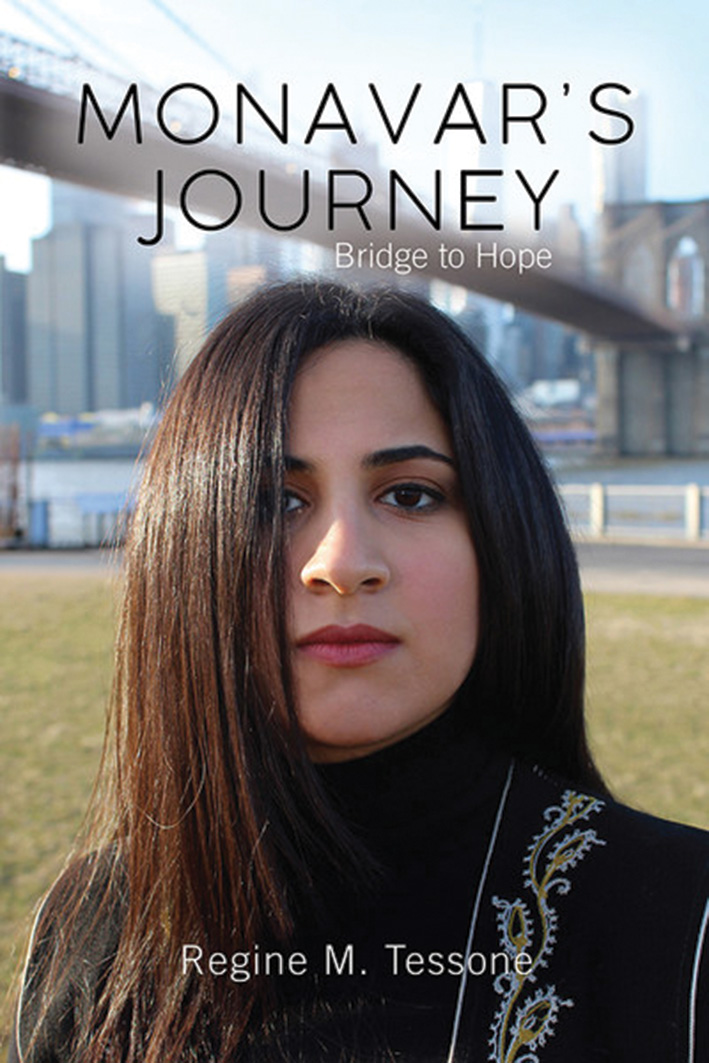
REGINE MONAVAR TESSONE RECALLS RUNNING THROUGH THE MEHRABAD AIRPORT WITH HER PARENTS AND THREE BROTHERS, ON FEBRUARY 1, 1979, TO BOARD THE LAST FLIGHT OUT OF TEHRAN ON THE EVE OF THE ISLAMIC REVOLUTION. THE PILOT ANNOUNCED AS THEY ENTERED THE AIRCRAFT, “YOU ARE THE LUCKY ONES! THE AIRPORT IS NOW CLOSED AND THE AYATOLLAH KHOMEINI HAS ARRIVED.”
In this intimate memoir, Monavar (a Farsi name meaning light) recreates the life of her Persian Jewish family before they fled Iran and her own adventures in their new home in America. Always buoyant, she describes reuniting with her mother’s family in Brooklyn, visiting Israel and serving as a volunteer, falling in love with a non-Persian Jew, and becoming a successful fashion designer. Her story reflects her nostalgia for the homeland of her youth and her embrace of the opportunities of her adopted homeland in the United States as a successful Iranian-Jewish immigrant.
Daniel Tsadik, author of Between Foreigners and Shi’is: Nineteenth-Century Iran and Its Jewish Minority, said, “Monavar’s Journey is a beautifully written moving memoir that sheds light on Iranian Jews’ lives during the Pahlavi era and the Revolution: lifestyle, food, religion, education, Muslim-Jewish relations, and so much more. It impressively offers an account of immigration, adjustment, and daily life in their new home.”
Ronnie Perelis, Associate Professor of Sephardic Studies at the Bernard Revel Graduate School of Jewish Studies of Yeshiva University, and author of Narratives From The Sephardic Atlantic: Blood & Faith, said, “This book is a testament to one family’s heroism and the wisdom of parents, but beyond the intimate value of the memoir, I believe it will add depth and nuance to our understanding of the experience of Persian Jewry. The story, however, is also universal. It is about love, family, and the all too familiar story of exile and immigration. The cosmopolitan gyrations between the Middle East and Europe and America with its swirl of languages make it a delightful read.”
Author Regine Monavar Tessone graduated from the Fashion Institute of Technology, and founded Aqua Modesta, a unique line of modest women’s swimwear and sportswear that attained worldwide success. Her initial professional goals achieved, she wrote this memoir to fulfill a lifelong dream: to share the story of her family’s incredible escape on the last flight out of Tehran.
WHICH CAME FIRST—THE CHICKEN OR THE EGG? DOES BEING DEPRESSED LEAD TO DEVELOPING AN EATING DISORDER OR DOES HAVING AN EATING DISORDER LEAD TO DEPRESSION? THE TRUTH IS THERE IS SUCH A COMPLEX EMOTIONAL AND BIOCHEMICAL INTERPLAY BETWEEN DEPRESSION AND EATING DISORDERS THAT WE ARE NOT SURE WHICH COMES FIRST.
What we do know is both depression and eating disorders feed on each other causing great suffering for the person who is trying to cope. Fortunately, many strategies exist to help someone get better.
SOME FACTS ABOUT DEPRESSION: • According to a recent Department of Health survey, one in eight New Yorkers suffer from symptoms of depression.
• The report also says that major depressive disorder is the single greatest source of disability in New York City. At any given time over half a million adult New Yorkers are estimated to have depression, yet less than 40% report receiving help.
• The Department of Health and Human Services now recommends that pregnant and postpartum women be routinely screened for depression. In the city, 12,000 new moms per year are affected by maternal depression. Maimonides Hospital announced that new mothers will now routinely be screened for postpartum depression.
• About 15% of the US population will experience major depression in their lifetime.
• Depression is twice as common in women as in men, in part due to hormones.
• Up to 40% of the risk for depression is inherited.
When you add an eating disorder, like binge eating disorder, anorexia, bulimia, or body image unhappiness on top of depression, people often feel helpless and hopeless that they will ever get back on track with healthy eating or a healthy sense of well-being. Keep in mind that helplessness and despair are actually symptoms of depression and will get better with treatment.
THE CONNECTION BETWEEN EATING DISORDERS AND DEPRESSION?:
• Eating disorder behaviors help people feel better temporarily. Overeating is a soothing activity, purging provides a cathartic relief, starving is an attempt to feel strong and in control.
• Bingeing, purging, starving, or obsessing about weight helps people distract themselves from emotional pain.
• Both depression and eating disorders often involve shame and secrecy. People with these disorders often feel a stigma about admitting their problems.
• Psychotherapy and sometimes medication can help people resolve their eating disorder and depression.
WHAT DOES DEPRESSION FEEL LIKE? When we think of depression, we picture a person who is tearful or doesn’t want to get out of bed in the morning. But, in fact, depression can take many different and unexpected forms: some people get agitated, some people get irritable and argumentative, others feel like they are moving in slow motion—as if their arms and legs are heavy—others feel body aches and pains, such as headaches or stomach aches. Depression can cause people to have contradictory and confusing symptoms: some binge and gain weight while others do not want to eat and lose weight; some have insomnia while others sleep too much. Sometimes the person just feels sad—constantly.
WHAT STEPS SHOULD I TAKE? • Acknowledging that you are depressed and that you are struggling with overeating, under eating, or purging is the first step. Do not be ashamed—we humans are biochemical and emotional people and sometimes we need help.
• Speak with your medical doctor. Blood tests can rule out hormone abnormalities, diabetes, thyroid issues, or premenstrual distress.
• Have a consultation with a psychotherapist to evaluate the emotional stresses you may be facing and a discussion of strategies to improve your eating behaviors as well as techniques to improve the stress in your life.
• The therapist may recommend a consultation with a psychiatrist to evaluate if anti-depressant medication can help jump start your recovery.
THERE IS NO VIRTUE IN SUFFERING IN SILENCE. HELP IS AVAILABLE. REACH OUT.
Reach out to MEND (Mindful Eating New Direction) to get the help you need. MEND is a new community initiative to help people like you. You are not alone!
We will work with you to: • Custom tailor an individual approach for your unique needs. • Help you get control of your eating back inside yourself. • Develop and maintain healthy eating patterns. • Regain body confidence. • Unlock what may be keeping you stuck in your eating problems.
Schedule an initial assessment with MEND, and we’ll help you determine if you can benefit from treatment. To start a confidential conversation about your eating, please contact us. Your contact with us is absolutely confidential. Please feel free to call 718 336-MEND.
MEND is a division of The SAFE Foundation.
Mary Anne Cohen, LCSW, BCD has been Director of The New York Center for Eating Disorders since 1982. She is also author of French Toast for Breakfast: Declaring Peace with Emotional Eating and Lasagna for Lunch: Declaring Peace with Emotional Eating. Mary Anne has hosted her own radio show on eating disorders, appears frequently on national television, and is a professional book reviewer.
Mary Anne Cohen, LCSW, BCD has been Director of The New York Center for Eating Disorders since 1982. She is also author of French Toast for Breakfast: Declaring Peace with Emotional Eating and Lasagna for Lunch: Declaring Peace with Emotional Eating. Mary Anne has hosted her own radio show on eating disorders, appears frequently on national television, and is a professional book reviewer.
LOSING WEIGHT IS RARELY EASY, AND IT CAN BE DOWNRIGHT FRUSTRATING, ESPECIALLY WHEN YOU THINK YOU’RE DOING EVERYTHING RIGHT, BUT THE NUMBERS ON THE SCALE REMAIN THE SAME. WEIGHT LOSS PLATEAUS ARE ALSO DISAPPOINTING. IF YOU’VE ADOPTED A HEALTHY DIET AND YOU’RE STILL NOT SEEING THE RESULTS YOU EXPECT, PERHAPS ONE OF THE FOLLOWING FACTORS IS TO BLAME.
REASONS YOU MAY NOT BE LOSING WEIGHT
• Eating just a salad for lunch. We’ve been told that salads are a great meal when you’re trying to lose weight, and they are good for you. However, a salad made of a few vegetables will not fill you up. In just a few hours you’ll be looking for a snack. You should add lean protein like tuna or chicken, and fiber rich foods, like beans and quinoa to your salad. These ingredients will keep you full for a much longer time.
• You’re eating too much of a healthy thing. Just because a food is healthy, doesn’t mean you can eat as much of it as you like. Be aware of your portion size.
• You’re eating too many refined carbs. Complex carbohydrates like whole wheat bread, barley and beans are full of fiber and fill you up. Refined carbs, like pretzels and pasta may give you an energy boost at first, but it will lead to a sugar crash, which will make you hungry and lead to additional eating. Switch to complex carbs combined with lean protein.
• You are letting too many hours go by without eating. When you allow too many hours to pass without eating, your blood sugar will drop, making you ravenously hungry. When this happens you are very likely to overeat. It’s best to eat healthy meals and snacks every couple of hours.
• You eat well all week and allow yourself a cheat day. Some diets recommend a cheat day once a week, however there are guidelines as to how much you can eat. When creating your own cheat day, it’s very possible to consume all the calories you didn’t eat during the week, and all of your hard work can be negated in those couple of hours. Be consistent. Plan your weekends and learn how to enjoy yourself without sabotaging your weight loss goals.
• You believe you can eat whatever you want because you exercised. A great snack or meal you can eat after a workout would be a mix of complex carbs and protein. This is a powerful combination that helps boost muscle recovery, reduce soreness and build strength.
Review your goals and your behavior. If you think one of the reasons mentioned is why you are having trouble losing weight, make a change. You’ll be happy with the results.
Laura Shammah MS, RDN has a masters degree in health and nutrition and is a registered dietitian. She has been operating her own private practice in both New York and NJ for over 20 years. She is happily married and has four children.
WE ARE EXCITED TO ANNOUNCE THAT MRS. PAULINA SALEM WILL JOIN OUR EDUCATIONAL STAFF IN THE FALL OF 2022 AS THE NEW PRINCIPAL OF GESHER YEHUDA YESHIVA. MRS. SALEM COMES TO US AFTER 13 YEARS OF SERVICE WITHIN THE NEW YORK SEPHARDIC COMMUNITY.
She began her teaching career at Barkai Yeshiva. For the past 11 years she taught both second and fourth grade at Yeshivah of Flatbush and more recently held the position of Assistant Director of Campus Life and served on various educational committees there as well.
`Mrs. Salem holds a Bachelor of Arts from Barnard College in Political Science, where she also completed an education program and received her initial teaching license. She received her Masters in Special Education from Brooklyn College, and is a graduate of YOU Lead, Prizmah’s signature program for Jewish day school professionals and leaders.
Mrs. Salem is eager to begin working as Principal of Gesher Yehuda. “On my very first visit to Gesher Yehuda, I immediately fell in love with the warmth of the environment, the individualized yet rigorous curriculum, the dedicated staff, and of course the unbelievable children. Gesher Yehuda is an extremely important institution in our community, and I am excited and honored to continue the great work that has been done.”
According to the Chairman of the Board, Mr. Jack Setton, “We look forward to Mrs. Salem joining our yeshiva and are certain that she will enhance and further strengthen our programs. She combines knowledge of our community and years of service with impeccable educational credentials. We are confident that she will promote a rigorous professional environment among our teaching staff and will provide a nurturing and meaningful educational experience for all the children who come through our doors.”
We would also like to thank Mrs. Deborah Katz for her years of services both as the first principal of our high school and then as the esteemed principal of our elementary school. Mrs. Katz has worked tirelessly to make Gesher the premier institution that it is. We thank her and wish her great success in all her endeavors.
About Gesher Yehuda Yeshiva
In 1996, with the purchase of their own educational facility, Gesher Yehuda Yeshiva was established as a community school providing individualize instruction in a small class setting. Six students in its first year blossomed to thirty-six by the third, and reached as many as 80 in the 2000s. In 2008, seeking to extend its individualized methodology beyond the elementary school years, the original founders launched Yeshivah Preparatory High School. Now, more than 25 years after its inception, Gesher Yehuda Yeshiva is well prepared to continue to provide a premier education with state-of-the art resources to the Brooklyn Jewish community.
Gesher Yehuda Yeshiva is located at 49 Avenue T, Brooklyn, NY 11223. For more information please contact: Executive Director, Dr. Eugene Miller at 718-714-7400.
“BLESSED ARE YOU, ADO-NAI, OUR G-d, KING OF THE UNIVERSE, WHO FORMED MAN WITH WISDOM AND CREATED WITHIN HIM MANY OPENINGS AND MANY HOLLOW SPACES. IT IS OBVIOUS AND KNOWN BEFORE YOUR SEAT OF HONOR THAT EVEN IF ONE OF THEM WOULD BE OPENED, OR IF EVEN ONE OF THEM WOULD BE SEALED, IT WOULD BE IMPOSSIBLE TO SURVIVE AND TO STAND BEFORE YOU EVEN FOR ONE HOUR. BLESSED ARE YOU, ADO-NAI, WHO HEALS ALL FLESH AND ACTS WONDROUSLY.”
THE AWESOME BRACHA OF ASHER YATZAR, (WHO FORMED), WHICH REFERS TO THE COMPLEXITY OF THE HUMAN BODY, THANKS HASHEM FOR CREATING OUR BODY AND FOR THE CONTINUOUS DAILY MIRACLE OF ITS PROPER FUNCTIONING. IT IS RECITED EVERY MORNING AS PART OF THE BIRCHAT HASHACHAR, (MORNING BLESSINGS) AND AGAIN, EVERY TIME AFTER USING THE BATHROOM. THE BLESSING AND THE MIRACLE OF OUR BODIES IS SOMETHING WE SHOULD NOT TAKE FOR GRANTED.
I couldn’t wait for Thanksgiving. Every year I look forward to spending several days with my family and some friends. I never knew, that one particular Thanksgiving would change my life forever.
We were in Baltimore, it was Thursday, Thanksgiving morning and I had a cold, but it wasn’t too bad. We went out to dinner to a kosher restaurant and had a great time with family and friends. I was looking forward to the next morning when I would first go for a run, something I enjoy very much. Little did I know I was just a few hours away from a life changing experience.
My cold got worse, as the night progressed and I woke up at 5 a.m. to take NyQuil. At approximately 7 a.m., I woke up again and of course the first thing I needed to do was use the bathroom. At first I felt fine as I walked to the bathroom, but then I suddenly felt a bit dizzy and the next thing I remember, I was waking up, unable to speak or move, due to the pain. I recall seeing my wife screaming and calling an ambulance. I didn’t know what happened. It took 40 minutes for an ambulance to arrive, as I lay on the floor wondering how I got there and what was going on.
Finally, the paramedics arrived, they put me on a stretcher and took me to the hospital. I was left waiting for a bed and a CAT-scan for over 10 hours. I was in excruciating pain, I could hardly walk, and had trouble breathing. I went from being able to run 10 miles to not being able to walk 30 feet.
After many hours of waiting in agony, I saw a young Jewish boy and begged him to go get me some Advil for the pain, because the hospital wouldn’t give me anything. He did and I’m still so grateful for that. He was like an angel.
After I finally had a CAT-scan, I was told I had five full fractures in four of my ribs, one of my lungs was compressed and bleeding, and I had a chip on my spine.
Somehow I was able to deal with all of it, but not with what was to come. When I needed to urinate, I couldn’t, and my biggest nightmare came true. The hospital staff told me I would need a catheter to empty my bladder, and after that I would feel better. Well, I did not. We decided to leave the next day, to go back to NY. I ended up in NYU Hospital the next morning. I was told my bladder was almost full and I would need a catheter for a few days, after which I could return for them to remove it.
Five days later l went back to have the catheter removed, but I was still unable to urinate on my own. I wondered how something so simple, that I took for granted all of my life, could suddenly become the most difficult challenge I ever faced.
I needed to be catheterized again, but at this point the pain of the procedure was unbearable and unimaginable. The doctor asked me to come back in two weeks to have it removed. So, after two long weeks of pain, taking Valium, pain killers and other meds, I was positive this time, when the catheter was removed, I’d be fine, but once again, I wasn’t, and I needed the catheter again.
After the first couple of times my wife couldn’t even accompany me to the hospital anymore, because the procedure was so painful, invasive and there was so much bleeding, that it was too much trauma for her to bare. It was like we were living in a nightmare.
This time when I went home, I fell into a deep depression. I reached out to other urologists to see if they could help. I went to six different doctors and did four different tests. I can’t even describe the pain I was in mentally and physically. I will never forget when one of the doctors’ told me, “There’s nothing physically wrong with you. You should be going to the bathroom on your own.”
Although nothing was wrong with me, in the back of my mind I wanted him to tell me there was an operation he could do to make me able to use the bathroom on my own. He said there was one thing we could try, but he wouldn’t recommend it, because he didn’t think it would help and it could cause serious side effects. It was an operation to open the neck of the bladder. Regardless, I was in such a desperate state that we scheduled the surgery for December 25, hoping a miracle would happen and it would work. After a few days of thinking about it, I cancelled the surgery.
As time passed, and I had two failed attempts to remove a catheter, it got to a point where I couldn’t take the pain. I was not able to walk much and still the agony was constant. Finally, I called one of my doctors’ and told him I needed to take the catheter out and try to use the bathroom again.
On my third attempt, I was able to urinate a bit on my own. I couldn’t believe it! I was so happy, I thought the worst was behind me and I was finally on my way to a full recovery. Little did I know another three weeks of nightmares would follow. They told me they would teach me how to use the catheter myself in case my bladder locked up again.
I can’t even explain how difficult this was. I went home and was able to use the bathroom, but with great difficulty. I had to jump up and down for 10 minutes or walk around the block or touch cold water or hot water—anything that would get the flow going. Sometimes it took 15 minutes, sometimes as long as three hours before I was able to go. It was unbearable! I couldn’t understand how in my 50s, and quite healthy, I would have to face the possibility of living this way for the rest of my life.
I would try to sleep as much as I could, from the days straight into the nights to numb myself from the pain and the reality of the nightmare I was living in. I silenced my phone and I wouldn’t take any visitors or calls. I shut everyone out.
My wife, kids and siblings felt so sad and helpless. I’ll never forget their faces, watching me trying my hardest to go to the bathroom, running up and down the steps in desperation. My wife would say to me every night, “I’m listening for the toilet to flush so I can relax.”
One day my wife told me I needed to get out of the house and walk for a bit and breathe fresh air. As we approached Ocean Parkway I just walked into the street without looking, while the sign flashed brightly in red, “Do Not Walk.” Cars were coming on both sides and my wife had to grab me and pull me back to the sidewalk. It was a close call. I was in a fog. B”H, my wife and Hashem were there to save me. At one point I thought, “Hashem, I’d rather You take me than live like this for the rest of my life.”
Three more weeks passed, and I lost over 20 pounds. I was very thin to begin with and the weight loss was not good for me. At 5’11”, my weight went down to 143 pounds. I completely stopped drinking, and very quickly became dehydrated and almost ended up back in the hospital.
I remember giving up, and started to do the catheter myself, at home. My doctor told me I could only do it four times a day, and it wasn’t easy, sometimes it got bloody. It was horrific! It got so bad, that I asked my wife to take me back to the doctor so he could put it back in.
Through it all, there was still the pain from my fall, my broken ribs and my lungs—I was a mess. The depression deepened everyday that I was in this nightmare.
I tried acupuncture and I even saw a psychiatrist who gave me anxiety medication plus a few other things to help me feel better. I had done all the tests necessary to know that there wasn’t anything physically wrong with my bladder; it was completely psychological. He reassured me that what had happened to me had caused trauma to my body as well as to my brain.
I reached out to a friend who also helped me using the Dr. Sarno approach. My condition was controlled by my brain and I had some work to do and with time I would be back to myself again. A doctor suggested hypnosis, which I researched and found a great venue. The hypnotist told me that my brain had shifted a bit and he would help me get back to normal through a couple of sessions of hypnosis. After just two sessions he told me to remove the catheter, because I wouldn’t need it anymore.
I was also in touch with a rabbi and his translator who helped me tremendously through out this ordeal. He told me not to lose hope. He kept my spirits up and kept reassuring me there was nothing wrong with me physically. He also told me that I would see a miracle and be fine. I finally got to meet with him in person and he asked me to remove the catheter immediately, because, B”H, I would be fine.
Four days later, I removed the catheter (for the last time B”H) and I was able to use the bathroom on my own. It was a miracle! I went through two and a half months of suffering beyond belief—not just every day—but every minute of every day. Now, I not only enjoy every day but every minute of my life! I came to realize how important the Asher Yatzar blessing is. (I took it for granted for most of my life.) I believe many other people do too.
Throughout my suffering, I always knew there was a purpose. I couldn’t see it then, but I see it now. I’m on a mission to tell my story, so people will not just say this beracha in passing, but say it with real kavanah. Hashem saved me and I’m living again B”H.
Although sometimes things happen to us that seem so hard, Hashem always does it for the good. I feel in my case it was to make everyone aware of how lucky we are, and we should not take anything in this world for granted. I now try to convince my friends to put this blessing next to every bathroom in their office and home.
I now wake up every morning and whether I see rain or shine, snow or a freezing day, I say: “What a beautiful day, because my bodily functions are working the way Hashem intended.” Thank you, Hashem!
WE LIVE IN UNIQUE TIMES. THE WORLD IS STILL STRUGGLING WITH THE IMPACT OF COVID-19. TO MASK, OR NOT TO MASK. VACCINATE, DON’T VACCINATE. THE USA IS POLITICALLY DIVIDED. CONFLICTS HAVE BECOME TABLETOP DISCUSSIONS. WHAT CAN WE DO? HOW CAN YOU OR I MAKE A DIFFERENCE TO IMPROVE OURSELVES, OUR FAMILIES, AND THE WORLD AROUND US? A MISHNA IN ABOT SAYS “AIZEHU MECHUBAD, HAMECHABED ET HABRIOT.” THE ONE WHO IS MOST HONORED IS THE ONE WHO RESPECTS OTHERS.
Starting on the second day of Passover we begin Sefirat H’aomer (the counting of the Omer.) We count the 49 days leading up to the holiday of Shavuot, when we celebrate the Torah’s acceptance on Mount Sinai. These days are called the days of sefirah (counting.) During this time we prepare ourselves and purify ourselves for accepting the Torah.
How do we prepare ourselves? By working on our midot (refining our character traits.) This of course enhances our behaviors. As it says, Derech Eretz Kadmu L’Torah, (The way of the land, the practice of being with people, precedes the Torah.) The Talmud tells us the story of the great sage Rabbi Akiva’s students dying. He was the leading sage of the Jewish people during his time. The Talmud states, “12,000 pairs of students died a terrible death from a plague during the short time between Passover and Atzeret, (the days of sefirah.) Why did they die? Shelo Nohagu Kavod Zeh La’Zeh. (They did not interact with each other with respect and honor.) Let’s say that again. 24,000 rabbinical students died in a short time from a plague, almost completely eradicating Torah wisdom and scholarship. Why? Because they were disrespectful.
The commentaries highlight a possible inner stinginess or jealousy. They didn’t want to support a fellow student, or they didn’t want to see someone else be more successful than they were in Torah study. This was an insult, not only to their fellow scholars, but it was offensive to the Almighty, who cherishes Torah study and supporting its scholarship.
Today, we are living through our own global plague. Perhaps, it’s time for us to begin treating others with more respect.
Food for thought: While facilitating a workshop for managers in a midsize company, I encouraged participants to crowdsource their personal and organizational values. We did an exercise to source and find the values and principles they want to embody. The goal; to bring alive the values, making them explicit and clear, and having everyone operate and integrate from shared values. I can report, most of the values and principles they chose and claimed, (caring, trust, honesty, patience) have underpinnings based on respect.
Think about this for a moment. How do you feel when your coworker treats you respectfully? Does it make you feel better or worse? How awesome would it be to help people feel better all the time? What if we were to treat ourselves and others with conscious respect? Wouldn’t our interactions be much more joyous?
What about at home in our family life? In our PARENTeen program, we begin with respect and honor. Fact: Most parents who reached out over the past 20 years for support, be it a personal challenge or a situation with a struggling teen, began by sharing a problem or struggle that described some form of irresponsibility. I love asking parents to please share something good, unique, or honorable about their son or daughter—especially the one they’re struggling with. At the completion of our call, I invite the parent to acknowledge their teenager while using the word respect in a specific and dynamic way. The results from this one exercise are transformational.
Keep in mind these rules for how to use the word respect effectively.
Conscious: Reflect and think, what do I respect about this person? When we find and know what we respect, we feel, think and act differently.
No Buts: We must give a genuine acknowledgment without any disclaimers.
Honest: Respect must be sincere. If we say the word respect and don’t mean it, we are being disrespectful.
During these days of Sefirat H’aomer, we’re working on ourselves. The number one lesson we learn from Rabbi Akiva’s students is to treat each other with honor and respect. What if we capitalize on this timely lesson and treat everyone with respect?
Remember Devarim Hayotzim Min Halev Nichnasim El Halev. (Words or feelings emanating from the heart enter the heart.) When we feel respect for others, even if we don’t manage to say it, our inner relationship with them will shift towards respect. Our behaviors will reflect the same. They will know and feel our respect.
Blessing you with respectful relationships in every area of your life.
Rabbi Ezra Max, PPC, MHMP, Xchange Guide & Creator of “The Max Method” assists businesses and professionals deal with stress and achieve success. Rabbi Max has witnessed 20 years of results helping executives, parents and teens overcome struggles, improve communication and thrive. He lives in New York with his wife and five children.