

What Parents and Grandparents Should Know About Trump Accounts
Ari Baum, CFP®
EVERY PARENT WANTS TO GIVE THEIR CHILD A HEAD START. EVERY GRANDPARENT WANTS TO LEAVE SOMETHING MEANINGFUL BEHIND. WHEN IT COMES TO BUILDING WEALTH, THE GREATEST ADVANTAGE ISN’T HOW MUCH A CHILD STARTS WITH. IT’S HOW EARLY THEY START.
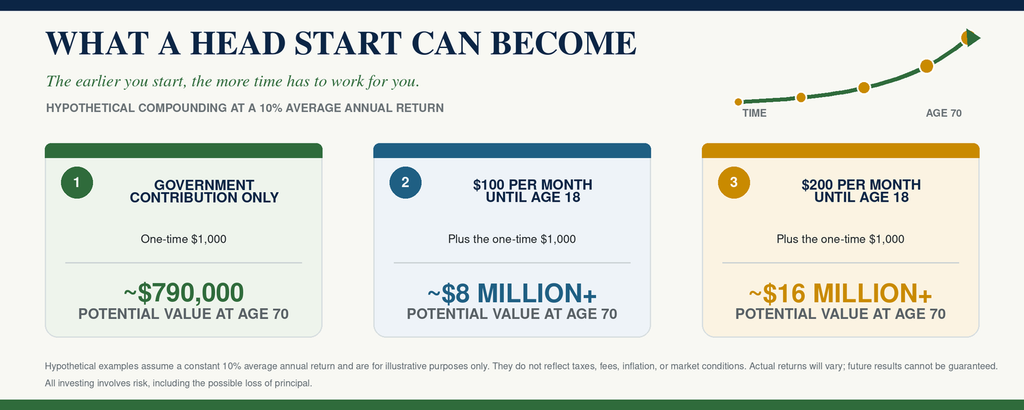
That’s what makes the new Trump Account a meaningful planning opportunity for many families. Since officially launching on July 4, 2026, Trump Accounts have generated plenty of attention, and a fair amount of confusion. Depending on the headline, they may sound like a college savings account, a retirement account, or something entirely new.
Eligible children born between January 1, 2025, and December 31, 2028, who are U.S. citizens with a valid Social Security number may qualify for a one-time $1,000 contribution from the federal government. However, the account must be opened and the required enrollment must be completed. Nothing happens automatically.
Standing alone, $1,000 may not seem life changing. The Council of Economic Advisers projects that the seed money alone could grow to roughly $5,800 by age 18 if nothing else is ever added. Helpful, but not transformative. Now imagine parents and/or grandparents adding $50 or $100 a month alongside it. That’s where the math changes, and it changes not because of the amount, but because of the runway.
More Than Just Another Savings Account
Trump Accounts are not 529 plans, Roth IRAs, or a brand-new category of tax-free account. Section 530A accounts, better known as Trump Accounts, are a type of traditional IRA created specifically for children. Contributions are invested in eligible low-cost U.S. stock index funds, which keeps costs low and decisions simple.
That distinction matters because the account doesn’t later “convert” into an IRA. A Trump Account is a traditional IRA from the day it’s opened. What changes at adulthood is that nearly all of the special rules fall away, and the account simply continues as an ordinary traditional IRA for the child’s benefit.
Understanding the Tax Rules
The most common misconception is that Trump Accounts are tax-free. They aren’t. Like a traditional IRA, they are tax-deferred. Investments have the opportunity to grow without annual taxation, and withdrawals are generally taxed as ordinary income.
One important nuance is that family contributions are made with after-tax dollars and are not deductible. Because of that, they create basis in the account, meaning your own contributed principal isn’t taxed a second time on the way out. Only the government’s seed money and investment growth are fully taxable. That distinction matters, and it’s the part clients most often get wrong.
The Money Is Locked Up Until 18, By Design
This is the question I get first, and the media often skips it. Before the child turns 18, both the investment choices and access to the money are restricted. Beginning January 1 of the year the child turns 18, the account is treated like any other traditional IRA. Distributions become possible, but withdrawals before age 59½ may be subject to a 10% additional tax unless an exception applies.
Two of those exceptions are worth knowing because they change how a family thinks about the account. They are qualified higher education expenses and a first-time home purchase. So this is not emergency savings, and it shouldn’t be positioned as a college fund. It’s a retirement account that happens to start at birth, with a few doors available earlier if life requires them.
Don’t Leave the $1,000 on the Table
To receive the government contribution, an authorized individual must open the account and make the enrollment using IRS Form 4547. The deadline is generous. The cost of waiting isn’t. An enrollment can generally be made until December 31 of the year when the child turns 17. You are unlikely to miss the $1,000 outright. What you lose by waiting is compounding, and that’s the part you can never buy back.
Building on the Foundation
Parents, grandparents, other family members, and even certain employers may contribute, subject to a combined annual limit of $5,000 per child under current law. Claiming the government’s $1,000 contribution and deciding whether to contribute additional money are two separate planning decisions. The federal contribution may be worth claiming if your family qualifies. Whether further contributions make sense depends on how the account fits alongside your 529 plan, retirement savings, emergency reserves, and other financial priorities.
Families ask me, “How much should we contribute?” I think the better question is, “How early can we begin?”
The Bigger Lesson
This is the first opportunity to begin investing for a child from birth with the benefit of a government contribution. Whether the account holds only the initial $1,000 or grows with contributions from parents and grandparents over two decades, the greatest advantage isn’t the amount invested. It’s the years those dollars have to grow.
One of the greatest gifts we can give the next generation isn’t simply money. It’s time. And while none of us can create more time, we can choose to start sooner. Families can learn more, review eligibility, and access the official Trump Accounts app at TrumpAccounts.gov. q
This material is for informational purposes only and should not be construed as investment, tax, or legal advice. Trump Account rules are new and subject to further IRS guidance and possible legislative correction. Individuals should consult their financial, tax, and legal professionals regarding their specific circumstances before making investment decisions. All investing involves risk, including the possible loss of principal.