



The Temptation to See Another Person’s Success as Our Loss
By Rabbi Meyer Laniado
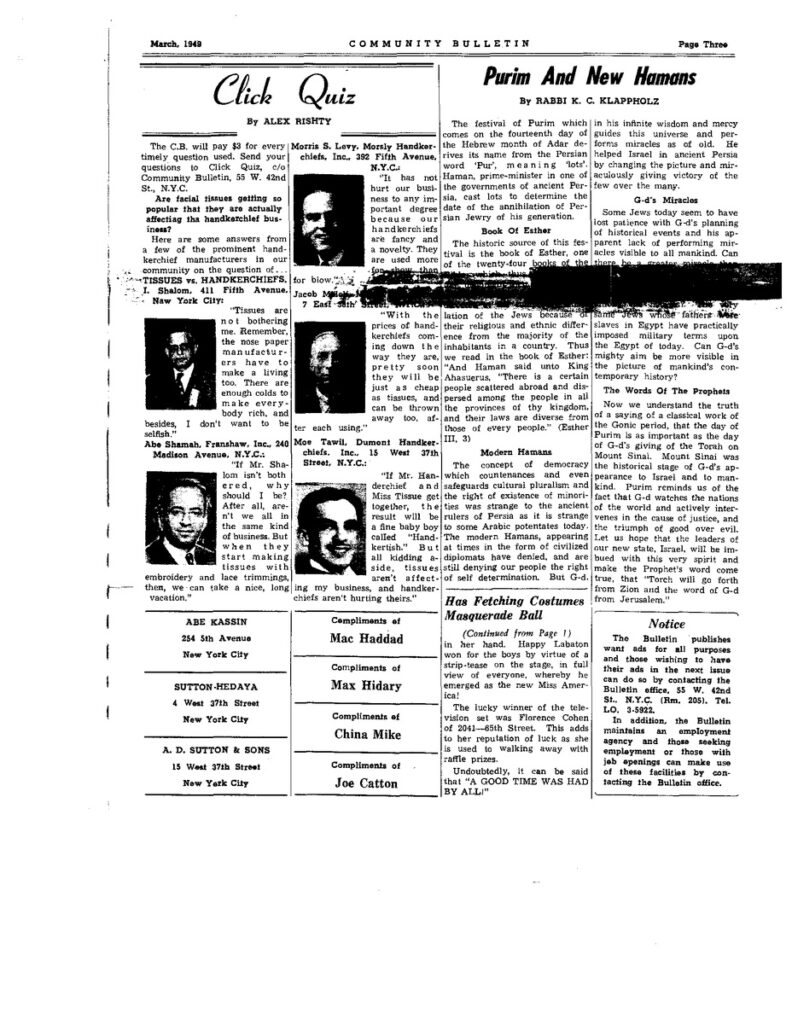
“ARE FACIAL TISSUES GETTING SO POPULAR THAT THEY ARE ACTUALLY AFFECTING THE HANDKERCHIEF BUSINESS?” THIS QUESTION APPEARED IN ALEX RISHTY’S “CLICK QUIZ” COLUMN IN THE SYRIAN JEWISH COMMUNITY BULLETIN OF MARCH 1949. THE FIRST RESPONSE CAME FROM ISAAC SHALOM, ONE OF THE COMMUNITY’S PROMINENT HANDKERCHIEF MANUFACTURERS. HE REMINDED READERS THAT THE PAPER MANUFACTURERS ALSO NEEDED TO MAKE A LIVING. HE RESPONDED, “THERE ARE ENOUGH COLDS TO MAKE EVERYBODY RICH,” ADDING THAT HE DID NOT WANT TO BE SELFISH.
I grew up on stories of Isaac Shalom’s generosity, particularly about how he would set up new Jewish immigrants in business. One of the stories I heard was that he would, on numerous occasions, hand new immigrants a suitcase full of his own merchandise, on credit, to help them establish their own business, albeit a competing business selling handkerchiefs. He could see someone else trying to establish himself and help him succeed, even knowing that they would be competing for customers.
If someone entered your market and began doing well, would you see their success as taking away from your own? Or would you see their rise as the result of something they did well, their product, planning, production, or marketing, and something you could learn from?
These questions appear almost immediately in Beresheit, in the story of Qayin and Hevel, the first brothers we meet in the Torah. Qayin is the elder, and Hevel is his younger brother. Qayin works the land, and he introduces the idea of bringing an offering to G-D. He takes from the produce of the land, from what he has worked to produce, and brings it as a gift to G-D.
His younger brother Hevel, like so many younger brothers, follows what his older brother does, and brings from the firstborn and best of his flock. Then G-D turns toward Hevel and his offering, but to Qayin and his offering, G-D pays no attention. (Beresheit 4:3–5) How would you feel if you were Qayin? I know how I would feel. I would be hurt, and probably infuriated. And then G-D speaks to Qayin and asks, lamah harah lakh velamah nafelu fanekha, why are you upset? Why has your face fallen? (Beresheit 4:6) Qayin’s reaction is understandable, and G-D knows what happened. What is He trying to get Qayin to see? Qayin has gone from not being recognized to concluding that the other person, who was recognized, is the reason he was passed over. He has also invented a motive: Hevel saw what I did and wanted to outshine me. In the explanation of Rabbenu Nissim brought by Abarbanel, the key phrase is sheHevel hu hagorem. Hevel is the cause. Qayin thinks that without his brother, his offering would have been accepted. But Hevel and his offering did not cause Qayin’s rejection. Rabbenu Nissim further explains that Qayin does not need another person “to publicize what is lacking in him.” Whatever was lacking in Qayin’s offering was lacking on its own. Hevel’s offering may have made the comparison more difficult for Qayin to ignore, but removing Hevel would not correct the lack in what Qayin had brought.
So, G-D challenges that understanding by saying halo im teitiv se’et, if you improve your ways you will raise yourself up (Beresheit 4:7). Your success is not contingent on Hevel, but rather on your own actions. G-D is saying this to Qayin before Qayin has done anything to his brother. A quick reading already shows a difference between the offerings. Qayin brings from the produce of the land, while Hevel brings from the firstborn and choicest portions of his flock. The commentators discuss what each offering reveals about the person bringing it. But Qayin is focused on his brother. He sees what happened as something Hevel did to him. And if Hevel is the reason his offering was rejected, then perhaps without Hevel, the problem goes away.
We see something very similar in the story of Shaul and David. Shaul is told that he will lose his kingdom as a result of his own failures, long before he comes to understand that it will be David who will rise to power in his place (I Samuel 13:13–14; 15:26–28). When Qayin’s offering is rejected, the Torah says vayihar leQayin me’od, Qayin became very angry. When Shaul hears the women singing of David’s victories, the Navi uses the same language: vayihar leShaul me’od, Shaul became very angry. (Beresheit 4:5; I Samuel 18:7-8) As David rises, Shaul increasingly sees him as the person who will occupy his place, and begins using his power to eliminate him, as though David were the source of his downfall.

We can go from seeing someone succeed, to feeling that they have taken something from us, to believing they meant to do it. And once we believe that, attacking them can begin to feel justified. How often do we struggle to make that distinction? Someone else rises, and all of our weapons come out. We begin looking for every possible way to take that person down. We attack their reputation and try to remove them from the position they have received, because we have decided that they are the reason we do not have what we wanted.
All of our energy is directed against the other person. We could be asking, How can I improve my ways? How can I be better? What is there here for me to address? Instead, we become occupied with their destruction. We believe that if they were out of the way, we would be able to rise.
The challenge is not to pretend that another person’s rise never affects us. Sometimes it does. But before our disappointment becomes a campaign against another person, we have to ask whether he actually did something to us, and what there may still be for us to address in ourselves.
Shaul’s son Yonatan sees David very differently. Instead of seeing David as a threat, Yonatan defends David and tells his father that David has not transgressed against him, that his actions have been good for him, and asks why he would shed innocent blood without cause (I Samuel 19:4–5).
Later, when Shaul tells Yonatan that as long as David is alive, Yonatan and his kingdom will not be established, Yonatan responds, lamah yumat, mah asah? Why should he die? What did he do? (I Samuel 20:31–32) And even more remarkable, Yonatan, who would have been next in line were it not for his father’s loss of the throne, says to David: “You will be king over Israel, and I will be second to you” (I Samuel 23:17). Yonatan was able to separate the rise of David from his own loss of opportunity, and even step up and support David as he rises.
Notice the role of the field in both stories. Qayin and Hevel are together in the field when Qayin kills his brother. Yonatan and David also go out into the field, but there Yonatan arranges how he will warn David if Shaul intends to kill him. Qayin goes into the field with his brother and kills him. Yonatan goes into the field with David to make sure he will not be killed (Beresheit 4:8; I Samuel 20:11–23).
The Torah also keeps returning to one word in the story of Qayin and Hevel. Seven times, it refers to their brotherhood, ahiv, ahikha, ahi (Beresheit 4:2, 8–11). Qayin has a brother, but comes to see him as the person standing in his way.
Yonatan is not David’s biological brother. He knows that David is the person who will become king in his place. And yet, Yonatan is the one who goes into the field to protect David, as a brother.
Rabbi Meyer Laniado is an associate rabbi at Congregation Kehilath Jeshurun and leads its Sephardic community on New York City’s Upper East Side. He teaches at Ramaz and is a growing voice in the broader conversation on Sephardic history, ideas, and culture, having shared perspectives at UJA, the Maimonides Fund, and the Bronfman Fellowship.


