



Rabbi Joshua E. Fruchter, Esq.
Readers may recall the Ice Bucket Challenge, a stunt that went viral on social media in 2014. The Challenge involved pouring a bucket of ice water over your head after being dared to do so by a family member, friend, or colleague. The goal was to raise funds for researching treatments for the disease known as Amyotrophic Lateral Sclerosis, or ALS (also known as Lou Gehrig’s disease). And it was wildly successful—according to the ALS Association, the Challenge raised $115 million in 2014 alone, thereby enabling the organization to increase its annual funding for ALS research around the world by 187 percent.

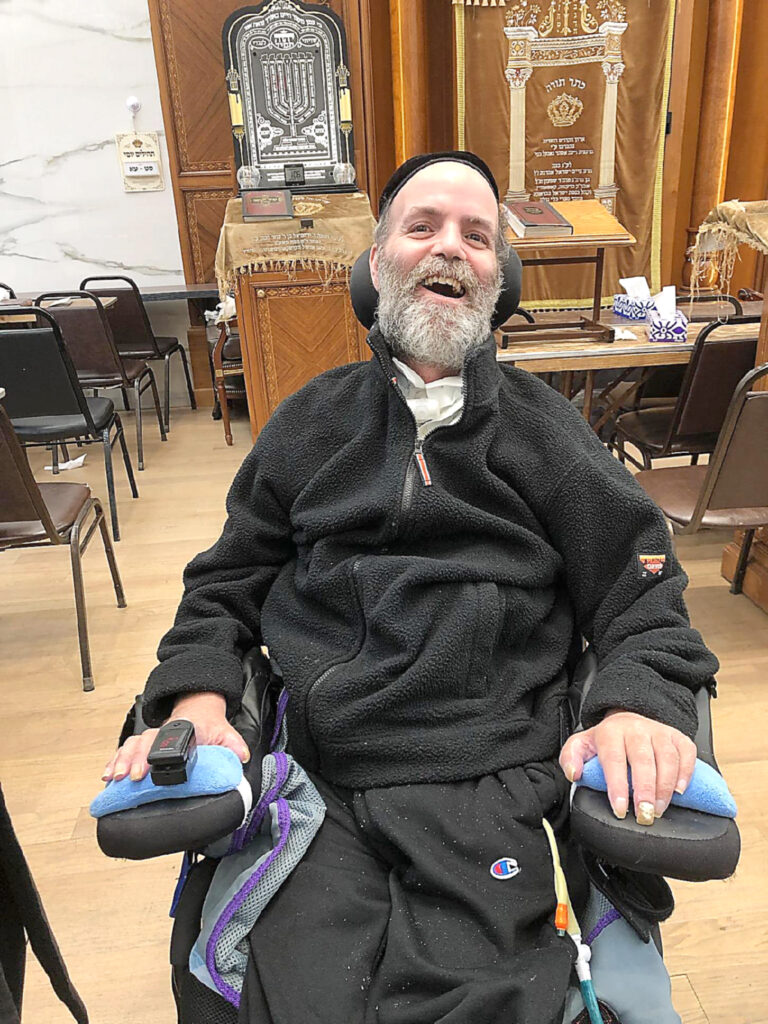
at his local shul.
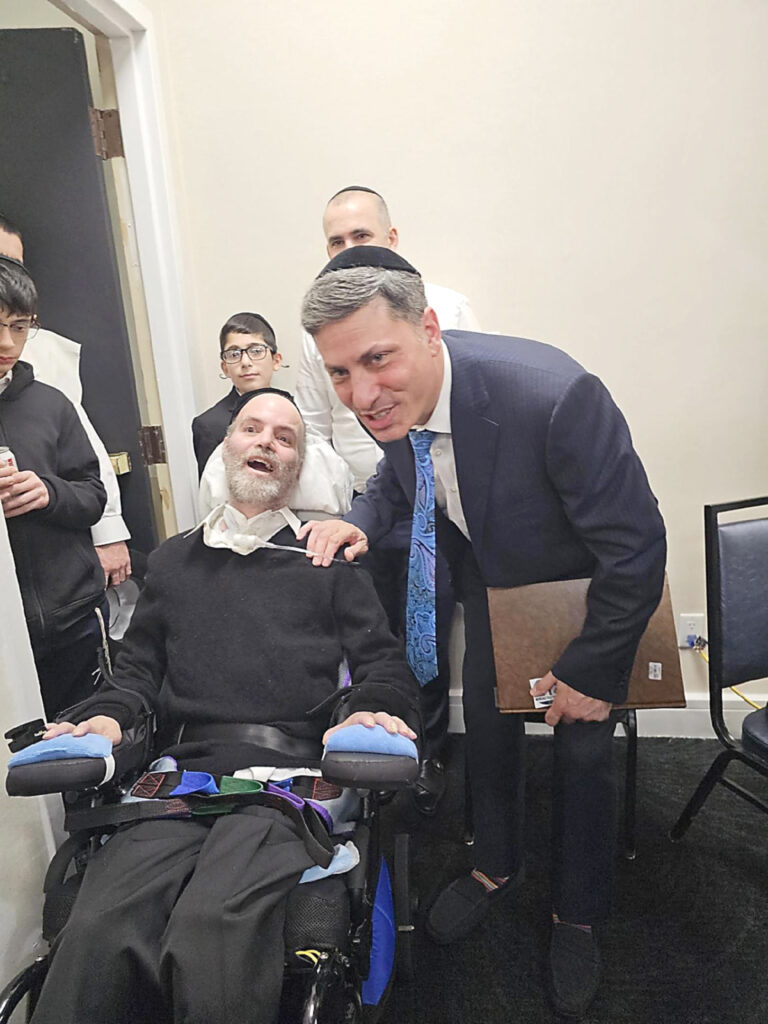
Connecticut, on Motzei Shabbat, December 21, 2024.
Since then, people have moved on to the next viral sensation. But for families with a spouse, parent, or other relative afflicted with ALS, the challenges remain—attending 24/7 to a loved one who can no longer care for their own needs, as well as consulting with medical professionals, evaluating treatment options, and making end-of-life decisions.
The tragedy of ALS is difficult to fathom—until it hits close to home. For the Airmont community in Monsey, New York, that moment came in 2022 when our dear friend and neighbor, Zelig Nirenberg, was suddenly afflicted with ALS and quickly lost the use of virtually all of his muscles. This article shares Zelig’s story—it is heartbreaking, but also an opportunity for the broader Jewish community to share in the ultimate chesed: saving the life of a fellow Jew.
Forty-six years ago, Zelig received a computer as a Bar Mitzvah gift. From that point onward, his enthusiasm for technology only grew. At the same time, his religious commitment intensified, and he embarked on a journey of spiritual growth alongside the development of his IT skills.
After Zelig met his wife, Aviva, they made aliyah together with their three children. With his computer expertise, Zelig worked for several startup companies in Israel while still managing to devote many waking hours to studying Torah.
In Israel, Zelig encountered the emerging field of cybersecurity. He became a specialist and, after returning to the United States with his family, Zelig (known as Curt professionally) worked as a private contractor for the Department of Defense and other government agencies.
But studying Torah remained Zelig’s priority—despite his heavy workload, he took the Dirshu exams every month and scored in the 90s each time. He also kept fit and trim by maintaining a daily routine of jogging and other exercises. A true Renaissance man, he eventually became fluent in seven languages.
By all counts, Zelig was blessed with extraordinary talents and was in the prime of his life and in the best of health. But then tragedy struck in March 2022, when Zelig was shockingly diagnosed with ALS (precipitated by a tick-borne infection, as the family later learned). Aviva and their children—and their friends in the Airmont community of Monsey—were devastated.
For the first nine months after his diagnosis, Zelig was confined to a nursing home, which was ill-equipped to provide the specialized level of care that he needed and to address the emergencies that arose with increasing and alarming frequency. Moreover, the facility was situated a considerable distance from Zelig’s neighborhood and offered limited visiting hours, which posed a challenge for Zelig’s friends who wanted to visit; stopping by on Shabbat was certainly not a possibility.
Deprived of the social interaction that was so vital for his recovery, Zelig’s health and spirits rapidly declined and his condition deteriorated. The situation also became unbearable for his wife, Aviva. A therapist with 20 years of experience, Aviva’s passion is helping individuals and families cope with life’s many challenges. But now she had her own. With their children living in Israel, Baltimore, and San Diego—and no relatives living nearby—Aviva rushed back to the nursing home every day after finishing work. A decision was made: to save his life, Zelig had to return home.
Fortunately, Aviva was not alone. Spurred to action, the couple’s friends and neighbors rose to the challenge, and in January 2023, Zelig returned home to a virtual hospital that had been painstakingly equipped by Aviva with help from local donors.
Zelig’s prognosis remained bleak, but then Aviva learned of a study comparing Lyme disease symptoms to those of ALS. Zelig was tested, and the results came back positive for several tick-borne infections. Such infections can mimic the neurological symptoms of ALS, such as muscle weakness and fatigue. But unlike ALS, Lyme disease is usually treatable with antibiotics.
Zelig commenced treatment with massive doses of antibiotics against his tick-borne infections. Boruch Hashem (thank G-d), the result was what Aviva, their children, and the Airmont community had prayed for: Zelig began showing increased movement in his hands and legs.
Only time will tell how effective the current antibiotic protocol will be. In the meantime, caring for Zelig at home remains the only option. Rabbi Chaim Shabbes, a renowned posek and rav of Congregation Knesses Yisroel in Monsey, has ruled that keeping Zelig at home is a matter of pikuach nefesh (preserving human life), and that sending him back to a facility would mean certain death.
The basis for that pesak is simple. At home, Zelig’s dedicated nursing team attends to his medical needs 24/7 (such as regular suctioning, because Zelig is unable to clear his throat—something every healthy person takes for granted).
Zelig’s home environment is also completely tailored to provide him with opportunities for intellectual stimulation. For example, a large TV screen enables Zelig to participate in Rabbi Stefansky’s daily daf yomi shiur broadcast from Israel. Another device playing music can be activated by Zelig’s gaze.
Finally, Zelig’s friends and neighbors can stop by at any time during the day—whether on weekday mornings to put tefillin on Zelig and pray with him, on Friday nights to form a minyan and recite Kabbalat Shabbat, or on Shabbat afternoons to sing zemirot and share divrei Torah. Were Zelig forced to leave his home and return to a facility because of cost considerations, all of these opportunities for social interaction would evaporate.
“With Hashem’s help,” shares Aviva, “it’s possible that the antibiotic treatment will enable Zelig to experience a full recovery. But we are not an affluent family, and thus need monthly support to keep Zelig at home and alive, since the unreimbursed costs of medical care—including doctors, nurses, therapists, tests, medicines, and other expenses not covered by government assistance—are astronomical. We are reaching out to individuals who are able to commit to contributing on a monthly basis, or even to make a one-time contribution, in whatever amount they are comfortable with. Such contributions will relieve the fundraising burden that constantly threatens the viability of the homecare arrangement necessary for Zelig to remain alive and hopefully improve.”
Please consider becoming a monthly partner in facilitating a refuah sheleimah for Zelig Nirenberg (Zelig Refael ben Sara). For further information and to contribute, please visit http://www.keepzelighome.org. You may also contact keepzelighome@gmail.com or call 845-200-3362 with any questions. Checks can be made payable to “Rockland Chesed Network” and mailed to: 335 Spook Rock Road, Building E, Unit 303, Suffern, NY 10901 (memo: Family15 Zelig).
Thank you, and tizku l’mitzvot (may you be rewarded with mitzvot).


